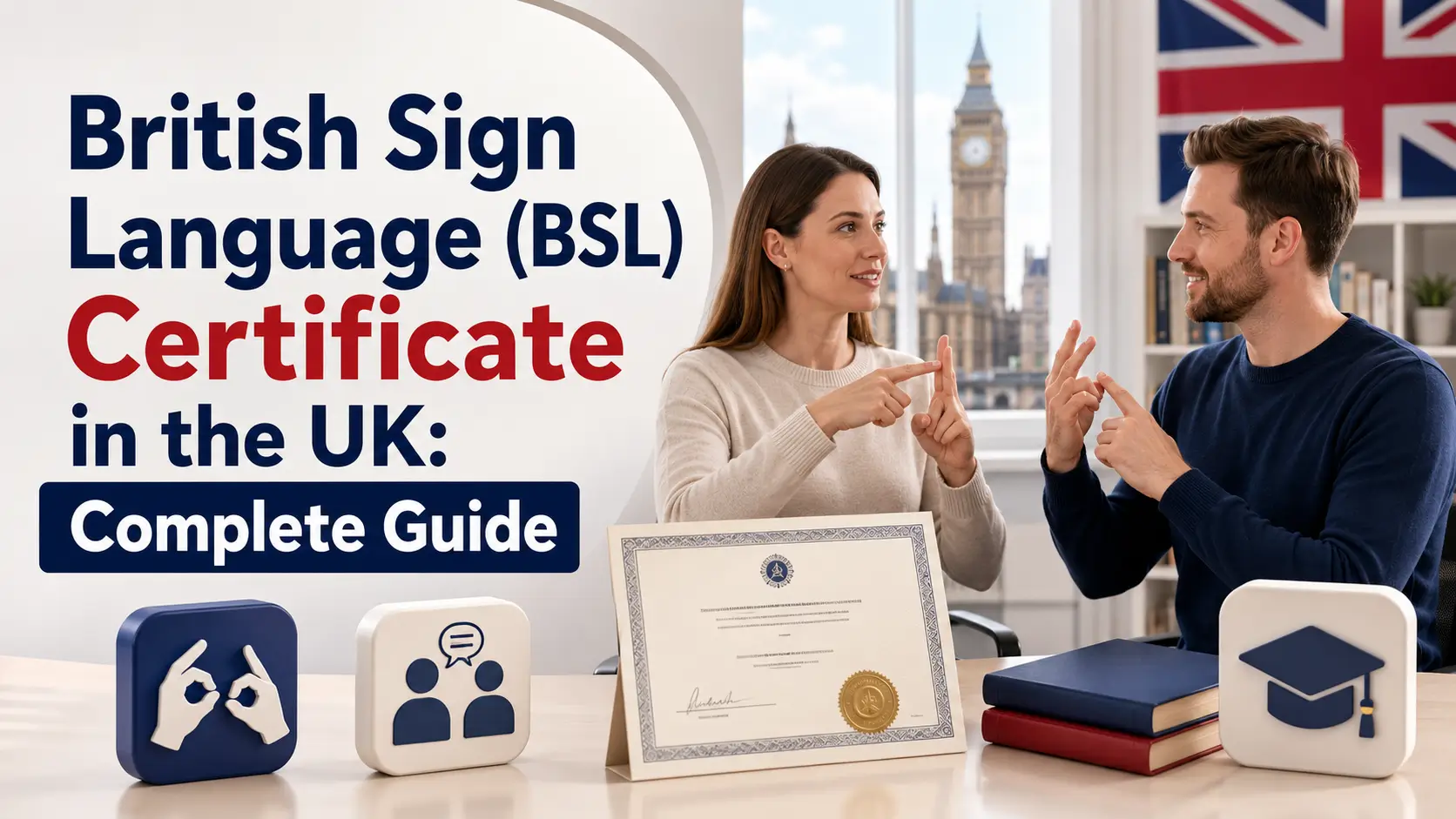
Communication is at the heart of every relationship, whether personal or professional, yet for many deaf meaning and hard-of-hearing individuals across the UK, everyday conversations can be filled with barriers. British Sign Language bridges that gap, giving voice to a community that relies on visual expression rather than spoken words. As awareness around inclusivity continues to grow across schools, workplaces, and public services, more people than ever are turning to BSL sign language as a way to connect, support, and understand those around them.
If you’ve ever wondered what it takes to learn this beautifully expressive language, or how a formal certificate in BSL can open new doors both personally and professionally, you’re in the right place. In this guide, we’ll walk you through everything you need to know, from the basics of finger spelling to how a recognised qualifications can boost your career prospects.
Certificate in British Sign Language (BSL) Level 1 & 2
Table of Contents
What Is a Certificate in the British Sign Language (BSL)?
British Sign Language (BSL) is the sign language used by the Deaf community in the United Kingdom. It’s a visual language that uses hand shapes, facial expressions, body language, and lip patterns to convey meaning, rather than spoken or written words.
A few key facts about BSL:
- It’s a full, independent language – not a signed version of English. BSL has its own grammar, syntax, and structure, which is quite different from spoken English (for example, word order often differs, and there’s no direct equivalent of words like “the” or “is”).
- It’s widely used – BSL is the preferred first or main language for an estimated 87,000+ Deaf people in the UK, with many more (family members, interpreters, professionals) using it as a second language.
- Legal recognition – The UK government formally recognised BSL as a language in its own right in 2003. This was strengthened further by the BSL Act 2022, which requires the government to report on how it’s promoting and facilitating BSL use, particularly in public services.
- Regional variation – Like spoken languages, BSL has regional dialects and variations in signs across different parts of the UK.
- Non-manual features matter – Facial expressions and mouth patterns aren’t just for emphasis; they’re grammatically essential. For instance, raised eyebrows can indicate a question, and specific facial movements can change the meaning of a sign entirely.
- Different from other sign languages – BSL is distinct from American Sign Language (ASL) and other sign languages around the world; they aren’t mutually intelligible.
What is the point of studying British Sign Language in the UK?
The British Sign language (BSL) is one of the skills to possess in the UK. It has the potential to guide you in communicating to the Deaf and hearing-impaired in a cordial and honourable manner that can expand entry and accommodations in the overall life.BSL is also useful particularly in the area of healthcare, education, social care and customer care where precision is a value that is greatly treasured. BSL also proves useful since the majority of the employers are taking into account the abilities of the language since it can help to narrow down the communication gap and service delivery.
The way to get a certificate of a British Sign Language (BSL) Online.
Online studies on a BSL certificate are easy and convenient. You have the privilege of studying at home, select the degree and study at your pace. The majority of online courses in BSL provide video lessons, demonstrations with signs, practice tasks, and short tests to achieve the goal of learning. They tend to be more adaptive and cheaper than classroom programmes with introductory courses lasting several weeks and the advanced courses lasting several months.
What Could You Do in a BSL Course?
A course in the British Sign Language (BSL) will equip you with the skills of practical communication that will enable you to communicate openly with both Deaf and hearing-impaired people both in the social and professional life.

In the course, you will generally learn:
- Finger spelling and the BSL alphabet – how to write down names, places and words with the help of hands.
- Skills in everyday conversation – introduction skills, how to make and give simple responses to common questions, simple conversation skills.
- BSL grammar, sentence structure – learning that BSL has its own rules, which are not similar to spoken English.
- Body language and facial expressions – acquiring knowledge about how facial expression and posture provide additional meaning and emotion to signs.
- Lifestyle communication skills – train on how to sign effectively, response interpretation and natural conversation in any circumstance.
Through such skills, you will feel better about communicating with Deaf people in the workplace, in public services, during education or in other forms of daily interaction. It enables you to relate to them in a respectful and effective manner, and this will assist in making environments more accommodating.
Advantages of Earning a British Sign Language Certificate.
Personal and professional advantage is a certificate in British Sign Language (BSL). Some of the greatest benefits include improved communication skills. You are also taught to use language in a simple manner with the assistance of visual language and are taught to understand non-verbal communication in a better manner. This helps in improving your overall abilities in communicating with people in different situations and not just with Deaf persons.
In terms of career, a BSL certificate may help to get a job in the UK job market. This is inclusive communication between the staff and the customers, which is welcome in various sectors such as health care, education, social care, customer service and the public services sectors. A BSL degree would make you emerge as an improved option among the potential candidates because it can prove that you have other pertinent skills that can be used in increasing access and equal communication.
Hub Post-BSL career Opportunities in the UK.
British Sign Language qualification may result in the following jobs such as:
- Work in BSL (advanced trained) in the area of interpretation.
- Support worker positions
- Teaching assistant roles
- NHS healthcare support jobs
- Social care careers
- Education and community services.
Who Needs to attend a course in British Sign Language (BSL)?
The British Sign Language course can be applicable to a large pool of individuals due to the instructiveness of a practical means of communication that benefits inclusivity and accessibility. It also comes in particularly handy to any person who communicates with the general population, is involved in the care or education sector, or just wishes to be more confident in communicating with Deaf and hearing-impaired people.

BSL courses are ideal for:
- Novices that wish to acquire sign language at the fundamental level.
- Learners who desire to acquire a new ability or pursue a personal passion
- Staff and healthcare workers of the NHS who assist Deaf patients.
- Educators and teaching aids as well as staff working with Deaf students.
- Social care workers, carers and community support staff.
- Retail, banking, transport, hospitality and local councils customer care staff.
- Every person who desires to become a better communicator, more confident, more empathetic, and more culturally aware.
In totality, a BSL course is a good alternative both in self-growth and professional growth including in the UK whereby inclusive communications are becoming popular in most sectors.
British Sign Language: How long to learn?
The time of learning the British Sign Language (BSL) will be based on three primary factors, namely the level at which you wish to be, the frequency of practicing, and your learning speed. With the Level 1 course, depending on the time you are taking it, you can always complete it within a few weeks/a few months, provided you attend it and you are practicing the signs regularly. The levels are generally more difficult due to the increased vocabulary, grammar and more practice of real life conversation.
Ready to take the first step? You can enrol on our Certificate in British Sign Language (BSL) Level 1 & 2 course today and begin building a skill that makes a genuine difference in people’s lines.
Final Thoughts
A certificate in British Sign Language (BSL) is an important qualification that may aid one in personal and professional development. It assists in facilitating communication, encouraging inclusiveness and it may create opportunities in sectors like healthcare, education, social care, and customer service. You may have reasons to learn BSL to create a useful life activity, serve Deaf people, or enhance your professional opportunities, but this process is not pointless and may help to create a more responsible and inclusive society.
FAQ on British Sign Language (BSL) Certificate in the UK: Complete Guide
BSL can be picked up faster than many spoken languages by beginners, especially since it doesn’t require reading or writing skills to start communicating. That said, mastering the grammar, facial expressions, and regional variations takes consistent practice, just like any language.
No. Most BSL certificate courses, including ours, are designed for complete beginners. You’ll start with the basics, such as the alphabet and everyday vocabulary, before progressing to more advanced concepts.
This varies depending on the course structure and your own pace. Many online BSL certificate courses can be completed within a few weeks to a few months, particularly if they’re self-paced.
Yes, many UK employers in healthcare, education, retail, hospitality, and public services value staff who can communicate in BSL. It demonstrates a commitment to accessibility and inclusivity, which can make your CV stand out.
No. BSL is a separate language with its own grammar and sentence structure, while SSE uses English word order but borrows signs from BSL. They’re related but distinct.
Yes, many BSL certificate courses are available online, using video demonstrations, quizzes, and practice exercises to help you learn from home at your own pace.
Not quite. While the core structure of BSL is consistent, there are regional dialects and sign variations, similar to accents and slang in spoken English.
A certificate can be a stepping stone toward further BSL qualifications, volunteering opportunities, improved communication with Deaf family members or colleagues, or even a career as a BSL interpreter (with further training).
Not necessarily. Since BSL has its own grammar system separate from English, your English skills won’t directly affect your ability to learn BSL, though strong language-learning habits can still help.
No, BSL courses are typically open to learners of all ages, from teenagers to adults, whether you’re learning for personal interest, family reasons, or professional development.
Recent Posts