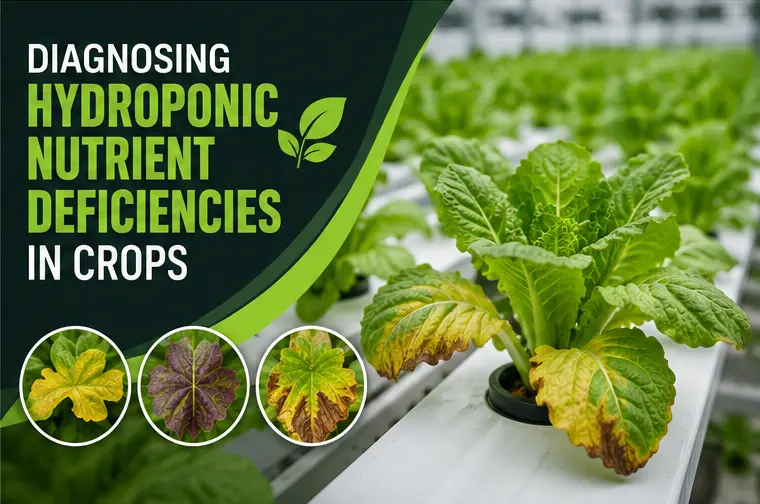
Growing without soil means you can’t dig down to check what’s going on around the roots. Everything your plants get comes straight from the water you feed them, so when something looks off, it almost always links back to what’s in that water, or what’s missing from it. A lot of new growers see yellow leaves and immediately tip in more nutrient mix, but that often makes things worse. Sometimes the nutrient is right there, but something else is stopping the plant from using it. This guide sticks to what you actually see with your own eyes, no fancy lab tests or confusing jargon. I’ll walk you through how to tell one problem from another, what causes them, and the simplest way to put things right.
Why “Nutrient Lockout” Is Now The Most Common Cause Of Deficiency Symptoms
You’ll run into this more than anything else these days: you measure your mix exactly as the label says, keep the tank topped up, and still leaves turn pale or curl at the edges. It’s almost never that you’ve put in too little food ,it’s that the food you’ve added is stuck where roots can’t reach it. Even the best, most carefully balanced feed becomes useless if small things shift just a little bit. Hard tap water leaves behind crusty mineral buildup, leftover additives from earlier feeds pile up over time, or tiny changes in water chemistry wrap around nutrients like a thin invisible shell. Roots can’t break through that shell no matter how hungry the plant is. A lot of new growers keep reusing old solutions for weeks or only top it off with more nutrients instead of swapping out part of the water, which makes this happen even faster. Most people see those pale leaves and pour in extra feed, but that just adds more stuff that stays locked away, turning a small, easy fix into a much bigger mess to sort out later.
How Growth Stage, Light And Temperature Change What Your Plants Actually Need
What works perfectly for tiny seedlings will burn out young plants, and what keeps leaves green won’t be enough when they start flowering or filling out fruit. Your plants don’t ask for the same thing every single day ,their needs shift as they grow, and as the space around them changes. Soft new growth only wants very light feed, but once stems thicken up and buds start forming, they pull far more calcium and phosphorus from the water. Bright, long hours of light make them drink and feed faster, so what feels right on a cloudy week will leave them short when the sun stays strong all day. If the water gets too warm or the air turns chilly, roots slow down and stop taking in as much, even if the nutrient levels look exactly right. Sticking to one fixed mix all the way through is the fastest way to run into confusing issues ,you’ve got to match what you give them to what they’re actually going through right now.
DON’T JUMP TO CONCLUSIONS – CHECK THESE FIRST
Opening
When I first started growing hydroponically, every time a leaf turned yellow I’d dump more feed into the tank. Half the time it got worse. I spent months learning the hard way: most “deficiencies” aren’t about missing food at all. Sometimes the nutrient is right there in the water, but something’s stopping the plant from using it. This guide is all the stuff I wish someone had told me back then ,no fancy terms, no confusing charts, just what you see and what you actually do.
Things that look like deficiencies but aren’t
Before you touch your nutrient bottles, walk through these checks. I’ve seen people spend weeks adjusting mixes when the real problem was one of these:
- pH balance: This is the biggest one. Most plants can only take up nutrients properly between 5.5 and 6.5. If it’s too high or too low, everything gets locked away out of reach ,even if your water is packed full of food.
- Root condition: Pull one plant up gently. Roots should be white or pale cream, firm and crisp. If they’re brown, slimy, or smell like something rotting, that’s root rot. No amount of perfect nutrient mix will fix that until you sort out water flow and oxygen levels.
- Water temperature: If it drops below 15°C, roots slow right down and stop feeding. If it climbs over 26°C, the water holds less oxygen and roots start to struggle.
- Pests or weather damage: Tiny bugs suck sap and leave yellow speckles that look just like a mineral shortage. Too much hot sun burns edges too ,always flip leaves over and have a good look.
The simple rule that tells you what’s wrong
You don’t need fancy lab tests to work out what’s missing ,just look at where the trouble starts. If the yellowing or damage shows up first on the older leaves down at the bottom and slowly works its way upwards, it means the plant is short of a nutrient it can move around. When supplies run low, it takes whatever it needs from the older growth to feed the new shoots coming through. But if the problem starts right on the fresh, young leaves at the top and stays there, that’s a nutrient that gets fixed in place once it’s been used. The plant can’t pull it back from the older leaves to help the new ones, so the youngest growth suffers first.
Advance Indoor Plant Growing & Care
Problems starting on older, lower leaves
Nitrogen
Leaves turn pale yellow all over, starting low down. New growth stays small and pale instead of dark green. The oldest leaves turn fully yellow and drop early. Whole plants grow very slowly.
Why it happens: You’ve topped up with plain water too many times without adding fresh feed, or your mix is weaker than it should be.
Fix: Drain about a third of your tank, top it back up with fresh mix at the normal strength. Don’t double the dose ,that will shock the plants.
Phosphorus
Leaves look dull dark green, or get a reddish purple tinge especially along the veins and underneath. Plants stay short and stunted. Flowers or fruit take ages to show up, or never come at all.
Why it happens: Water is too cold, or pH is sitting above 7.0.
Fix: Warm your water to around 20°C, adjust pH to 5.8–6.2, then top up with fresh balanced feed.
Potassium
Edges and tips of older leaves turn brown and look scorched, like they’ve been held too close to heat. Yellow or brown spots pop up between the veins. Fruit stays small, doesn’t ripen evenly, or tastes weak. Plants may wilt even when there’s plenty of water.
Why it happens: Your tap water has too much calcium or magnesium, which stops potassium being taken in.
Fix: Use rainwater or filtered water for your next full tank, and pick a mix made for harder water if that’s your situation.
Magnesium
Yellowing shows up clearly between the veins, while the veins themselves stay bright green, like pale stripes running down the leaf. Over time the yellow bits turn brown and crisp, and leaves curl slightly downwards.
Why it happens: Super common in hard water areas. Extra calcium pushes magnesium out of reach.
Fix: Add 1 gram of plain Epsom salts per 10 litres of water. It’s cheap, safe, and usually shows results in about a week.
Problems starting on new, upper leaves
Calcium
New leaves come out twisted, cupped, or with ragged brown edges. The very tip of the main stem may turn black and die back. On tomatoes or peppers, you’ll see dark sunken spots on the bottom of the fruit ,that’s blossom end rot.
Why it happens: pH is too low, or your pump is running too slow so calcium can’t travel up to growing tips.
Fix: Bring pH up to 6.0–6.5, check your pump isn’t blocked, and add a little calcium supplement if needed.
Iron
New leaves turn pale yellow or almost white, but the veins stay bright green. Nothing else looks quite like this ,it’s very easy to spot once you know.
Why it happens: pH is too high, or you’ve used too much disinfectant in your system.
Fix: Lower pH slowly to 5.5–6.0. If nothing changes after four days, add a tiny amount of chelated iron.
QUICK CHECKLIST, MISTAKES TO SKIP, AND EASY ROUTINE
| Nutrient | Clearest Sign | Where It Starts | Most Common Cause |
|---|---|---|---|
| Nitrogen | Full pale yellow leaves | Bottom, older growth | Weak feed mix |
| Phosphorus | Purple or dull green tint | Bottom, older growth | Cold water |
| Potassium | Burnt brown edges | Bottom, older growth | Hard water balance |
| Magnesium | Yellow stripes along veins | Bottom, older growth | Hard water |
| Calcium | Curled, ragged new leaves | Top, new growth | Low pH or poor flow |
| Iron | White leaves with green veins | Top, new growth | High pH |
The mistakes I see almost every new grower make
- Piling on more and more feed until the water is twice as strong as recommended. This burns roots and creates more problems than it solves.
- Changing pH, adding extra nutrients, and cleaning the system all in one go. You’ll never know what worked ,or what made things worse.
- Assuming every yellow leaf means low nitrogen. It’s the easiest guess, but it’s wrong more often than not.
- Panicking and draining the whole tank straight away. You almost never need to do this.
Simple routine to follow every time
- Stand back and look: is the damage at the bottom, top, or everywhere?
- Check pH and water temperature first.
- Match what you see to the signs above.
- Make one small change only.
- Wait 3 to 5 days ,plants don’t fix themselves overnight.
- Check new growth only: old damaged leaves will never turn green again.
Final Thought
You don’t need to be a chemist to get this right. Most of the time it’s just a tiny pH shift or water that’s a little too cold. When you do need to adjust something, take it slow. Growing well is about watching closely, not rushing to fix things before you understand what’s actually going on.
Frequently Asked Questions on Diagnosing Hydroponic Nutrient Deficiencies In Crops
Deficiency symptoms may result from an insufficient nutrient supply, incorrect pH, poor root health, unsuitable water temperature, nutrient imbalance, or nutrient lockout.
Nutrient lockout occurs when nutrients are present in the water but the roots cannot absorb them. Incorrect pH, mineral buildup, hard water, and accumulated additives are common causes.
Check the pH level, water temperature, root condition, water flow, pests, and signs of heat or light damage before adjusting the nutrient solution.
Most hydroponic plants absorb nutrients effectively when the pH remains between approximately 5.5 and 6.5. Requirements can vary slightly between crops and systems.
Look at where the symptoms first appear. Problems beginning on older, lower leaves often involve mobile nutrients, while symptoms on young upper leaves may indicate deficiencies in less mobile nutrients.
Uniform yellowing that starts on older leaves may indicate nitrogen deficiency. It can happen when the nutrient solution is too weak or the reservoir has repeatedly been topped up with plain water.
Yellowing between green veins may indicate magnesium deficiency when it begins on older leaves. When it appears on young leaves, it may be associated with an iron deficiency.
Brown, scorched-looking edges on older leaves may indicate potassium deficiency. It can also result from nutrient imbalance, excessive salts, or unsuitable water quality.
Twisted, cupped, or ragged new leaves may be associated with calcium deficiency. Low pH, poor water flow, root problems, and restricted nutrient movement can contribute to these symptoms.
Make one small adjustment at a time, such as correcting the pH, improving water temperature, refreshing part of the nutrient solution, or increasing water flow. Wait three to five days and assess the new growth rather than expecting damaged leaves to recover.
Recent Posts