Starting a pool maintenance business can be a practical opportunity for anyone who enjoys working outdoors, solving problems, and providing valuable services to customers. Compared with many other trades, it requires relatively low startup costs, and with the right approach, a reliable customer route can create steady recurring income throughout the year.
However, running a profitable pool maintenance business involves much more than cleaning pools and adding chemicals. Successful operators understand water chemistry, equipment maintenance, customer service, pricing strategies, and efficient route management. This guide explains the key steps to starting your own pool maintenance business, from researching your market and choosing services to managing costs, attracting customers, and building a successful long-term operation.
Table of Contents
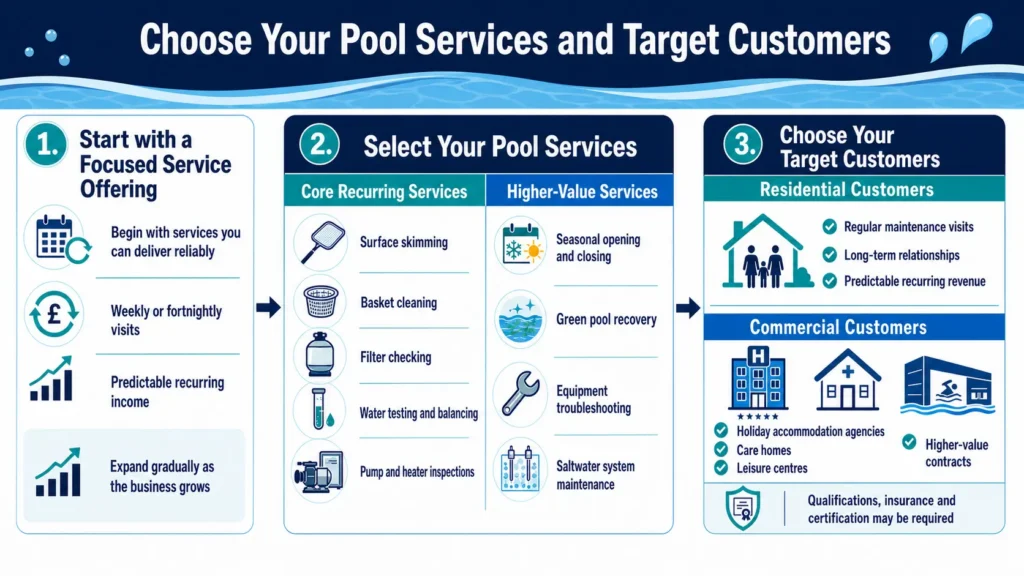
Choose Your Pool Services and Target Customers
You don’t need to offer everything from day one. Start with a tight list of services you can deliver well, then add more as you grow. Most profitable businesses build around recurring weekly or fortnightly visits, which give you predictable cash flow.
Core services include surface skimming, basket cleaning, filter checking, water testing and balancing, and inspecting pumps and heaters. You can add higher-value work such as seasonal opening and closing, green pool recovery, equipment troubleshooting, and saltwater system maintenance. Decide whether you will focus only on residential clients, or also target commercial accounts like holiday agencies, care homes, or leisure centres ,these pay more but usually require formal certification.
Complete Pool Maintenance Training and Qualifications
You can learn the basics from experience, but proper training stops expensive mistakes and opens better work. In the UK there is no single legal requirement for a licence to clean private pools, but you will need to prove you know what you are doing to get insurance and win commercial contracts.
Look for recognised courses such as the Swimming Pool Technical Operator (SPTO) or Pool Plant Operator Certificate (PPOC). These cover water chemistry, chemical safety, filter systems, and basic fault finding. Membership of bodies like BISHTA or ISPE also adds credibility, and lets you be found in their directories. If you plan to work on public pools, these qualifications are almost always expected.
Register Your Business and Meet Legal Requirements
Choose your business structure first. Most new operators start as a sole trader because it is simple and low cost, then switch to a limited company once turnover grows. Register with HMRC for tax purposes, and follow rules for recording income and expenses.
Insurance is non-negotiable. You will need public liability cover to work on private property, commercial vehicle insurance, personal policies usually exclude work use ,and pollution liability, because chemicals are classed as pollutants and spills can cause costly damage. Professional indemnity cover protects you if advice you give leads to problems. If you take on staff, employers’ liability is a legal requirement.
You also need to follow rules on chemical storage, waste disposal, and health and safety. Keep acids and chlorine in separate locked compartments, and never mix different cleaning products.
Calculate Pool Maintenance Business Startup Costs
You can launch a basic service for around £1,500–£3,500, or up to £6,000 if you need to buy a suitable vehicle and better equipment from scratch. Breakdowns vary, but you should plan for these main areas: training and registration, insurance, initial chemicals and testing kits, cleaning tools, vehicle branding, and a small website or marketing materials.
Avoid overspending on fancy gear at the start. You can upgrade later as you earn. Keep aside a small emergency fund too, fuel prices rise, chemicals cost more in peak season, and vehicles sometimes need repairs.
Essential Pool Maintenance Equipment and Costs
| Item | Purpose | Typical Cost Range |
|---|---|---|
| Telescopic pole, net, brush and leaf rake | Surface and wall cleaning | £40–£120 |
| Liquid test kit or photometer | Accurate water-balance readings | £60–£250 |
| Chemicals: chlorine, pH adjusters, algaecide and salt | Water treatment | £80–£200 initial stock |
| Vacuum head and hose | Floor cleaning and debris removal | £50–£150 |
| Bucket, gloves, goggles and spill kit | Safety and handling | £25–£70 |
| Vehicle branding | Professional appearance | £100–£500 |
Set Profitable Pool Maintenance Prices
This is where most new operators go wrong, they set prices too low just to get work, then find they can’t cover fuel, chemicals, or their own time. Always work out your full costs first, then add a margin that leaves you with a healthy profit.
Factor in travel time between jobs, chemical use, filter cleaning, insurance, and overheads. As a rough guide, weekly residential maintenance usually ranges from £40–£75 per visit, or £120–£220 per month depending on pool size and condition. Seasonal opening or closing often costs £150–£350 per job. Aim for a gross margin of at least 50% on routine work, and higher on one-off projects or repairs.
Find Your First Pool Maintenance Customers
Start close to home. Concentrate your first 10–15 clients within a small area, this cuts travel time and fuel costs, and makes it easier to manage your route.
- Tell local pool installers you are ready to take on their maintenance work, they often get asked for recommendations
- Create a simple Google My Business profile and website, so people searching for “pool maintenance near me” can find you
- Leave cards at garden centres, estate agents, and holiday let management offices
- Ask your first clients to leave a review and pass your name to neighbours
Stick to these three simple rules:
- Never promise more than you can deliver
- Be clear about what your price includes
- Show up exactly when you say you will
Manage Pool Routes and Daily Operations Efficiently
Time is your most valuable resource. Once you have 15 or more clients, plan your route so you travel as little as possible. Group pools in the same neighbourhood on the same day. This can cut your fuel bill by a third and let you fit in more jobs without working longer hours.
Keep clear records for every pool: size, type, typical chemical needs, and any known issues. Use simple scheduling or billing software to automate reminders and payments ,chasing late invoices wastes hours every month. Most successful operators switch to card-on-file or direct debit payments from day one.
How To Boost Earnings And Scale Up
Once you have a steady routine, you can increase income without adding huge extra work. Upsell services like annual filter servicing, pump checks, or winterisation to existing clients, these carry higher profit margins.
You can also take on small repairs such as replacing filters or pressure switches once you have the knowledge. When you reach 30–40 regular pools, you can take on an assistant to help with cleaning and travel, freeing you up to quote new work and build relationships with bigger commercial clients.
Pool Maintenance Career Training
Pool Maintenance Business Mistakes to Avoid
Even experienced operators slip up here and there.
- Don’t price match every competitor ,if someone else charges less, check what they actually include
- Never skip proper water testing, balancing blindly wastes chemicals and damages surfaces
- Don’t store chemicals together or transport them unsealed, this is both dangerous and illegal
- Don’t take on clients spread too far apart ,it will eat into your profits fast
Final Thought: Start Building Your Profitable Pool Maintenance Business
A profitable pool maintenance business is built on consistency, clear pricing, and knowing your limits before you expand. You don’t need expensive equipment or years of study to start, just good training, proper insurance, and a commitment to doing the job right.
Start small, build your reputation locally, and focus on regular clients rather than chasing every one-off job. Over time, you will have a route that delivers steady income, the freedom to work outdoors, and room to grow at your own pace.
FAQs on Start a Profitable Pool Maintenance Business: Costs, Pricing and Growth Steps
Start by researching local demand, completing relevant pool maintenance training, registering your business, arranging insurance and purchasing essential cleaning and water-testing equipment. You should then set profitable prices and focus on securing recurring residential or commercial maintenance contracts.
Yes, a pool maintenance business can be profitable because customers usually require regular weekly, fortnightly or monthly services. Profitability depends on your pricing, route efficiency, chemical costs, number of recurring clients and ability to offer additional services such as repairs and winterisation.
A basic pool maintenance business may cost approximately £1,500 to £3,500 to launch. Startup costs can rise to around £6,000 when purchasing a suitable vehicle, professional equipment, insurance, chemicals, training and marketing materials.
Formal qualifications may not be required for maintaining private residential pools, but professional training is strongly recommended. Courses such as the Swimming Pool Technical Operator or Pool Plant Operator Certificate can improve your knowledge, support insurance applications and help you win commercial contracts.
Essential pool maintenance equipment includes a telescopic pole, pool net, brushes, vacuum head, hose, water-testing kit, protective gloves, goggles, chemical storage containers and a spill kit. You may also need basic tools for inspecting filters, pumps and heaters.
Residential pool maintenance may cost approximately £40 to £75 per visit or £120 to £220 per month, depending on the pool’s size, condition and required services. Your prices should cover labour, travel, chemicals, insurance, equipment and a reasonable profit margin.
A pool maintenance business should normally have public liability insurance and commercial vehicle insurance. Pollution liability and professional indemnity cover may also be appropriate because the work involves chemicals and technical advice. Employers’ liability insurance is legally required when employing eligible staff.
Create a professional website and Google Business Profile, collect customer reviews and build relationships with pool installers, estate agents, holiday-let managers and property management companies. Local SEO and referral marketing can help you attract customers searching for pool maintenance services nearby.
Yes, but you should complete beginner-friendly training before working independently. Learning about water chemistry, chemical safety, filtration systems and equipment maintenance will help you avoid costly mistakes and provide a safer, more reliable service.
Build a concentrated route of recurring customers and offer additional services such as pool opening, winter closing, filter servicing, green pool recovery and minor equipment repairs. As your customer base grows, you can hire an assistant and pursue larger commercial maintenance contracts.
Recent Posts