If you want to learn British Sign Language you are probably thinking about how it will take to get a certificate. The time it takes to get certified in Sign Language depends on how often you practice British Sign Language ,how much time you have to practice British Sign Language and what level of British Sign Language you want to achieve. To learn British Sign Language you need to practice Sign Language regularly because British Sign Language has its own grammar and its own structure.
In the United Kingdom you can get certified in Sign Language from Level 1 to Level 6 and each level of British Sign Language is more difficult than the last one. Learning Sign Language is not just about learning the signs, it is also about learning facial expressions, body language and how to put sentences together in British Sign Language.
Table of Contents
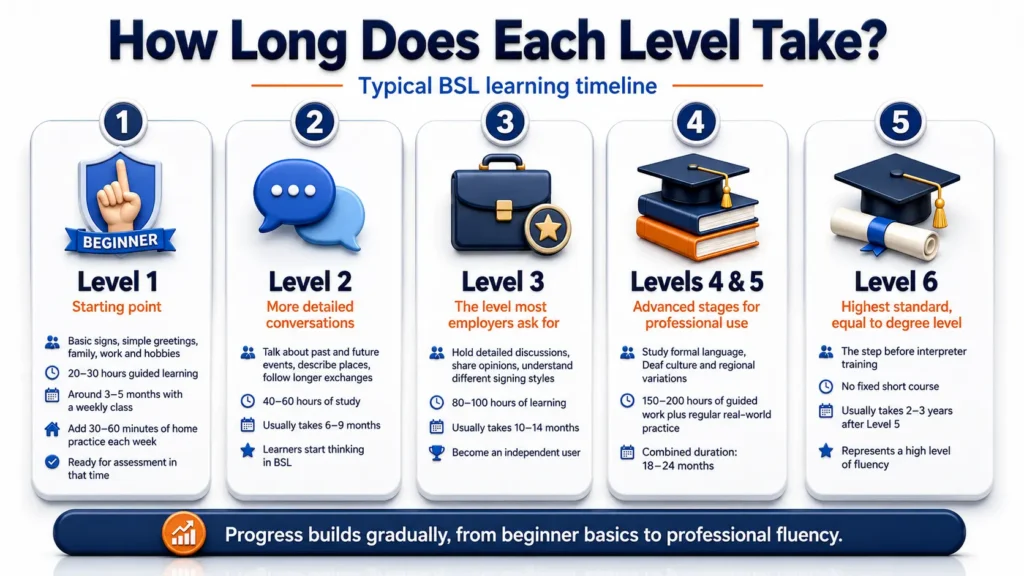
How Long Does Each Level Take?
Level 1
This is the starting point. It covers basic signs, simple greetings, and everyday topics like family, work, and hobbies. Most courses include 20–30 hours of guided learning. If you attend a weekly class, that works out to around 3–5 months. Add in 30–60 minutes of practice at home each week, and you’ll be ready for assessment in that time.
Level 2
Here you move to more detailed conversations. You’ll learn to talk about past and future events, describe places, and follow longer exchanges. This stage needs 40–60 hours of study. For most people, it takes 6–9 months. Many find this step slower because you start thinking in BSL rather than translating from English in your head.
Level 3
This is the level most employers ask for. You’ll hold detailed discussions, share opinions, and understand different signing styles. It requires 80–100 hours of learning, usually taking 10–14 months. It’s the point where you stop being a beginner and become an independent user.
Levels 4 & 5
These are advanced stages, aimed at people wanting to use BSL professionally. You’ll study formal language, Deaf culture, and regional variations. Combined, they take 18–24 months, with 150–200 hours of guided work plus regular real-world practice.
Level 6
The highest standard, equal to degree level. It’s the step before training as an interpreter. There’s no fixed short course here – most learners take 2–3 years after Level 5 to reach this level of fluency.
Timeline Overview
| BSL Level | Guided Hours | Typical Timeframe | What You Achieve |
|---|---|---|---|
| Level 1 | 20–30 | 3–5 months | Simple communication and introductions |
| Level 2 | 40–60 | 6–9 months | Talk about daily life and events |
| Level 3 | 80–100 | 10–14 months | Independent, confident communication |
| Levels 4–5 | 150–200 | 18–24 months | Professional and complex use |
| Level 6 | Variable | 2–3+ years | Near-native fluency and interpreter-ready skills |
Factors That Affect How Fast You Learn
Not everyone follows the same schedule. A few things make a big difference:
- Practice frequency: 20 minutes every day works far better than 3 hours once a month. Regular use helps fix signs and patterns in your memory.
- Meeting fluent signers: Watching and speaking with people who use BSL daily teaches you natural flow and expression that books alone can’t give.
- Your study method: Evening classes suit steady progress; intensive courses can cut time in half but need more focus. Online learning gives flexibility but needs self-discipline.
A few habits can slow you down too – only learning signs without grammar, skipping revision, or taking long breaks between study sessions.
Different Study Routes and Their Timelines
How you choose to learn changes how long the whole journey takes. There is no single “best” way – it all depends on your lifestyle, how much free time you have, and how quickly you want to progress.
Weekly evening classes are the most common choice. They fit easily around work, school, or family duties. You usually attend one or two sessions a week, and follow the standard timelines we covered earlier. This steady pace helps what you learn stick, and you have a tutor there to correct mistakes as you go.
If you want to move faster, intensive courses are an option. These often run over weekends or full days during the week, packing many hours of learning into a shorter period. You could cut the time for each level by almost half, but be prepared to put in extra work at home to keep up – there’s less time to let things sink in between lessons.
Online learning offers the most flexibility. You can log in whenever suits you, repeat lessons as many times as you like, and work at your own speed. It works well for getting through Levels 1 and 2, but once you reach higher levels, you will still need access to a qualified tutor and official assessments to gain recognised certification.
Common Mistakes That Slow Down Progress
Many people take longer to learn BSL, and it’s not because they’re not good enough. It’s usually just small habits that stop them from moving forward. Once you know what these habits are, you can save yourself so much time and effort.
One big mistake is only focusing on learning individual signs. It feels great when you learn lots of new signs, but BSL works in its own way. If you just put them in the same order as English words, what you sign won’t make any sense. The goal is to learn how to think in BSL – not just translate every word straight from English.
Skipping practice is another common problem. Going to class once a week helps, but if you don’t practise on your own every day, you’ll quickly forget what you’ve learned. Learning a language works best when you do it little and often. Even just 20 minutes each day can make a really big difference.
Lots of people won’t sign in front of others because they’re scared of getting things wrong. But the truth is, mistakes are actually the best way to learn. Every time you try to communicate, you work out what works and what doesn’t. If you stay quiet, you’ll never feel more confident – and you won’t get anywhere with your learning either.
How to Practise Effectively Outside Class
What you do in class is only a tiny part of the whole picture. The real learning starts when you go home and put what you’ve been taught into practice. Get into good habits, and you’ll get to where you want to be – like passing your exams or gaining your qualification – much faster.
Start by sticking to a simple routine. It doesn’t have to take hours out of your day, but it does need to happen regularly. Try to go over everything from your last lesson within 24 hours – this helps move what you’ve learned from your short-term memory into something you’ll remember long-term. Jot down any new signs you picked up, or even film yourself signing simple sentences; you can watch it back later and see where you’re going right or wrong.
One of the best ways to improve is to watch videos made by Deaf people themselves. This shows you how signs are really used in everyday life, how facial expressions change what you mean, and what normal signing speed actually looks like. You can easily find news clips, personal vlogs, or posts on social media in BSL – it’s a great way to get used to how the language works in the real world.
What Each Level Qualifies You For
It helps to know what each certificate actually lets you do, so you can set goals that match what you want to achieve. Qualifications aren’t just pieces of paper – they mark a clear level of ability.
Level 1 is great for personal use. It lets you say hello, introduce yourself, and talk about simple topics with Deaf friends or family. It is not usually enough for paid work, but it is the solid foundation you need to go further.
Level 2 gives you more confidence. You can hold longer conversations, ask for directions, and talk about past or future plans. Some volunteer roles or entry-level positions in care or community work may accept this level, but it is still limited.
Level 3 is the standard benchmark. This is the level most employers look for when hiring staff who interact with Deaf people. It means you can communicate independently, understand different topics, and follow conversations at a reasonable speed. It opens doors to work in education, healthcare, customer service, and support roles.
Levels 4, 5 and 6 are for those who want to work professionally in the language. At Level 6, you have the depth of knowledge needed to train as a qualified interpreter or translator, working across formal settings like legal, medical, or educational environments.
Costs and Time Investment Over the Long Term
Learning BSL is an investment of both time and money, and it helps to have a realistic idea of what you will spend as you go up the levels.
At the lower levels, costs are quite reasonable. Courses for Level 1 and 2 are widely available, and many community centres or local colleges offer them at affordable rates. You will also need to pay for assessment fees when you are ready to take your exams.
As you move to Level 3 and above, the costs do rise. There are fewer providers, classes are often smaller, and the learning materials and assessments are more detailed. You may also need to travel further or take time off work to attend sessions.
It is also worth remembering that the time you spend learning is not just for passing exams. Once you have gained fluency, you have a skill that stays with you for life. It opens up new ways to connect with people, helps you understand another culture, and can even lead to new career paths. For most people, the time and effort put in feels well worth it.
Conclusion
There’s no fixed rule for how long it takes to get your BSL qualification. If you’re only aiming for basic everyday skills, you could reach that point in just a few months. But if you want to use BSL professionally, you’ll need to set aside anything from two to five years of steady, regular learning.
Just remember: a certificate only shows what you’ve studied. The real ability comes from actually using the language, building connections with people, and understanding the culture that sits behind it all. Take things at a pace that works for you, and you’ll find progress happens naturally – no need to rush.-
Certificate in British Sign Language (BSL) Level 1 & 2
Frequently Asked Questions on BSL Qualification Timeline: How Long Does Certification Take?
You may be able to complete BSL Level 1 and begin or complete Level 2 within six months if you study consistently. Reaching advanced levels usually requires significantly more time, practice and assessment.
BSL Level 1 commonly takes around three to five months, depending on the course format, lesson frequency and the amount of independent practice you complete.
Reaching Level 3 may take approximately one to two years when Levels 1 and 2 are completed first. Your progress will depend on your study schedule, signing practice and previous experience.
BSL is different from spoken languages because it uses hand movements, facial expressions and body language. Many learners find it enjoyable once they become familiar with its visual structure and grammar.
Yes. Recognised BSL qualifications normally require assessments. These commonly include practical activities where you demonstrate your ability to produce and understand signed communication.
You can learn vocabulary, basic grammar and everyday signs online. However, recognised qualifications usually require structured teaching, tutor feedback and formal assessment through an approved course provider.
The required level depends on the role. Some volunteering and support positions may accept Level 2, while jobs involving regular communication with Deaf people may prefer or require Level 3 or above.
Aspiring interpreters generally need advanced BSL skills, often at Level 6, alongside specialist interpreter training, practical experience and any professional registration requirements that apply.
BSL certificates do not usually have an expiry date. However, your signing and receptive skills may weaken if you do not practise regularly or communicate with other BSL users.
Attend lessons consistently, practise signs every day, review recorded demonstrations, join conversation groups and seek regular tutor feedback. Frequent real-world signing practice can improve confidence and fluency.
Recent Posts