
Every trading forum, YouTube comment section and search engine query eventually circles back to the same handful of questions. What does it actually take to trade intraday markets successfully from the UK? Is scalping realistic for someone with a full-time job? And why do so many newcomers lose money within the first few months, regardless of how much they read beforehand?
This guide approaches those questions from a practical angle, treating intraday trading as a skill built through structure and repetition rather than a lucky guess dressed up as a strategy. It draws together the fundamentals that experienced traders tend to return to again and again, presented in a way that should make sense to someone opening their first trading account this week.
Table of Contents
Setting the Scene: What Intraday Trading Involves
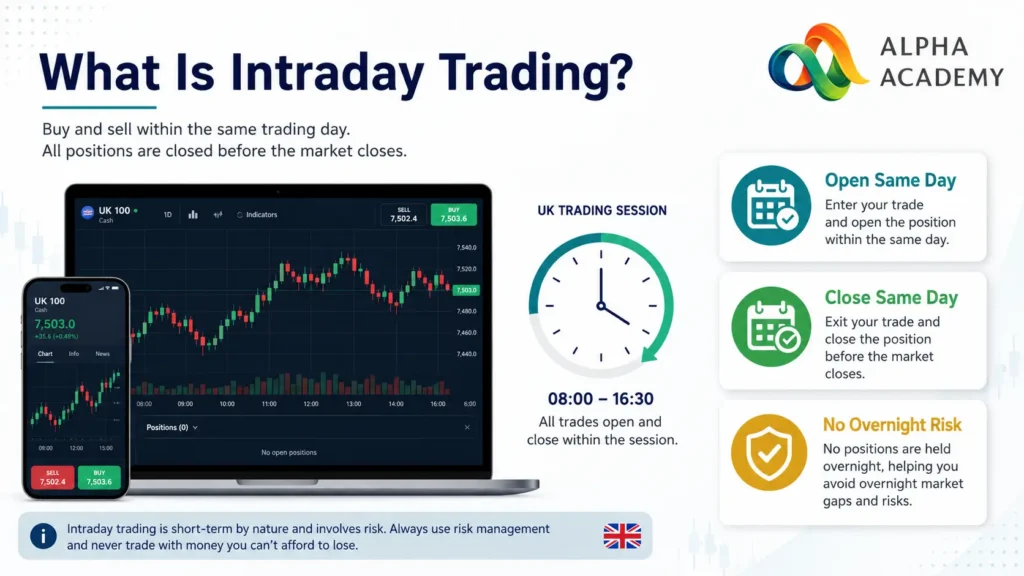
Intraday trading covers any approach where positions are opened and closed within the same trading session, avoiding overnight exposure entirely. Within that broad category sit two closely related disciplines: day trading, where trades might run for minutes or hours, and scalping, where trades often last mere seconds. Both share the same underlying principle of never carrying risk into the next session, but the practical experience of each differs enormously.
Neither discipline is inherently better than the other. What matters is whether the chosen approach genuinely fits the trader’s schedule, temperament and available capital, rather than whichever style happens to look most exciting on social media. A trader with a demanding nine-to-five job, for instance, will likely find day trading around lunch breaks or after work considerably more sustainable than attempting to scalp continuously through the busiest hours of the session.
Day Trading in Practice
A day trader typically studies the market before the session opens, identifies a handful of promising setups, and executes selectively throughout the day. Trades are closed before the market shuts, removing overnight risk entirely, which many traders find psychologically easier to manage than holding positions across days or weeks. Consider a trader who spots a share showing strong early momentum shortly after the London open; rather than holding overnight in the hope of further gains, the position is closed before the close, and any further upside becomes somebody else’s opportunity rather than a source of anxious speculation.
This discipline of closing out daily suits people who prefer clean, defined outcomes at the end of each session, rather than carrying open positions through news cycles they cannot control whilst asleep.
Scalping in Practice
Scalping compresses this process considerably. Instead of a handful of trades, a scalper might place dozens within a single session, each targeting a very small price movement. This demands sharper focus, faster execution and considerably tighter tolerance for error. A scalper working a liquid currency pair during a busy morning session might enter and exit a position within thirty seconds, aiming for a handful of points before moving straight on to the next setup.
This pace is not for everyone. Some traders thrive under this kind of pressure, whilst others find it exhausting within the first hour. Recognising which category one falls into early on saves considerable frustration further down the line.
Why the UK Trading Environment Has Its Own Character
British traders operate within a market structure shaped by the London Stock Exchange’s opening hours, the overlap with the New York session later in the day, and a steady calendar of domestic economic releases from the Bank of England and the Office for National Statistics. These factors combine to create identifiable patterns of volatility and liquidity that differ somewhat from purely US-centric trading advice found online. Recognising these patterns, rather than importing strategies wholesale from American trading content without adjustment, tends to produce more consistent results for London-based and wider UK traders. A strategy built entirely around US pre-market activity, for example, may need substantial rethinking before it translates sensibly to a London opening session with its own distinct rhythm. It is also worth noting that UK traders benefit from a regulatory environment that, whilst sometimes viewed as more conservative than certain offshore jurisdictions, generally affords stronger consumer protections. This matters considerably when things go wrong, whether through a broker dispute or a technical fault during a volatile session.Building the Trading Toolkit
Before any strategy can be applied sensibly, certain foundations need to be in place. Skipping this groundwork is one of the most common reasons enthusiastic newcomers lose money faster than they expected.Broker Selection and Regulation
A broker used by a UK resident ought to be authorised by the Financial Conduct Authority, providing a baseline of protection around client fund segregation and dispute handling. Traders are well advised to check the FCA register directly rather than trusting promotional claims at face value, since a slick website and generous bonus offers say very little about genuine regulatory standing.Charting and Execution Software
Reliable charting software offering multiple timeframes, combined with a platform capable of fast order execution, forms the backbone of any serious intraday setup. For scalpers particularly, execution speed can influence outcomes as much as the underlying strategy itself, since a delay of even a second or two can turn a well-planned trade into a losing one.A Practical Toolkit Checklist
Beyond the broker itself, a handful of supporting tools tend to appear across most serious intraday setups, and comparing options against personal needs helps avoid a costly mismatch further down the line.| Tool or Resource | Purpose | Particularly Important For |
|---|---|---|
| FCA-regulated broker account | Capital protection and fair execution | Both day traders and scalpers |
| Multi-timeframe charting platform | Analysing price action across different horizons | Day traders especially |
| Level 2 order book access | Reading immediate buying and selling pressure | Scalpers especially |
| Economic calendar | Anticipating scheduled volatility spikes | Both, but critical before news events |
| Trading journal (digital or paper) | Recording and reviewing decisions objectively | Both, throughout the learning curve |
A Volatility Pattern Chart Across the UK Trading Day
Rather than treating every hour of the session as equal, it helps to visualise how volatility and volume typically shift across a standard UK trading day. The chart below represents this pattern qualitatively, based on commonly observed intraday behaviour rather than any fixed statistic.Relative Market Activity Through the UK Trading Day
Traders often find that matching strategy choice to this general rhythm, rather than trading with identical intensity throughout the day, produces steadier results over time.
A trader who insists on forcing trades during the quiet midday lull, purely out of restlessness, is often working against the grain of the market rather than with it.
Core Strategy Frameworks Worth Understanding
Several broad frameworks recur across successful intraday approaches, each suited to different conditions. Rather than adopting all of them at once, most traders find it more productive to master one framework thoroughly before layering in additional approaches.Trend-Following Setups
These setups involve identifying an instrument moving persistently in one direction and joining that movement, typically confirmed through moving averages or clear higher highs and higher lows. Trend-following tends to perform best during the opening surge or the afternoon overlap, when directional conviction is strongest. A trader spotting a share breaking cleanly above a recent high on strong volume shortly after the open, for instance, might view this as a reasonable trend-following opportunity rather than a random spike to be ignored.Mean-Reversion Setups
During quieter periods, price often drifts back towards a recent average after stretching too far in either direction. Traders using mean-reversion setups look for these stretched conditions and position for a return towards the average, usually during the calmer midday window. This approach suits patient, methodical personalities considerably better than those craving constant action.Liquidity-Based Scalping
For traders drawn towards scalping specifically, focusing efforts during the most liquid windows of the day, rather than scalping continuously regardless of conditions, tends to improve the ratio of clean setups to noisy, unreliable ones. Attempting to scalp thin, illiquid conditions during the midday lull, for example, often produces frustrating, inconsistent results compared with the same technique applied during the afternoon overlap.Comparing the Two Core Disciplines
| Consideration | Day Trading | Scalping |
|---|---|---|
| Typical trade duration | Minutes to hours | Seconds to a few minutes |
| Screen time demands | Focused but flexible | Near-continuous attention |
| Sensitivity to spreads | Moderate | Very high |
| Suits full-time employment | Often manageable | Considerably harder |
| Emotional intensity | Elevated | Very high |
The Trading Decision Flow
Regardless of which discipline a trader leans towards, a consistent decision-making process tends to separate disciplined traders from impulsive ones. The diagram below outlines a straightforward version of this process, one that can be adapted to either day trading or scalping with only minor adjustments to timing.Structured Trade Execution Process
Risk Management as the True Foundation
Strategy selection matters, but risk management ultimately determines whether a trader survives long enough to benefit from experience at all. Professional traders often describe capital preservation as the primary objective, with profit generation treated as a secondary outcome of disciplined execution rather than the starting point.Where Trading Focus Typically Goes
Understanding Risk Layer by Layer
It can help to think of trading risk as sitting in distinct layers, each requiring its own attention rather than being addressed all at once.Three Layers of Trading Risk Management
Account-Level Risk
Overall capital allocated to trading, kept separate from essential personal or household funds.
Session-Level Risk
The maximum acceptable loss permitted during any single trading day.
Trade-Level Risk
The amount risked on an individual position through position sizing and stop-loss placement.
Addressing each layer deliberately, rather than assuming that a sensible stop-loss on individual trades alone will protect the account, tends to produce a far more resilient approach overall.
A trader might, for instance, set a firm rule to stop trading entirely for the day after a defined number of consecutive losses, regardless of how tempting the next setup appears.
Common Errors That Undermine Otherwise Sound Strategies
Even a technically sound strategy can fail repeatedly if certain habits go unaddressed. Overtrading during quiet periods, abandoning a strategy prematurely after a handful of losses, and increasing position size in an attempt to recover a bad session are amongst the most frequently observed mistakes across new traders.
Recognising these patterns early, ideally through consistent journaling, allows a trader to correct course before a manageable setback becomes a serious account drawdown. A trader who catches themselves doubling position size after two consecutive losses, purely out of frustration rather than sound analysis, has usually already identified the single habit most likely to damage their account over the following weeks.
The Value of Structured Learning
Piecing together fragments of advice from forums, videos and casual conversation tends to take considerably longer, and cost considerably more in avoidable losses, than following a properly structured curriculum. The Day Trading & Scalping Strategies course brings together session timing, strategy selection and risk discipline into a single, coherent programme built specifically around these principles, rather than leaving learners to stitch together contradictory advice from scattered sources.
Traders serious about building genuine competence, rather than relying on scattered information, are encouraged to purchase the Day Trading & Scalping Strategies course as a structured next step, one that pairs theoretical grounding with practical exercises reflecting real market conditions.
Day Trading & Scalping Strategies
Developing the Right Mindset Over Time
Technical knowledge forms only part of the picture. Patience during quiet sessions, comfort with small, frequent losses, and the discipline to follow a plan even when a setup feels emotionally compelling to abandon are qualities that typically develop through sustained practice rather than sudden realisation.
Many experienced traders describe their early months as something of a psychological apprenticeship, learning to separate genuine analysis from impulsive reaction, well before their technical skills reached any particular level of sophistication. This mental development, whilst harder to measure than a strategy’s win rate, often proves the more decisive factor in long-term success.
Conclusion: Looking Ahead as a UK Intraday Trader
As platforms continue to improve and access to real-time data becomes increasingly affordable, intraday trading is likely to remain a demanding but achievable pursuit for those willing to treat it as a genuine skill rather than a shortcut. Traders who combine session awareness, sound risk management and structured education tend to build far more durable results than those chasing quick wins based on incomplete understanding.
The path from complete beginner to competent trader is rarely linear, and setbacks along the way are best treated as data points rather than verdicts on personal ability. With a properly structured approach, the learning curve, whilst still demanding, becomes considerably more manageable.
Frequently Asked Questions on Day Trading & Scalping Strategies: A UK Beginner's Guide
Intraday trading is the broader category covering any position opened and closed within a single session, whilst day trading typically refers to the specific practice of holding positions for minutes to hours within that window.
Scalping generally demands faster decision-making and tighter risk tolerance, which is why many educators recommend building day trading skills first.
The opening hour and the afternoon overlap with the New York session are typically the busiest, most liquid periods of the UK trading day.
Individual retail traders are not typically required to hold regulatory authorisation themselves, though the broker used must be properly regulated by the FCA.
There is no fixed legal minimum, though starting with an amount that can genuinely be afforded to lose is widely regarded as essential.
Mean-reversion trading involves identifying a price that has moved unusually far from its recent average and positioning for a return towards that average.
Trend-following strategies typically perform less reliably during quiet, low-volatility periods, when mean-reversion approaches are often considered more suitable.
Consistent journaling is widely regarded as one of the most valuable habits a trader can develop, revealing patterns in behaviour and decision-making over time.
Overtrading, particularly during quiet or unclear conditions, is amongst the most frequently cited mistakes made by newcomers.
Day trading can be manageable alongside full-time employment for those trading during specific windows, though scalping generally demands more continuous attention.
Recent Posts