Here’s a moment most nursing assistants remember clearly: the first time they received a payslip and realised the figure on it did not quite match the weight of what they had done that week. A night shift with a confused patient at 3 a.m. Three call bells ringing at once while a colleague is off sick. The work is real. The question of whether the pay reflects it is one that thousands of people entering this profession, as well as many already working in it, are asking right now.
This guide answers that question properly. It does not rely on vague ranges or outdated figures. Instead, it covers the confirmed 2026/27 NHS pay scales, clearly explains what actually lands in your bank account, gives an honest look at the private sector, compares salaries globally, and offers practical advice for moving up the pay scale faster than many people realise is possible.
What Does a Nursing Assistant Actually Do?
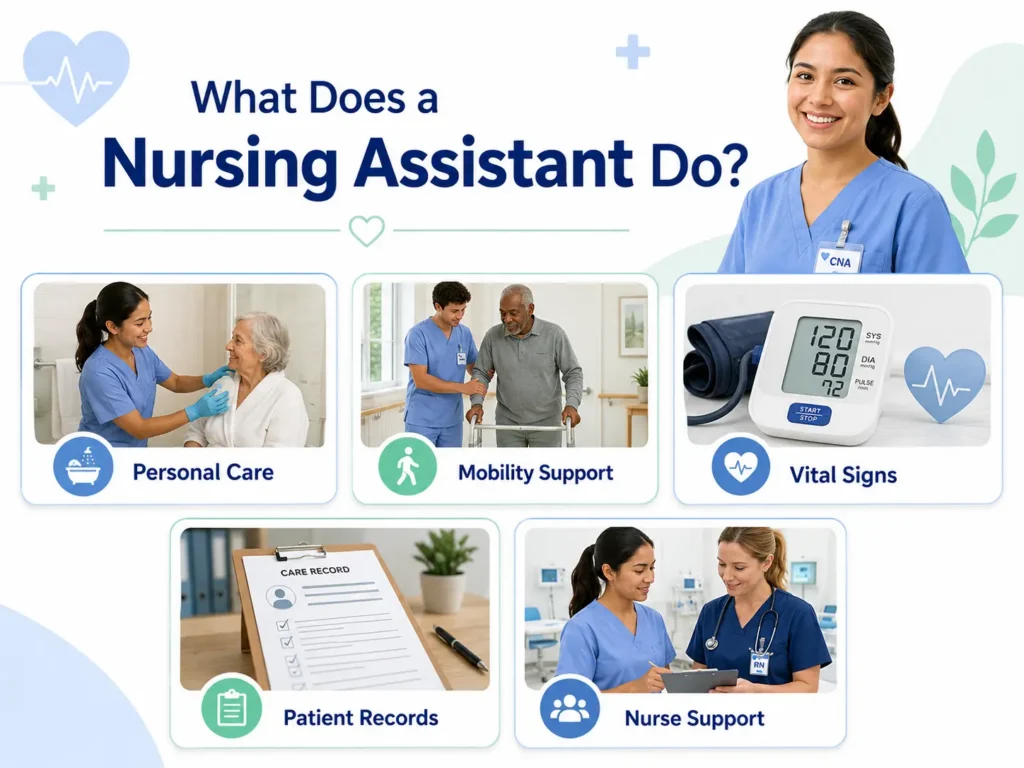
It’s worth grounding this in reality before getting to numbers. A nursing assistant – known in most UK settings as a Healthcare Assistant (HCA) or Healthcare Support Worker (HCSW) – works alongside registered nurses to deliver direct, hands-on patient care. That includes helping with washing, dressing, and eating, supporting mobility, monitoring vital signs that were trained to do so, and maintaining accurate care records.
The role varies significantly by setting. A nursing assistant in an NHS hospital ward works in a fast-paced, clinically complex environment where early observation and accurate reporting are critical to patient safety. One working in a care home may have more continuity with the same residents and a different kind of emotional intensity. Domiciliary care assistants work independently in people’s homes, often managing more unpredictable situations with less immediate backup.
The common thread is that this is skilled, demanding work – and understanding what it pays in 2026 requires looking at both the official pay framework and the reality on the ground.
UK Nursing Assistant Salary in 2026: The NHS Pay Structure
In the UK, most nursing assistants employed by NHS trusts are paid under the Agenda for Change (AfC) framework. This is the national pay system covering the majority of NHS staff across England, Scotland, Wales, and Northern Ireland – everyone except doctors, dentists, and very senior managers. It exists to ensure that two people doing the same job at different NHS trusts get paid the same basic salary, regardless of geography.
For 2026/27, the NHS Pay Review Body recommended a 3.3% consolidated pay rise, which was confirmed by the government and took effect from 1 April 2026. “Consolidated” matters here: it means the increase is permanently baked into every salary going forward, not a one-off bonus.
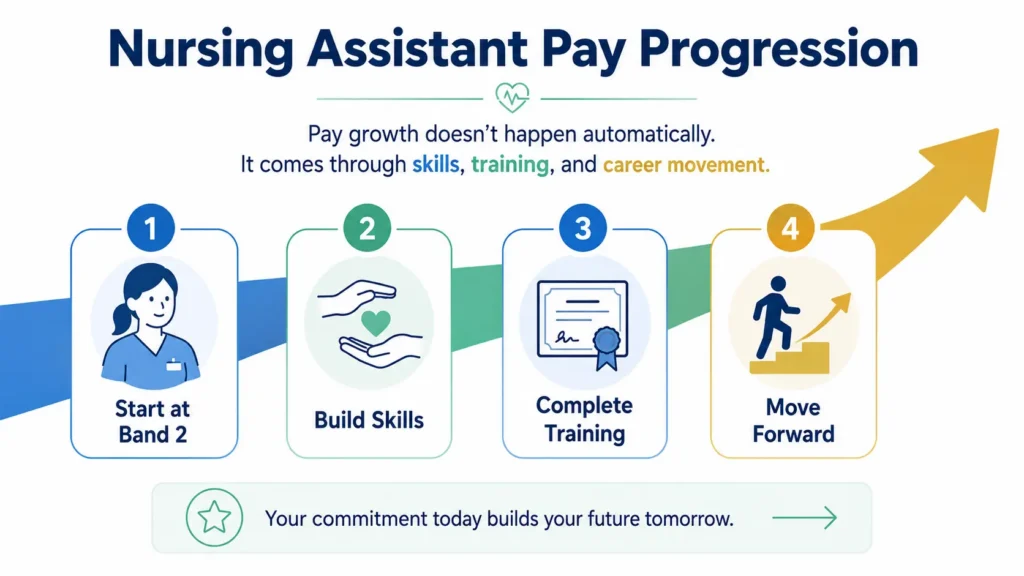
Nursing assistants and healthcare assistants in the NHS typically sit at Band 2 or Band 3.
Band 2: Entry-Level Healthcare Assistant
Band 2 is where most nursing assistants begin. It covers general healthcare assistants, clinical support workers in less complex roles, domestic staff in clinical settings, and similar positions. Band 2 has a flat structure – there is a single pay point with no automatic within-band increment, which is an important detail many people only find out after starting.
Band 2 salary in England (from 1 April 2026): £25,272 per year
That works out to approximately £12.91 per hour based on a standard 37.5-hour working week. After income tax, National Insurance at current rates, and the standard 5.2% NHS Pension contribution, take-home pay is approximately £1,700–£1,790 per month depending on individual tax code.
In Scotland, the 2026/27 pay award was slightly higher at 3.75%, and staff work a 36-hour standard week rather than 37.5 hours, resulting in a higher effective hourly rate. Wales received the same 3.3% as England. Northern Ireland operates under separate arrangements; always verify with the relevant regional NHS pay authority for exact current figures.
Because Band 2 has no internal progression points, the only way to increase your base salary while remaining on Band 2 is through shift enhancements. The good news is that those enhancements are significant.
The Impact of Unsocial Hours Pay
Under the AfC framework, staff working evenings, nights, weekends, and bank holidays receive enhanced pay rates. Weekend and night shift rates are meaningfully higher than standard hourly pay, and bank holiday rates are the highest of all. For a Band 2 HCA regularly working nights and weekends, these enhancements can add a noticeable percentage to annual earnings – sometimes equivalent to several months’ additional base salary across the year.
This is why take-home pay for two nursing assistants on the same band can differ considerably depending on shift patterns. Someone working predominantly 9-to-5 Monday to Friday and someone on rotating nights are technically on the same rate but earning quite differently.
Band 3: Senior Healthcare Assistant / Clinical Support Worker
Band 3 covers healthcare assistants who have taken on more advanced or autonomous clinical duties – things like basic wound care, ECG support, venepuncture, or catheter care, typically carried out under the supervision and delegation of a registered nurse. It also includes clinical coding officers, therapy assistants, and some administrative roles.
Band 3 salary in England (from 1 April 2026): £25,760 at entry, rising to £27,476
Unlike Band 2, Band 3 has two pay points, so there is internal progression. After demonstrating competency at entry level and accumulating experience, staff progress to the higher pay point. The jump from Band 2 to Band 3 entry is relatively modest in cash terms, but the progression to the top of Band 3 represents a more meaningful difference – and more importantly, Band 3 signals to employers that you’re ready for more clinical responsibility.
NHS Pay Bands and Typical Roles 2026/27
NHS Band
Typical Roles
2026/27 Salary (England)
Band 2
Entry-level HCA, healthcare support worker
£25,272 flat rate
Band 3
Senior HCA, clinical support worker
£25,760 – £27,476
Band 4
Nursing associate, assistant practitioner
£28,392 – £31,157
Band 5
Registered nurse, newly qualified
£32,073 – £39,043
NHS Pay Bands and Typical Roles 2026/27
| NHS Band | Typical Roles | 2026/27 Salary (England) |
|---|---|---|
| Band 2 | Entry-level HCA, healthcare support worker | £25,272 flat rate |
| Band 3 | Senior HCA, clinical support worker | £25,760 – £27,476 |
| Band 4 | Nursing associate, assistant practitioner | £28,392 – £31,157 |
| Band 5 | Registered nurse, newly qualified | £32,073 – £39,043 |
Private Sector and Care Home Pay: A Realistic Comparison
A large proportion of nursing assistants in the UK don’t work for the NHS directly – they work in private hospitals, residential and nursing care homes, or domiciliary care. Pay in these sectors is more variable and less transparent than the NHS banding structure.
Some private hospitals, particularly larger chains competing with NHS trusts for experienced staff, pay rates that broadly align with Band 2 or Band 3 – and in areas with acute staffing shortages, pay premiums above NHS rates are not uncommon. The trade-off is that private sector roles typically don’t carry the same pension, sick pay, and annual leave provisions that NHS AfC contracts provide.
Care homes at the entry level often pay closer to the National Living Wage, which from April 2026 is £12.21 per hour for those aged 21 and over. This is below the Band 2 NHS hourly rate of around £12.91, though care home roles can sometimes offer schedule flexibility or overtime that partially compensates. The gap between NHS and care home entry pay has narrowed over recent years due to sector-wide recruitment pressure, but for most candidates weighing up options, NHS roles retain a meaningful total-compensation advantage when pension contributions, sick pay entitlement, and structured pay progression are factored in.
For many career-changers, a care home or domiciliary care role serves as an effective first step – a way to build genuine clinical experience and a Care Certificate before applying for an NHS Band 2 or Band 3 post. That’s a practical strategy rather than a permanent destination.
Global Salary Snapshot: How the UK Compares
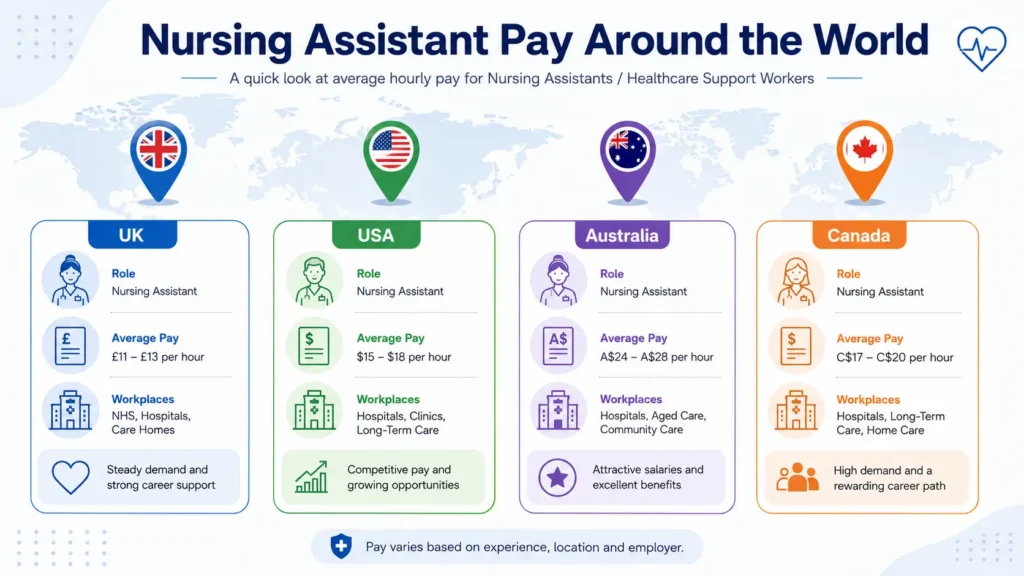
For context – or for anyone considering international options – nursing assistant pay varies considerably across the English-speaking world.
In the United States, certified nursing assistants (CNAs) earn broadly in the range of high-$30,000s to low-$40,000s annually on average, according to industry reports referencing US Bureau of Labor Statistics data, with significant variation by state. California, New York, and the Pacific Northwest tend to sit higher; parts of the South and Midwest considerably lower. The US system also involves direct certification requirements – CNAs must complete a state-approved training programme and pass a competency exam before working.
In Australia, personal care assistants and aged care workers are covered by the Aged Care Award, with rates broadly comparable to UK Band 2 levels when adjusted for the higher Australian cost of living. Industrial agreements have been driving above-award pay increases in recent years following government-backed wage reviews in the aged care sector.
In Canada, nursing aide and personal support worker pay varies widely by province and sector – from Alberta’s unionised healthcare support worker rates through to more variable community care rates in smaller provinces. Broadly, pay sits in a range comparable to UK Band 2/3 in purchasing power terms, though benefits structures differ.
The consistent pattern globally is that nursing assistant roles are often undervalued relative to the physical, emotional, and clinical demands involved – which is precisely why career progression within the UK structure is so important.
What Actually Moves Your Nursing Assistant Salary?
Time served is the weakest lever available to a nursing assistant looking to increase earnings. NHS Band 2 has no within-band progression points at all – meaning someone who has been in the same Band 2 role for five years earns the same base salary as a colleague in their first month. The only way to increase base pay is to progress to Band 3 or above.
Here’s what genuinely makes the difference:
Qualifications are the single biggest accelerator. Employers associate formal Level 3 training with the kind of clinical understanding needed for senior HCA and Band 3 roles – infection control, safeguarding, medication awareness, person-centred care at a level beyond basic induction.
Demonstrated clinical competencies matter as much as the paper. Venepuncture, ECG recording, catheter care, and wound dressing support are the types of additional skills that consistently appear in Band 3 job specifications. If you can document them, they open doors.
Location affects total earnings significantly through the High Cost Area Supplement. A Band 2 HCA in Inner London earns noticeably more than one in the Midlands on exactly the same pay point, simply because of the HCAS uplift.
Shift patterns remain one of the most underused levers. Regularly taking nights, weekends, or bank holiday shifts can add a meaningful sum annually – without requiring any promotion or qualification.
Sector matters at entry level. NHS roles typically offer better total compensation than care homes when the full employment package is weighed up.
Why Structured Training Is the Fastest Route to a Pay Rise
Here’s an honest observation that most salary guides gloss over: the difference between a nursing assistant stuck at Band 2 for three years and one who has moved to Band 3 within eighteen months usually comes down to one thing – structured training.
This is where the Nursing Assistant Training Diploma Level 3 becomes a genuinely worthwhile consideration. If you’re currently working as an entry-level HCA and want to move into a Band 3 role – or transition from a care home position into the NHS – this kind of structured Level 3 qualification gives you something your employer, and any interviewer, can actually evaluate.
It’s not just a certificate on a CV. A Level 3 diploma demonstrates that you understand the depth of patient care, safeguarding principles, infection control, medication awareness, professional boundaries, and the clinical reasoning that sits behind senior HCA duties. Many NHS trusts and private healthcare providers list Level 3 qualifications either as essential or desirable criteria for Band 3 positions – precisely because that depth of knowledge separates a candidate who says they can handle more responsibility from one who can show it.
For career changers entering the field without existing care experience, completing the Nursing Assistant Training Diploma Level 3 before applying builds a foundation that makes the Care Certificate induction faster to complete and makes you more credible in interview than someone who simply “applied and hoped.” The diploma covers the kind of grounded, practical knowledge that employers know takes time to develop – and that signals you’ve invested seriously in understanding the role rather than treating it as a temporary stopgap.
Online completion also means you can work through it at your own pace, alongside existing employment or family commitments, before stepping into your first NHS application with genuine confidence.
Nursing Assistant Training Diploma Level 3
What Comes After a Nursing Assistant?
Band 2 is not a destination for most people – it’s a starting point. And the career pathways from here are more varied and more accessible than many entering the profession realise.
Band 3: Senior Healthcare Assistant – The most immediate and achievable next step. Band 3 roles typically involve additional clinical competencies and a degree of autonomous responsibility under delegation. The route there is demonstrating those competencies through training and experience.
Band 4: Nursing Associate / Assistant Practitioner – A nursing associate sits between HCA and registered nurse, carries NMC registration, and earns meaningfully more than a Band 3 HCA. The route is via a Nursing Associate apprenticeship, which is typically funded by the employing NHS trust and takes around two years. Many Band 3 staff move into this route once they have a year or two of experience.
Band 5: Registered Nurse – Many nursing assistants use their ward experience as the practical foundation for a nursing degree – either through a traditional university route, a degree apprenticeship that allows you to keep earning while you study, or an accelerated route for those with relevant prior learning. The pay jump from any HCA band to Band 5 is substantial, and the clinical grounding built in an HCA role is something university-only students simply can’t replicate.
Specialist HCA Pathways – Not everyone wants to become a registered nurse, and there’s nothing second-best about staying in the support workforce. Specialist roles – phlebotomy, theatre support, maternity care, critical care support – often carry their own pay premiums and offer distinct professional identity within the healthcare team.
Practical Steps to Maximise Your Pay in 2026
A few grounded, specific actions worth taking this year:
Check your duties against your band. If you’re consistently performing Band 3-level clinical tasks on a Band 2 contract, that’s worth raising directly with your line manager or HR. It happens more frequently than most people realise, particularly on understaffed wards where experienced HCAs routinely step into more complex roles without formal regard.
Ask explicitly about unsocial hours payments before accepting a post. These aren’t always detailed in job adverts, but they’re often the difference between two roles that look identical on paper.
Look into funded training opportunities actively. Many NHS trusts run funded Level 3 diploma cohorts or apprenticeship routes with limited annual intake windows. Waiting to be told about them is rarely as effective as asking.
Keep a written record of every clinical competency you’re signed off on. When you apply for a Band 3 role or a nursing associate apprenticeship, having a documented evidence log is considerably more persuasive than a verbal claim.
Final Thoughts
Nursing assistant pay in 2026 tells a story that goes beyond the headline figure. At Band 2, £25,272 is a stable, pensioned starting point with real enhancement potential from unsocial hours – but it’s also a flat rate with no within-band progression, which means it stays at £25,272 until you actively do something to change it.
That’s the crucial insight. Pay progression in this career is something you build, not something that happens to you automatically. And the most direct route to Band 3, to a stronger NHS application, or to a nursing associate pathway, runs straight through structured, recognised training.
If you’re serious about moving forward, whether from a care home into the NHS or from Band 2 into Band 3, investing in the Nursing Assistant Training Diploma Level 3 is one of the most direct steps available to you right now. It builds the knowledge base that employers are looking for – and in a profession where your competence is what defines your value, that matters more than anything else.
FAQs on First Aid at Work UK: Legal Requirements for 2026
Most entry-level nursing assistants and HCAs are placed at Band 2. Those with additional clinical competencies and responsibilities may work at Band 3 as senior HCAs or clinical support workers.
In most UK settings, yes. Both titles refer to support workers who help registered nurses with daily patient care. The exact job title varies by employer and setting — NHS trusts, care homes, and private hospitals all use slightly different terminology, but the core duties are very similar.
Yes, and it’s one of the most achievable pay progressions in the NHS. Moving to Band 3 requires demonstrating competency in more advanced clinical duties, and completing a recognised Level 3 qualification significantly strengthens both your application and your case for regrading in an existing role.
Yes. Under the NHS Agenda for Change framework, all staff receive enhanced pay rates for working evenings, nights, weekends, and bank holidays. For a Band 2 HCA on regular nights, these enhancements can add a substantial sum annually on top of the base salary.
Yes. Many nursing assistants go on to complete a Nursing Associate apprenticeship (Band 4, NMC-registered) and then a shortened nursing degree, or pursue a full nursing degree or degree apprenticeship directly. Ward experience as an HCA provides a practical foundation that is genuinely valued in nursing programmes.
UK Band 2 pay is broadly comparable to nursing assistant roles in Australia and Canada when adjusted for cost of living, and sits in a similar range to US CNA pay in many states. The UK NHS offers stronger employment benefits – including a defined-benefit pension and generous sick pay – than most comparable roles internationally.
For anyone aiming to move from entry-level care work into Band 3 or above, or from the private sector into the NHS, a recognised Level 3 diploma is one of the most cost-effective investments available. It demonstrates the depth of knowledge employers associate with senior clinical support roles, and it directly addresses the most common gap between candidates who get shortlisted and those who don’t.
In the NHS, nursing assistants at Band 2 earn £25,272 per year in England from April 2026, following a 3.3% consolidated pay rise. Band 3 healthcare assistants earn between £25,760 and £27,476. Take-home pay is lower after tax, National Insurance, and NHS pension contributions, but shift enhancements for nights and weekends can add meaningfully to overall earnings.
Recent Posts