If you have ever wondered whether to say soy or estoy in Spanish, you’re not alone. Both come from verbs meaning “to be”, but Spanish uses them differently.
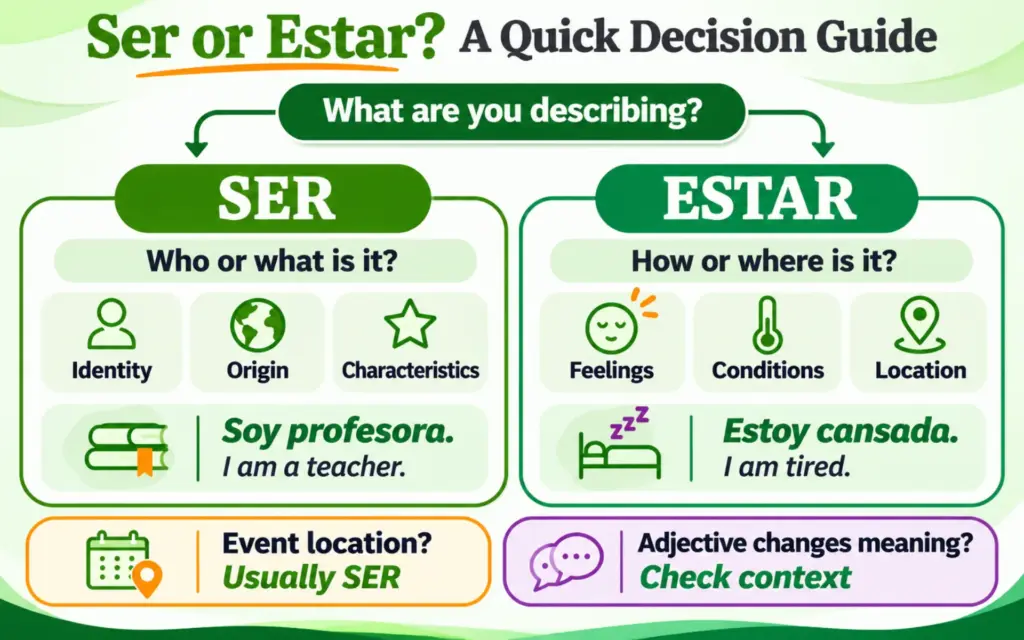
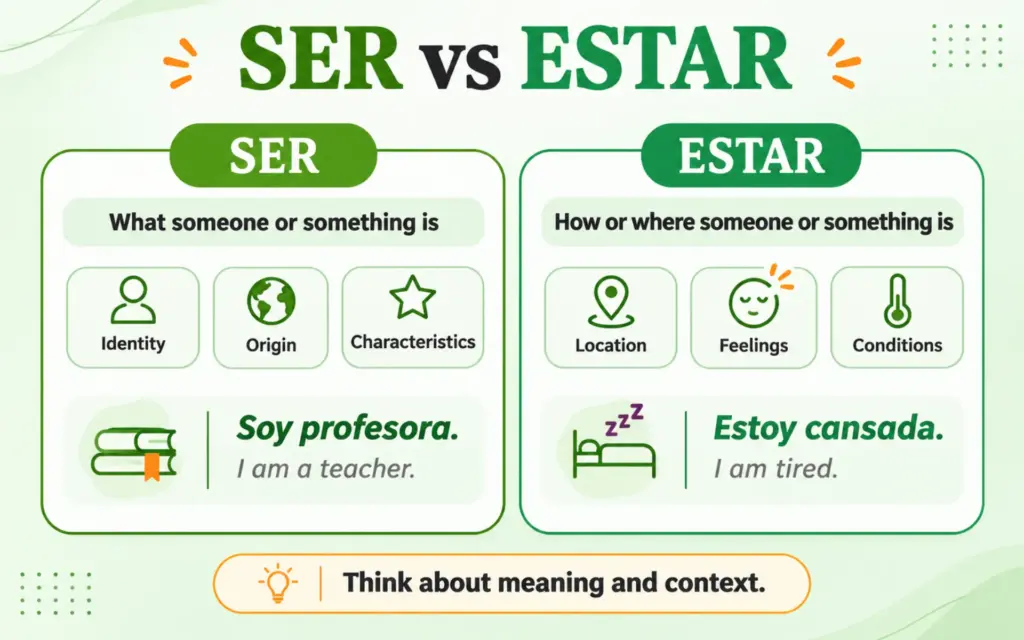
Ser generally describes what someone or something is, while estar describes how or where someone or something is.
For example:
- Soy profesora. — I am a teacher.
- Estoy cansada. — I am tired.
The difference becomes easier once you understand a few key rules. This guide explains when to use each verb, how to conjugate them and how to avoid common mistakes.
If you’re starting from scratch, our how-to-learn-Spanish guide can help you build a broader learning routine.
Table of Contents
Ser vs Estar: What’s the Difference?
The main difference between ser and estar is the information they communicate.
Use ser to talk about identity, origin, professions and general characteristics. Use estar for location, feelings, conditions and ongoing actions.
Here’s a quick comparison:
| Ser | Estar |
|---|---|
| Identity and profession | Location and position |
| Origin and nationality | Feelings and emotions |
| General characteristics | Conditions and states |
| Time, dates and events | Actions happening now |
Consider these sentences:
- Ella es simpática. — She is friendly.
- Ella está contenta. — She is happy.
The first describes someone’s personality. The second describes how she feels.
You may have heard that ser is for permanent things and estar is for temporary things. That can help initially, but it doesn’t explain every situation.
If you’d like structured lessons alongside these grammar rules, Alpha Academy’s Complete Spanish Online Course – Beginner to Intermediate covers ser, estar and other foundational Spanish topics.
Complete Spanish Online Course – Beginner to Intermediate
Learn Spanish step by step, from pronunciation and everyday vocabulary to key verbs and tenses. Build the confidence to understand and speak Spanish in real situations.
Enrol NowSer vs Estar Conjugation Chart (Present Tense)
Both verbs are irregular, meaning they don’t follow the usual Spanish verb endings.
Here are their present-tense forms:
| Subject Pronoun | Ser | Estar |
|---|---|---|
| Yo (I) | soy | estoy |
| Tú (you, informal) | eres | estás |
| Él/Ella/Usted (he/she/you, formal) | es | está |
| Nosotros/as (we) | somos | estamos |
| Vosotros/as (you, plural) | sois | estáis |
| Ellos/Ellas/Ustedes (they/you, plural) | son | están |
Notice that soy and estoy both mean “I am”. Similarly, es and está can both mean “is”. The correct choice depends on what you’re saying.
In Spain, vosotros is commonly used when addressing several people informally. In Latin America, ustedes is generally used instead.
These forms belong to the present tense. If you want to explore how verbs work in other time frames, our Spanish tenses article explains the present, past and future.
When to Use Ser in Spanish
Think of ser when you’re identifying someone or describing what something is.
Identity, Occupation and Origin
Use ser to introduce people, describe jobs and explain where someone comes from.
- Soy Ana. — I am Ana.
- Mi hermano es médico. — My brother is a doctor.
- Somos de Londres. — We are from London.
- Ella es española. — She is Spanish.
Notice that Spanish normally doesn’t use un or una before a profession in simple statements such as Soy profesor.
Characteristics, Time and Events
Ser also describes general characteristics and expresses time.
- Mi amiga es inteligente. — My friend is intelligent.
- La casa es grande. — The house is big.
- Son las tres. — It’s three o’clock.
There’s another useful rule: Spanish commonly uses ser to say where an event takes place.
La reunión es en la biblioteca. — The meeting is in the library.
Even though the sentence mentions a location, it uses ser because it identifies where the event is happening.
When to Use Estar in Spanish
Estar is commonly used to describe where something is, how someone feels or what condition something is in.
Location and Position
Use estar to say where people, places and objects are located.
- El libro está en la mesa. — The book is on the table.
- Estamos en casa. — We are at home.
- Madrid está en España. — Madrid is in Spain.
The last example is important. Madrid’s location isn’t temporary, yet Spanish uses estar. This is why the permanent-versus-temporary rule can be misleading.
Emotions and Conditions
Use estar to describe feelings, physical states and conditions.
- Estoy contenta. — I am happy.
- Estamos cansados. — We are tired.
- La puerta está abierta. — The door is open.
- El café está caliente. — The coffee is hot.
These sentences describe how someone feels or the condition something is in.
Actions Happening Now
Estar also helps form the Spanish present continuous.
The basic structure is:
Estar + present participle
For example:
Estoy estudiando español. — I am studying Spanish.
Estamos comiendo. — We are eating.
You only need to recognise this pattern for now. Learning the complete tense system can come later.
Ser vs Estar With Adjectives: How Meaning Changes
Some Spanish adjectives can follow either verb, but the meaning changes depending on which one you choose.
This is where learning through complete sentences becomes particularly useful.
| Adjective | With Ser | With Estar |
|---|---|---|
| Aburrido | Es aburrido. — He is boring. | Está aburrido. — He is bored. |
| Listo | Es listo. — He is clever. | Está listo. — He is ready. |
| Rico | Es rico. — He is rich. | Está rico. — It tastes delicious. |
Take listo, for example.
If you say Juan es listo, you’re describing Juan as clever.
If you say Juan está listo, you’re saying Juan is ready.
The adjective hasn’t changed, but the verb gives it a different meaning.
For UK GCSE learners, these distinctions are also included in the official GCSE Spanish grammar specification.
As your grammar develops, you’ll encounter more situations where context matters. When comparing an intermediate Spanish course, look for opportunities to practise these differences in complete sentences.
Three Common Ser vs Estar Mistakes
Even learners who know the basic rules can confuse these verbs. Here are three mistakes worth watching for.
1. Assuming Ser Is Always Permanent
The permanent-versus-temporary rule is a starting point, not a complete explanation.
For example:
Madrid está en España. — Madrid is in Spain.
The location isn’t temporary, but estar is still correct.
2. Using Estar for Every Location
Compare these sentences:
- El hotel está en Madrid. — The hotel is in Madrid.
- La reunión es en el hotel. — The meeting is at the hotel.
The first describes where a building is located. The second identifies where an event takes place.
3. Choosing the Wrong Verb Form
Knowing which verb to use is only half the task. You also need the correct conjugation.
For example, yo soy and yo estoy are both correct, but yo es and yo está are not.
If these distinctions feel unfamiliar, our article exploring is Spanish hard to learn explains some of the challenges English speakers encounter.
How to Remember Ser vs Estar
Two popular memory aids are DOCTOR for ser and PLACE for estar.
They group common uses into memorable categories, but they aren’t perfect rules.
A simpler approach is to ask yourself:
- Am I identifying someone or describing their origin or profession? Usually use ser.
- Am I describing how someone feels or where something is? Usually use estar.
- Am I saying where an event takes place? Usually use ser.
- Does the adjective change meaning? Consider what you want to communicate.
The more complete sentences you practise, the less you’ll need to rely on memory tricks.
Ser vs Estar Practice: Test Yourself
Ready to try? Fill each gap with the correct present-tense form of ser or estar.
- Yo ______ estudiante. (I am a student.)
- Mi hermana ______ cansada. (My sister is tired.)
- Nosotros ______ de Inglaterra. (We are from England.)
- El restaurante ______ cerca del hotel. (The restaurant is near the hotel.)
- La fiesta ______ en mi casa. (The party is at my house.)
- Tú ______ muy amable. (You are very kind.)
Answers and Explanations
- Soy — You’re identifying yourself as a student.
- Está — You’re describing your sister’s condition.
- Somos — You’re expressing where you come from.
- Está — You’re describing the restaurant’s location.
- Es — You’re identifying where an event takes place.
- Eres — You’re describing someone’s general characteristic.
How many did you get right?
If you made mistakes, look at the reason behind each answer before trying again. That matters more than simply remembering the correct word.
For learners exploring different ways to continue practising, our comparison of how to learn Spanish online looks at courses, apps and tutors.
How to Practise Ser and Estar in Everyday Spanish
You don’t need complicated exercises to improve. Start by using the verbs to describe familiar things.
Try this routine:
- Write three sentences about yourself using ser.
- Write three sentences about how you feel or where you are using estar.
- Practise pairs such as es listo and está listo.
- Read your sentences aloud.
- Return to them a few days later without checking your notes.
Speaking and writing your own examples helps you move beyond memorised rules.
If you’d like to build on these foundations, Alpha Academy’s Complete Spanish Online Course – Beginner to Intermediate offers structured lessons covering Spanish verbs, vocabulary and communication skills.
Frequently Asked Questions About Ser vs Estar
Not always. Ser often describes identity or general characteristics, while estar often describes states and locations. However, estar can describe permanent locations, and ser can be used for temporary events. Context is more reliable than permanence alone.
Both mean “I am”, but they belong to different verbs.
Soy estudiante. — I am a student.
Estoy cansado. — I am tired.
Use soy here for identity and estoy for a condition.
Usually, estar describes where a person, place or object is located.
For example, El museo está en el centro means “The museum is in the centre.”
However, ser is commonly used to identify where an event takes place, as in El concierto es en el parque.
Yes. Some adjectives change meaning depending on the verb.
For example, es listo means someone is clever, while está listo means someone is ready.
Recent Posts