Many people think that sign languages work like spoken English. This is a big mistake beginners make. British Sign Language is a language with its own rules and patterns. It is not English in sign form. To sign well you need to learn more than the alphabet and basic words. You must understand how to use those signs. Grammar helps you turn signs into a real conversation. Without grammar your signing will sound like a list of words.
Table of Contents
BSL vs. Spoken English: Key Differences
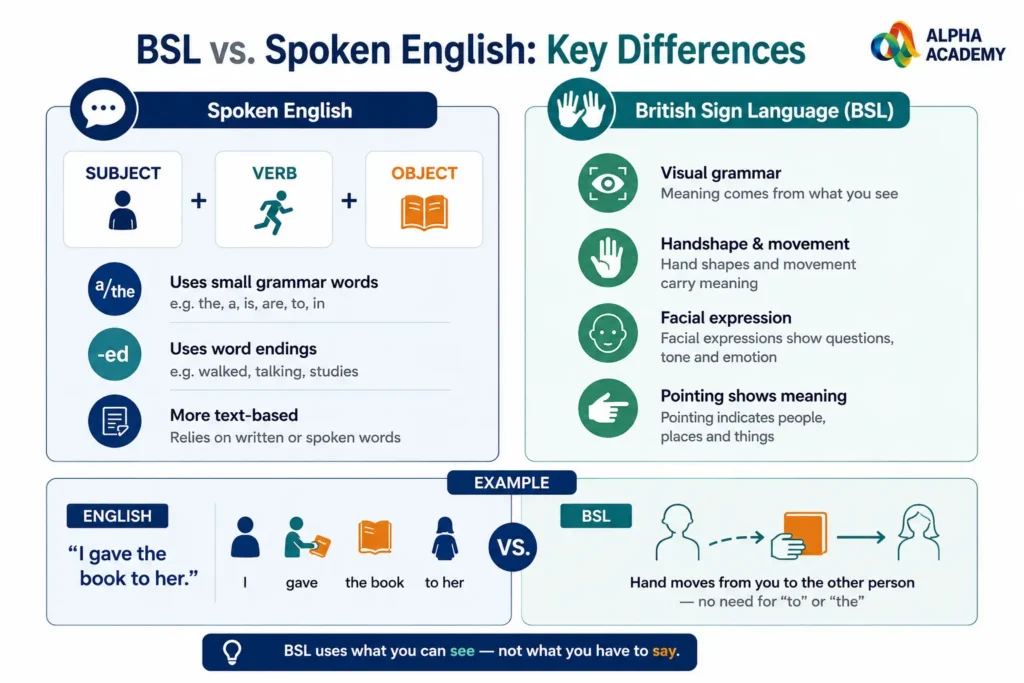
To get BSL grammar you gotta forget how English sentences work. In English we usually say things like Subject, Verb, then Object. Like “I drink tea.” If you change that order it gets confusing. Means something different.
BSL is not like that. It does not use word endings or little words like “the” “‘s “are” or “to”. Instead it uses things you can see: the shape of your hand, where you’re, how you move, how you look and where you’re pointing. One sign in BSL can say a lot. Like what would take words in English.
For example in English you might say “I gave the book to her.” In BSL you just move your hand from yourself to the person. That shows who gave what to whom. You do not need signs for “to” or “the”. This way of using visuals makes BSL more flexible and short, than language.
Basic Word Order in BSL Sentences
The common way that people make sentences in British Sign Language is to start with what the sentence is about and then add more information. British Sign Language sentences follow the pattern Topic-Comment. This means you introduce what you are talking about first then add information about it. A way to remember it is Time then Subject then Object then Verb.
Let us take an example of British Sign Language. The English sentence “Yesterday I bought a car” would be signed as:
Yesterday, I bought a car.
Notice how the verb comes at the end of the sentence in British Sign Language. This order allows the person watching to follow the subject and object first then understand the action that is happening in the British Sign Language sentence. It also makes it easier to show what is most important in the British Sign Language sentence. If you want to stress when something happened in British Sign Language you can place the time phrase at the start of the British Sign Language sentence.
Another common structure in Sign Language is Object then Subject then Verb. For example the English sentence “The cat chased the mouse” becomes:
Mouse Cat Chase.
This pattern puts focus on the thing being acted upon first in the British Sign Language sentence. With practice you will learn to switch between these structures depending on what you want to highlight in British Sign Language sentences.
Using Time and Tense
In English, we change the verb to show when something happened — “walk”, “walked”, “will walk”. BSL does not change the sign itself to show tense. Instead, it uses time markers placed at the beginning of the sentence.
Signs like now, today, yesterday, last week, or next year set the time frame. Once you have stated the time, every action that follows belongs to that same period. You do not need to repeat it for every sentence.
For example:
- Future: “Tomorrow I go to work” → Tomorrow → Work → I → Go
- Past: “Last month we visited London” → Last month → London → We → Visit
This system keeps sentences clear and avoids repetition. It also means you can talk about events across different times without changing the way you form each individual sign.
The Role of Space and Location
Space is one of the most powerful tools in BSL grammar. You use the area in front of your body to represent people, places, or objects. This is called spatial grammar.
Imagine you are talking about two people: Sam and Alex. You can point to a position on your left to represent Sam and a position on your right to represent Alex. Once you have set these locations, every time you point or sign towards that spot, you are referring to that person.
If you want to say “Sam gave the book to Alex”, you sign the Book, then move the sign from the Sam position across to the Alex position. The direction of movement tells the whole story. There is no need to sign “gave” as a separate word in the same way as English.
This method also applies to places. If you mention a city or a room, you can assign it a space and refer back to it simply by pointing. It makes conversations flow faster and reduces the number of signs you need.
Directional Verbs
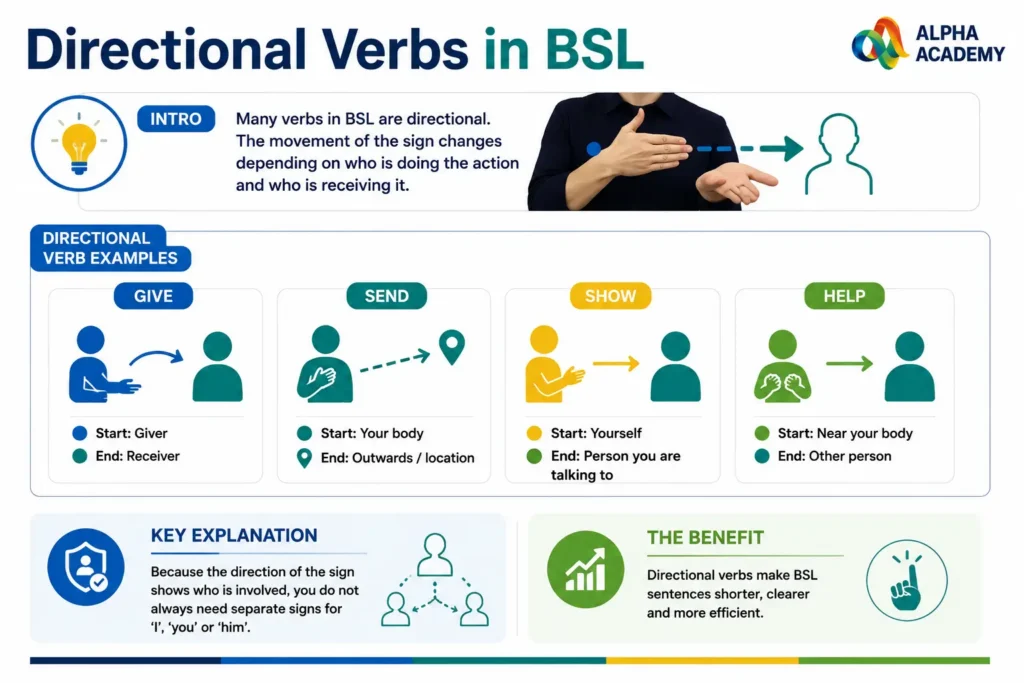
Many verbs in BSL are directional. This means the movement of the sign changes depending on who is doing the action and who is receiving it. The same hand shape can mean different things depending on where it starts and ends. Some common examples include:- Give: Move from the giver towards the receiver
- Send: Move from your body outwards or to a set location
- Show: Move from yourself towards the person you are talking to
- Help: Start near your own body and move towards the other person
Facial Expressions and Non-Manual Features
Facial expressions are not just about showing emotion in BSL — they are part of the grammar. They change the meaning of the sentence and show whether it is a statement, question, or command. These are known as non-manual features. For example:- Statements: Neutral or relaxed face, head held steady
- Yes/No questions: Eyebrows raised, eyes wide, head tilted slightly forward
- Wh- questions (who, what, where, when, why): Eyebrows lowered, head tilted slightly back
- Negation: Shake the head slightly, mouth turned down, or lips tightened
Questions and Negation
Asking questions in BSL follows clear rules. The type of question decides both the word order and your expression. For questions that need a simple “yes” or “no” answer, you usually place the topic first, then the comment, and raise your eyebrows. For example:- English: “Are you tired?”
- BSL: You → Tired + raised eyebrows
- English: “Where is the station?”
- BSL: Station → Where
- English: “I do not like coffee”
- BSL: Coffee → I → Like + shake head + negative face
Classifiers: Describing Size, Shape and Movement
Classifiers are special hand shapes used to describe objects, their size, shape, and how they move or are placed. They act like visual adjectives and verbs combined. Each classifier represents a category. For example:- A flat hand can represent a table, shelf, or flat surface
- Two fingers pointing down can represent a person walking or standing
- A curved hand can represent a cup, bowl, or round object
BSL Grammar Structure Summary
The table below brings together the main structures we have covered, so you can compare English and BSL side by side. This will help you adjust your thinking when building sentences.| Feature | Spoken English Structure | BSL Structure |
|---|---|---|
| Basic Sentence | Subject → Verb → Object | Time → Subject → Object → Verb |
| Tense | Verb changes, for example: walk → walked | Time marker at the start of the sentence |
| Relationships | Words such as “to”, “from” and “with” | Direction of movement and use of signing space |
| Questions | Verb or auxiliary placed at the start or end | Facial expression with the question word at the end |
| Description | Adjectives placed before nouns | Classifiers and signs for size and colour |
| Negation | “Not”, “no” or “never” used with the verb | Negative sign, head shake and facial expression |
Certificate in British Sign Language (BSL) Level 1 & 2
Common Grammar Mistakes to Avoid
When starting out, it is easy to carry over habits from English. Here are three of the most frequent errors and how to correct them:
- Following English word order: Signing “I eat apple” instead of “Apple I eat” makes sentences feel stiff. Focus on placing the action last.
- Forgetting facial expressions: Using only your hands without matching your face makes questions and statements hard to tell apart.
- Overusing small words: Signs for “the”, “is”, or “are” are rarely used. Leaving them out keeps your signing clear and natural.
Building Longer Sentences and Narratives
Once you are comfortable with simple sentences, you can combine them to tell stories or explain ideas. BSL uses sequencing to link events. You can use signs like then, after, or next, or simply move smoothly from one idea to the next while keeping the same time frame.
For example, a short story might look like this:
Morning → Wake up → Shower → Breakfast → Work → Bus
Each action follows the last, and because the time is set at the start, the meaning is clear. You can also add details using space and classifiers to make the scene more vivid.
As you build longer sentences, try not to rush. Keep each sign clear and maintain the correct structure. Over time, you will notice how sentences flow naturally without needing to plan every single word.
Practising Grammar Effectively
Grammar is best learned by doing things, not just remembering the rules. Here are some easy ways to get better at grammar:
- Watch videos of people who use Sign Language and see how they put signs together and use their face and body when they sign.
- Try writing sentences from English into British Sign Language and then try to do it the other way around.
- Practice describing things or places using the space around you and signs called classifiers.
The goal of practising grammar is not to be perfect but to help your brain get used to thinking in a visual way. As you keep practising British Sign Language grammar it will start to feel natural and easy.
Conclusion
Learning British Sign Language grammar is really important if you want to have conversations. British Sign Language is a language you can see. It is all about looking at people moving your hands and using your face to show what you mean.
When you learn about the order of things like what you’re talking about and what you think about it and you use the space around you and look in the right direction and you make faces that match what you are saying then people will understand you easily. Just remember that all the rules are there to help people understand each other better, not to make things harder.
Frequently Asked Questions on Understanding BSL Grammar Rules and Sentence Structure
Yes. British Sign Language has its own grammar and sentence structure. It uses hand movements, facial expressions, body position and signing space rather than following standard English word order.
Yes. Facial expressions are an essential part of BSL grammar. They help communicate questions, emotions, emphasis and meaning. Without the correct facial expression, a sign may be unclear or misunderstood.
Beginners may initially rely on English word order, but it can make their signing look unnatural. Learning the correct BSL structure early helps develop clearer communication and better signing habits.
Classifiers are specific handshapes used to represent people, objects, shapes, sizes, locations and movements. They allow signers to describe situations visually without using a separate sign for every detail.
Classifiers make descriptions more detailed, natural and efficient. They can show how an object moves, where it is located, what shape it has or how it relates to other objects.
A time sign such as “yesterday”, “last week”, “tomorrow” or “next year” is usually placed near the beginning of the sentence. The actions that follow are then understood within that time frame.
BSL does not use many small connecting words found in spoken English. Words such as “the” and “a” are usually omitted because meaning is communicated through sentence structure, movement and context.
Questions are formed using signs, sentence structure and facial expressions. Eyebrow position, head movement and body posture help show whether the signer is asking a yes-or-no question or requesting specific information.
Yes. Signing space can represent people, objects and places. Once a location has been assigned, the signer can point or direct later signs toward that area to show who or what they are referring to.
Regular practice with fluent signers, video examples and structured lessons is highly effective. Focus on sentence order, facial expressions, classifiers and the use of signing space rather than translating English word for word.
Recent Posts