Imagine a care worker visiting an older client at home. The client casually mentions that a relative has been helping by managing their bank cards. Up to now, nothing out of the ordinary has taken place. No one has been hurt. But a good safeguarding response means acting on this small comment now, rather than waiting for it to become a crisis. This is the essence of safeguarding – protecting people before harm happens, not only responding after harm has occurred.
In England, the Care Act 2014 provides the legal framework for adult safeguarding and is underpinned by six principles which are embedded in most policies, training courses and safeguarding job descriptions you encounter. This article introduces the concept of safeguarding, explains each of the six principles in terms of practical examples and considers safeguarding training and career opportunities for those interested in working in this area.
Table of Contents
What Is Safeguarding?
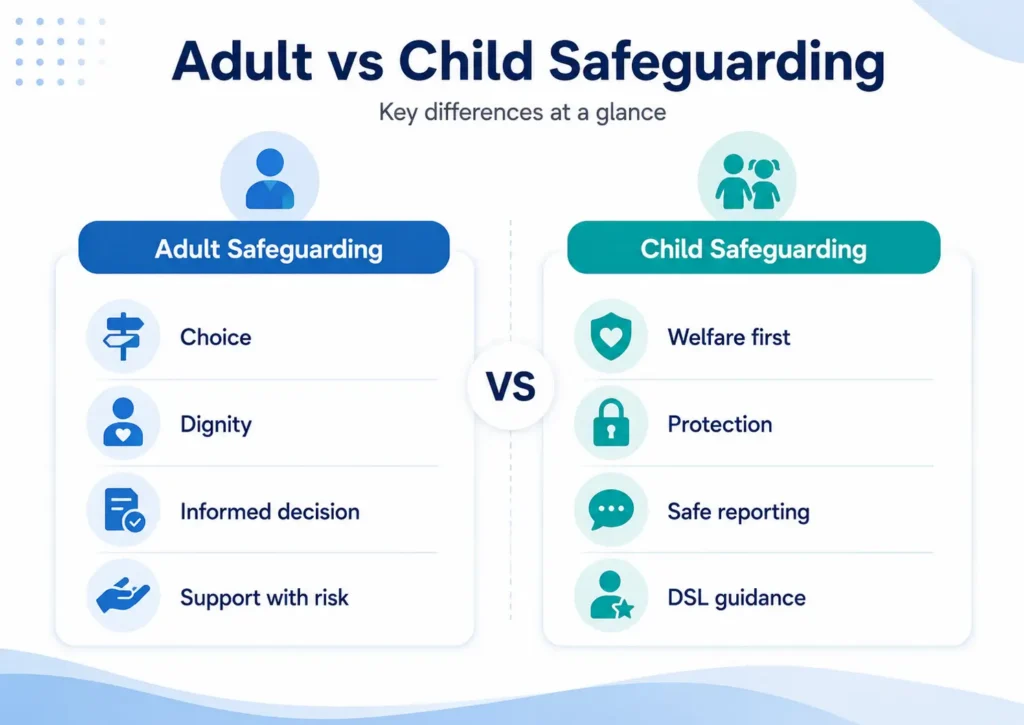
Safeguarding means protecting people’s right to live safely, free from abuse, neglect and exploitation. In England, adult safeguarding applies where an adult has care and support needs, is experiencing or at risk of abuse or neglect, and, because of those needs, may be unable to protect themselves. Children’s safeguarding follows a separate legal framework.
Safeguarding isn’t just about responding to abuse that has already occurred. It’s about ensuring the environment – awareness, early intervention, reporting procedures – is in place to prevent harm from happening in the first place. Hence, the term “protect before harm happens” better conveys the intent of the entire system than could the term “respond after harm happens”.
The legal framework for adult safeguarding in England is contained in the Care Act 2014 which for the first time put safeguarding duties on local authorities on a proper statutory footing. For children in England, safeguarding is shaped by the Children Act 1989 and Working Together to Safeguard Children 2026, the latest statutory guidance for multi-agency safeguarding work. While the legal details are different for adults and children, both frameworks have the same values.
The Vulnerable Adults Safeguarding Training helps people understand this wider duty. It connects safeguarding with dignity, person-centred care, communication, duty of care, and professional responsibility.
It is also important to understand the scope of safeguarding. Adult safeguarding concerns can include physical abuse, domestic abuse, sexual abuse, psychological abuse, financial or material abuse, modern slavery, discriminatory abuse, organisational abuse, neglect, acts of omission and self-neglect. It is everyone’s job – not just the job of social workers or designated leads.
Child Safeguarding Diploma
The 6 Principles of Safeguarding, Explained
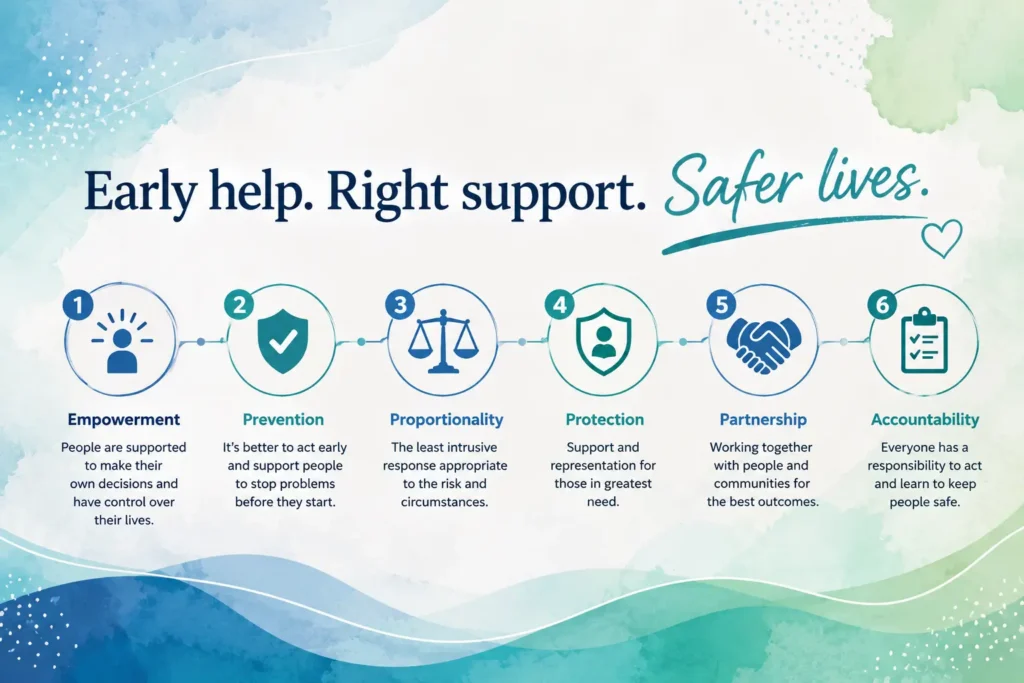
In England, the Care Act 2014 sets out six principles that should guide all safeguarding work. They are not abstract ideals contained in a policy document, but real tests which professionals, carers and organisations can apply to a real situation.
1. Empowerment
Empowerment means involving the person in decisions and actions that affect them.
In practice, this means asking the person what outcome they want, rather than assuming you already know what is best. Consider a care worker supporting an older man who has early-stage dementia who wants to stay living in his own home. The best safeguarding response does not ignore his wishes but takes account of what is important to him and thoroughly discusses the risks, considering what help might make staying at home safer, while recording the discussion clearly.
Empowerment does not mean ignoring genuine risk. It means a person is not reduced to a passive case file as decisions are made around him.
2. Prevention
Prevention is taking action to avoid harm, not responding to damage that has already occurred.
Prevention work is often the most overlooked principle; the work of prevention doesn’t typically look dramatic. This involves things such as training staff to be aware of early warning signs, establishing a culture of the workplace where staff feel comfortable raising small issues, and regularly checking care plans for progress, not just when something goes wrong.
A practical example: A support worker observes that an adult with learning disabilities is much quieter than usual after being visited by a certain acquaintance. No incident has been reported yet. Recognising that pattern early and asking gentle, non-leading questions is prevention in action. Waiting for a formal disclosure before acting defeats the purpose of prevention.
This is where courses such as Safeguarding and Counselling Course become useful. They help learners spot risk early and respond before harm grows.
3. Proportionality
Proportionality means the response to a safeguarding concern should be the least intrusive option that still manages the risk properly.
Even though a safeguarding action is done with good intentions it restricts someone’s rights to some degree. The proportionality principle helps prevent overreaction. If a concern can be resolved through a supportive conversation and a revised care plan, escalating straight to a full safeguarding enquiry may be unnecessarily intrusive.
This is where professional judgement is most important. The reason why continuous training (rather than a one-off course) is so important in this discipline is because it is important to act proportionately, which involves considering the nature and severity of the risk, and the consequences of the response.
4. Protection
Protection involves intervening to support and represent individuals who are in the greatest need, and who may be unable to safeguard themselves.
This means taking prompt action to take someone out of immediate danger, understanding who to report to and how to do so to ensure a situation is dealt with appropriately and not informally. Protection is the closest to what people usually think about when they hear the word “safeguarding” and that is when there is a concern and action is taken.
Protection and empowerment can sometimes sit in tension. This is recognised by the Care Act itself. If a person is an adult and has full mental capacity they are free to make decisions that involve risks, and it is not the role of professionals to override that choice, but to ensure the person is making an informed choice, and to record these discussions clearly in case the circumstances change later.
5. Partnership
It is important to work in partnership, not on one’s own, and this is best achieved when different services and agencies work together.
Safeguarding issues are not always contained to a single organisation. Imagine that a domiciliary care worker, a GP surgery and a local housing officer have all picked up different indicators that something is wrong with the same vulnerable adult, but no one knows the other has concerns as well. That’s exactly why partnership working exists, and it is a fundamental condition of it that information is shared (according to data protection obligations) and that as a result of this sharing, a coordinated response is achieved rather than three disconnected responses.
The same applies to communities. Public safeguarding awareness is as important as professional training as neighbours, local charities and faith groups will often pick up on warning signs first.
6. Accountability
Accountability is about open and clear responsibility, and a clear record of decisions made during the process.
In reality, it should always be clear to a vulnerable person who is doing what, and why, in a professional setting. It also means that should anything go wrong then the organisation involved can provide written evidence of what steps were taken and when. Accountability does not mean assigning blame after a tragedy, it’s a discipline that, if executed properly, prevents tragedies from ever happening because responsibility was unclear or passed on without proper follow-up.
| Principle | Core Idea | Practical Example |
|---|---|---|
| Empowerment | The person’s voice shapes the response. | Inquire about the desired result instead of making assumptions. |
| Prevention | Act before harm occurs. | Identify and address a change in behaviour before an incident is reported. |
| Proportionality | Use the least intrusive response that works. | Resolve a concern through a supportive conversation rather than immediately escalating to a full enquiry. |
| Protection | Support those in greatest need. | Carry out safe procedures when removing a person from imminent danger. |
| Partnership | Agencies and communities work together. | Collaborate to address concerns in care, health and housing services. |
| Accountability | Clear roles and documented decisions. | Record exactly who did what, and when, throughout a case. |
Safeguarding Children: What’s Different
After observing how the pathway functions in practice, there are a number of patterns that repeatedly appear with people who have difficulties in their first few months and most of these are easily avoidable.
The first is the underestimation of the physical requirements. Moving and handling training, which includes the safe ways to move and handle patients, is covered for a reason and for those who believe it’s basic, it is a quick way to get hurt in the first year of practice. Don’t skip this part of the induction, even if it seems like repetition.
The second is treating the role as a waiting room rather than a job in its own right. Some people treat the role only as a stepping stone and forget that it is an important care role in its own right, and treat the position as if it were a separate one. Patients and supervising nurses notice the difference between someone who’s fully present and someone who’s just clocking hours, and it tends to show up later in references and performance reviews.
A smaller but genuinely useful tip is to ask your mentor or supervisor for honest feedback early on, rather than waiting for a formal review. Most experienced nurses will gladly share with Healthcare Assistant (HCA) what they are doing well and what they need to focus on, particularly if asked specifically; however, continuous positive feedback without feedback will not help any nurse improve their skills quickly.
Safeguarding Training: What You Actually Need
Safeguarding training is often described in levels, but the exact level required depends on the sector, job role, local safeguarding partnership guidance and professional framework. In many workplaces, Level 1 is basic awareness, Level 2 is for staff with regular contact with children or adults at risk, and Level 3 is for staff with greater safeguarding responsibility, such as Designated Safeguarding Leads or safeguarding leads. Healthcare roles may follow intercollegiate competency frameworks, while schools and colleges must follow current Department for Education guidance.
Generally:
- Level 1: Basic awareness training for almost anyone who may encounter vulnerable people, such as receptionists, volunteers, drivers and other staff.
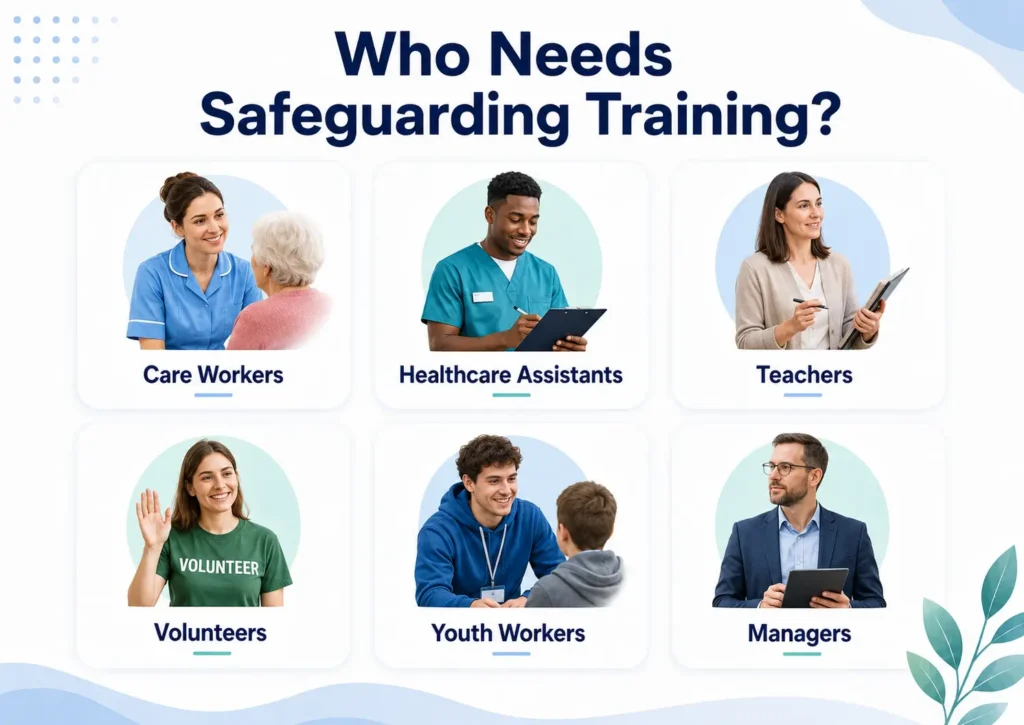
- Level 2: Suitable for people with regular contact with children or vulnerable adults, such as care workers, healthcare assistants, teaching assistants and teachers.
- Level 3: This training is usually targeted at Designated Safeguarding Leads and those who have direct responsibility for safeguarding – the staff member to whom another staff member would go with a safeguarding concern. This training is normally expected to be refreshed at least every two or three years as safeguarding guidance and case law changes.
If you are not sure which level applies to your role, check your employer’s safeguarding policy, local safeguarding partnership guidance or sector regulator requirements. This will vary greatly depending on the nature of the direct interaction with vulnerable individuals and the level of responsibility which may be required if a concern is raised.
Vulnerable Adults Safeguarding Training
Safeguarding Jobs: Where This Knowledge Leads
Safeguarding is not only a compliance issue. It can also be a career path, with safeguarding knowledge required across care, education, health, housing, youth work and charity roles.
Schools and care organisations, local authority safeguarding officers, social workers, and specialist roles within the NHS and police safeguarding teams are just a few roles where safeguarding is at the heart of the job. Beyond these dedicated roles, safeguarding knowledge is increasingly expected in a variety of careers including healthcare, education, housing, youth work and in the charity sector.
This is a sensible route for a person thinking of moving into this field to make their way up to become a DSL or safeguarding officer: work in a frontline care, education or healthcare setting and learn about safeguarding in this context, then once they have acquired sufficient experience in practice in this role, move on to Level 3 training and a role as DSL or safeguarding officer within the setting. Safeguarding knowledge is widely expected across care, health, education, housing, youth work and charity roles, especially where staff work directly with children or adults at risk.
Why This Matters Beyond the UK
Although the focus of this article is on the Care Act framework in the UK, there is a similar logic here in other parts of the world, even if the legal frameworks are different. The National Principles for Child Safe Organisations in Australia and the state-based adult safeguarding policies share the same focus on prevention, proportional responses and accountability. The United States and Canada apply similar concepts through adult protective services and child welfare laws, even without a single nationwide equivalent to the Care Act.
These systems have one thing in common: the best protection is a proactive, not reactive approach, and when it treats the person at the centre of a concern as someone with a voice, not simply a case to be managed.
Final Thoughts
Safeguarding is, at its core, a deceptively simple idea: act early, act proportionately, and never lose sight of the person at the centre of the decision. The six principles set out in the Care Act 2014 – empowerment, prevention, proportionality, protection, partnership, and accountability- give that idea a practical shape that professionals across health, social care, education, and beyond can actually apply day to day.
If you work with children or vulnerable adults, the next step is to check which safeguarding training level applies to your role, make sure it is current, and know exactly who to report concerns to. Safeguarding is not a one-off induction exercise.It involves noticing, asking and taking action in time so that a small concern never becomes a serious one.
Construction Safeguarding
Frequently Asked Questions
Proportionality means responding to safeguarding concerns in the least intrusive way while still managing the risk properly. The aim is to protect the person without unnecessarily removing their independence, dignity, or choice.
Protection means supporting people who are at serious risk or unable to keep themselves safe. This may involve following reporting procedures, contacting the right authorities, removing someone from immediate danger, or arranging professional support when a safeguarding concern is identified.
Partnership is important because safeguarding often involves different people and organisations working together. Care workers, schools, healthcare services, housing teams, charities, families, and local authorities may all need to share concerns appropriately to protect someone effectively.
Accountability means everyone involved in safeguarding must be clear about their responsibilities. It also means keeping accurate records, documenting decisions, explaining actions clearly, and making sure concerns do not get ignored or passed on without proper follow-up.
Safeguarding training is useful for anyone who works with children, vulnerable adults, or people who may be at risk. This includes care workers, healthcare assistants, teachers, teaching assistants, volunteers, social workers, youth workers, support staff, and managers responsible for safeguarding procedures.
Safeguarding means protecting people’s right to live safely, free from abuse, neglect, exploitation, and harm. It applies to children and vulnerable adults who may need support because of age, illness, disability, or other risks. Safeguarding focuses on early action, clear reporting, and prevention before serious harm happens.
Safeguarding is important because it helps protect vulnerable people before harm becomes a crisis. It ensures that concerns are noticed, recorded, reported, and managed properly. Good safeguarding practice supports dignity, safety, wellbeing, and the legal responsibility to protect children and adults at risk.
The six principles of safeguarding are empowerment, prevention, proportionality, protection, partnership, and accountability. These principles guide safeguarding decisions by making sure people are listened to, risks are managed early, actions are proportionate, and organisations remain responsible for their decisions.
Empowerment means placing the person’s views, wishes, and feelings at the centre of safeguarding decisions. Instead of making decisions for someone without involving them, professionals should listen carefully, explain options clearly, and support the person to make informed choices wherever possible.
Recent Posts