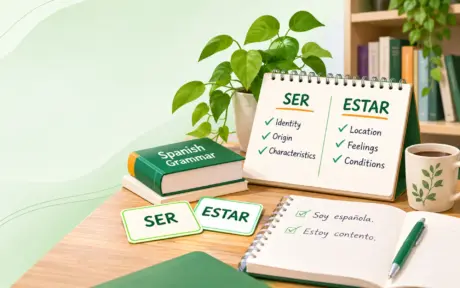

Learning Spanish is easier to manage when you know what to study first and how to build on it. Whether you’re starting from scratch or returning to the language after a break, a clear plan can help you make steady progress.
The best way to learn Spanish is to start with pronunciation, everyday vocabulary and simple grammar, then practise listening, speaking, reading and writing regularly. As your confidence grows, you can move towards longer conversations, different verb tenses and more complex expressions.
You don’t need to master everything immediately. This guide explains how to learn Spanish step by step, from your first phrases to intermediate communication, with practical exercises and a daily study routine you can follow at home.
If you prefer structured lessons, Alpha Academy’s Complete Spanish Online Course – Beginner to Intermediate covers pronunciation, vocabulary, essential grammar and everyday communication. The self-paced format lets you work through beginner and intermediate topics while building your Spanish knowledge at a pace that suits your schedule.
Table of Contents
How to Start Learning Spanish: Set Your Goals and Know Your Level
Before memorising vocabulary or studying grammar, decide what you want to achieve. Your goal will influence the words, phrases and situations you prioritise.
Decide Why You Want to Learn Spanish
You might want to communicate while travelling, speak with Spanish-speaking friends, develop useful workplace skills or simply enjoy learning another language.
Turn that motivation into a specific goal. Instead of saying, “I want to speak Spanish,” try “I want to introduce myself and ask basic questions without reading from notes.”
Small, measurable goals make it easier to recognise improvement and decide what to practise next.
Understand the Spanish Learning Levels
The Common European Framework of Reference for Languages (CEFR) describes language proficiency through different levels.
For beginners, the most relevant stages are:
- A1 – Beginner: Understand and use familiar everyday expressions.
- A2 – Elementary: Communicate in simple, routine situations.
- B1 – Intermediate: Discuss familiar topics, describe experiences and explain opinions using connected language.
These levels describe communication abilities, not simply the number of lessons completed.

Complete Spanish Online Course – Beginner to Intermediate
Learn Spanish step by step, from pronunciation and everyday vocabulary to key verbs and tenses. Build the confidence to understand and speak Spanish in real situations.
Enrol NowHow to Learn Spanish Step by Step: 7 Essential Steps
A practical Spanish learning plan should develop your knowledge gradually. The following seven steps combine vocabulary, grammar and real communication so you can build useful skills rather than memorising disconnected information.
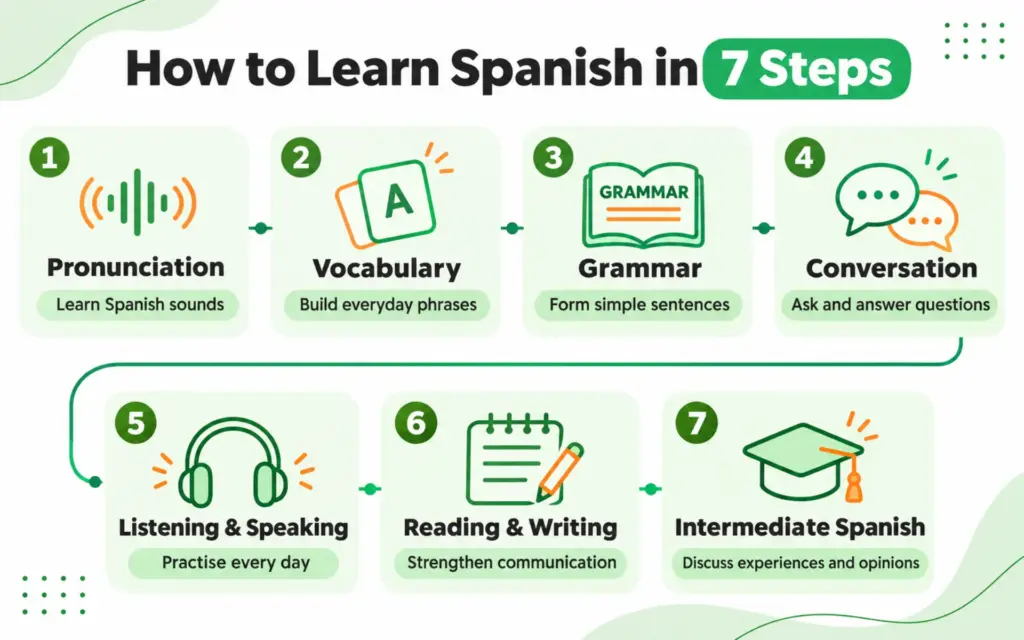
Step 1 – Learn the Spanish Alphabet and Pronunciation
Start by becoming familiar with Spanish sounds. Spanish uses the Latin alphabet, but some letters and combinations are pronounced differently from English.
Pay particular attention to its five vowel letters (a, e, i, o, u), which generally have more consistent sounds than English vowels.
You should also become familiar with sounds represented by letters such as ñ, j and rr. Pronunciation varies between Spanish-speaking regions, so listen to different speakers as your confidence develops.
You don’t need a perfect accent before starting conversations. Your first goal is to recognise sounds and pronounce common words clearly enough to communicate.
Try this: Choose five beginner words, listen to their pronunciation and repeat each one aloud. Record yourself and compare your pronunciation with the original audio.
Step 2 – Build Your Everyday Spanish Vocabulary
Once you understand the basic sounds, begin learning words and phrases you can use immediately.
Start with greetings, polite expressions, numbers, question words and vocabulary related to your daily life.
| Spanish | English |
|---|---|
| Hola | Hello |
| Gracias | Thank you |
| Por favor | Please |
| Sí | Yes |
| Adiós | Goodbye |
Learning numbers is another useful starting point. The numbers one to eight are uno, dos, tres, cuatro, cinco, seis, siete and ocho.
However, memorising individual words isn’t enough. Try learning them within complete expressions.
For example:
- Buenos días. — Good morning.
- ¿Cómo estás? — How are you?
- Muchas gracias. — Thank you very much.
- No entiendo. — I don’t understand.
These expressions help you communicate before you fully understand every grammar rule.
You can also use flashcards and spaced repetition to revisit vocabulary over several days instead of repeatedly studying the same list in one session.
Try this: Learn five useful expressions and practise using them in short spoken or written sentences.
Step 3 – Understand Basic Spanish Grammar and Sentence Structure
Spanish grammar becomes more manageable when you connect rules to sentences you actually want to use.
Begin with personal pronouns, articles, noun gender and present-tense verbs. Spanish nouns are generally grammatically masculine or feminine, and articles often reflect that distinction.
For example, el libro means “the book”, while la casa means “the house”.
Next, learn essential verbs such as ser, estar, tener and ir.
| Spanish Sentence | English Meaning |
|---|---|
| Soy estudiante. | I am a student. |
| Estoy cansado/a. | I am tired. |
| Tengo un libro. | I have a book. |
| Voy al trabajo. | I am going to work. |
One common challenge is understanding ser and estar, because both can translate as “to be” in English.
Broadly, ser is often used for identity and characteristics, while estar commonly describes location and states or conditions. However, choosing between them involves more than a simple permanent-versus-temporary rule.
If you’re unsure when to use these two verbs, our guide to ser vs estar explains the key differences with simple rules and practical examples.
Try this: Write five sentences about yourself using ser, estar and tener. Read them aloud to practise grammar and pronunciation together.
Step 4 – Learn to Ask Questions and Handle Everyday Conversations
After learning basic sentences, practise using Spanish in familiar situations.
Start with common question words:
- ¿Qué? — What?
- ¿Dónde? — Where?
- ¿Cuándo? — When?
- ¿Cómo? — How?
Use them to create simple questions you might ask while travelling, shopping or meeting someone.
For example:
- ¿Dónde está la estación? — Where is the station?
- ¿Cuánto cuesta? — How much does it cost?
- ¿Cómo te llamas? — What’s your name?
- Practise both asking and answering questions. This helps you prepare for conversations rather than relying entirely on memorised phrases.
Try this: Write a four-line conversation between a customer and a café worker. Practise speaking both parts aloud.
Step 5 – Practise Spanish Listening and Speaking Every Day
Understanding written Spanish and following spoken conversations are different skills. That’s why listening and speaking should become part of your routine early.
Start with short recordings designed for beginners. Listen once to understand the general meaning, then listen again to identify individual words and expressions.
You can also try shadowing: listen to a short sentence and repeat it, attempting to follow the speaker’s pronunciation and rhythm.
Speaking practice doesn’t always require another person. You can describe objects around your home, explain what you’re doing or answer simple questions aloud.
As you improve, conversation partners, tutors or language exchanges can provide opportunities for real interaction and feedback.
Try this: Listen to a one-minute Spanish recording twice. Identify three familiar expressions, then repeat one complete sentence aloud.
Step 6 – Strengthen Your Spanish Reading and Writing
Reading exposes you to useful vocabulary and sentence patterns in context. Writing gives you time to organise ideas and apply the grammar you’ve learned.
Begin with short dialogues, graded reading materials, simple stories and everyday messages. Choose texts appropriate to your level rather than attempting difficult novels immediately.
Keep a record of useful expressions and revisit them in your writing.
For example:
- Me gusta leer y escuchar música. — I like reading and listening to music.
- As your knowledge develops, write about your family, daily routine, interests or plans.
- Reading your work aloud also connects writing practice with speaking.
Try this: Write five sentences describing a normal day. Check unfamiliar words, review your grammar and read the sentences aloud.
Step 7 – Progress Towards Intermediate Spanish
Once you can manage basic everyday communication, gradually introduce more complex grammar and longer conversations.
Start exploring past tenses, future expressions, object pronouns and connecting words that help you explain events and ideas.
For example:
- Ayer fui al mercado. — Yesterday I went to the market.
- Mañana voy a estudiar español. — Tomorrow I am going to study Spanish.
You can also begin comparing experiences, explaining preferences and giving reasons for your opinions.
At this stage, challenge yourself with longer audio recordings, graded articles and conversations about familiar topics.
Remember that studying intermediate grammar doesn’t automatically mean you’ve reached B1 proficiency. Your listening, speaking, reading and writing abilities must also develop.
Try this: Describe something you did yesterday, explain what you plan to do tomorrow and give a reason for one of your choices.
What Should You Know at A1, A2 and B1 Spanish Levels?
Knowing what each level involves can help you set realistic learning goals.
According to the Council of Europe’s CEFR framework, language proficiency is measured through practical communication abilities.
Swipe left to see the full table →
| CEFR Level | Typical Learning Focus | Practical Goal |
|---|---|---|
| A1 – Beginner | Basic expressions, introductions, simple questions | Introduce yourself and exchange basic personal information |
| A2 – Elementary | Everyday routines, shopping, familiar situations | Manage simple conversations about familiar needs |
| B1 – Intermediate | Experiences, plans, opinions and connected language | Discuss familiar topics and explain experiences in more detail |
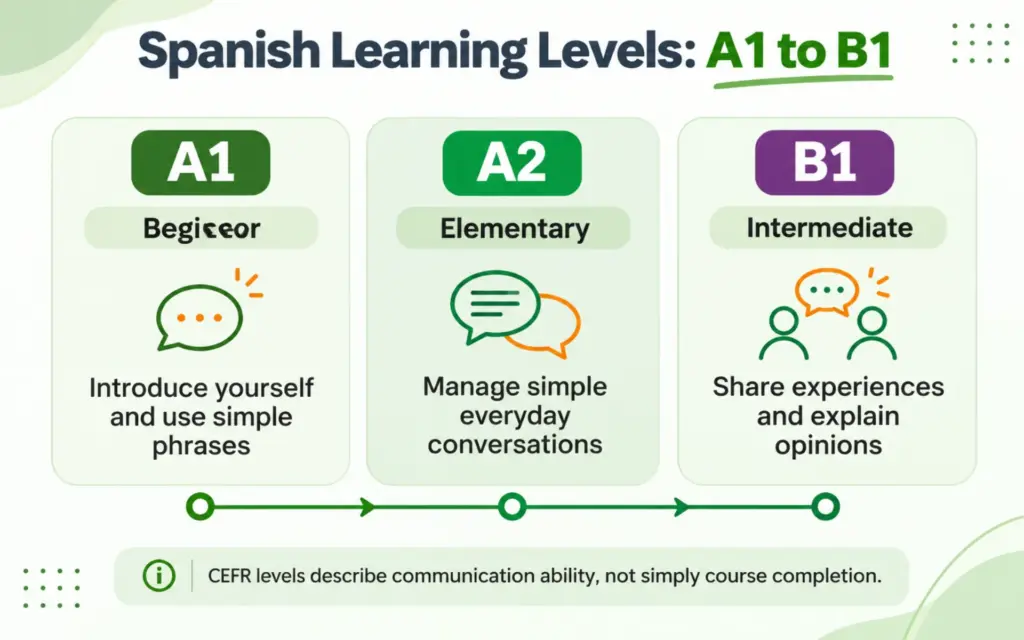
For example, an A1 learner might introduce themselves and state where they live. An A2 learner may be able to describe their routine or manage a straightforward shopping conversation.
A B1 learner should be able to communicate more independently in familiar situations, although complex discussions may still present challenges.
How quickly you progress depends on your starting knowledge, study habits, practice opportunities and learning goals.
As you work towards your next level, you might wonder, how long does it take to learn Spanish? Our detailed guide explains realistic learning timelines for A1, A2 and B1 learners.
How Can You Teach Yourself Spanish at Home?
You can teach yourself Spanish without attending traditional classroom lessons. However, independent learning works better when you have a clear plan and practise more than one language skill.
Choose Resources That Develop Different Skills
Use a combination of resources rather than depending entirely on one learning method.
Structured lessons can help organise grammar and vocabulary. Beginner podcasts and videos provide listening practice, while graded readers introduce written Spanish at a manageable level.
Flashcards are useful for reviewing vocabulary, but speaking activities help you practise turning that knowledge into communication.
The BBC Bitesize guide to learning Spanish also emphasises developing speaking, reading, listening and writing together.
Choose resources that suit your current ability and gradually introduce more challenging material.
Use the 80/20 Rule to Prioritise Useful Spanish
The 80/20 rule, or Pareto principle, is a way of prioritising activities that deliver the greatest practical value.
For Spanish learning, this means concentrating first on frequently used vocabulary, everyday phrases and essential grammar.
For example, learning common verbs such as tener, ir and hacer allows you to construct many useful sentences.
You can explore less common vocabulary and more advanced structures later.
The 80/20 rule isn’t a guarantee that a small amount of study will produce fluency. It’s a reminder to focus your limited learning time on material you’re likely to use.
A Simple 30-Minute Daily Spanish Study Routine
You don’t need to spend several hours studying every day to establish a useful learning habit.
A manageable routine can help you practise consistently while balancing work, education and other commitments.
Here’s a suggested 30-minute Spanish study plan:
Swipe left to see the full table →
| Activity | Time | What to Do |
|---|---|---|
| Structured lesson | 10 minutes | Study one grammar topic or lesson |
| Vocabulary review | 5 minutes | Recall words and phrases from previous sessions |
| Listening and speaking | 10 minutes | Listen to short audio and practise speaking |
| Writing or self‑test | 5 minutes | Write sentences or test your knowledge |
| Total | 30 minutes |
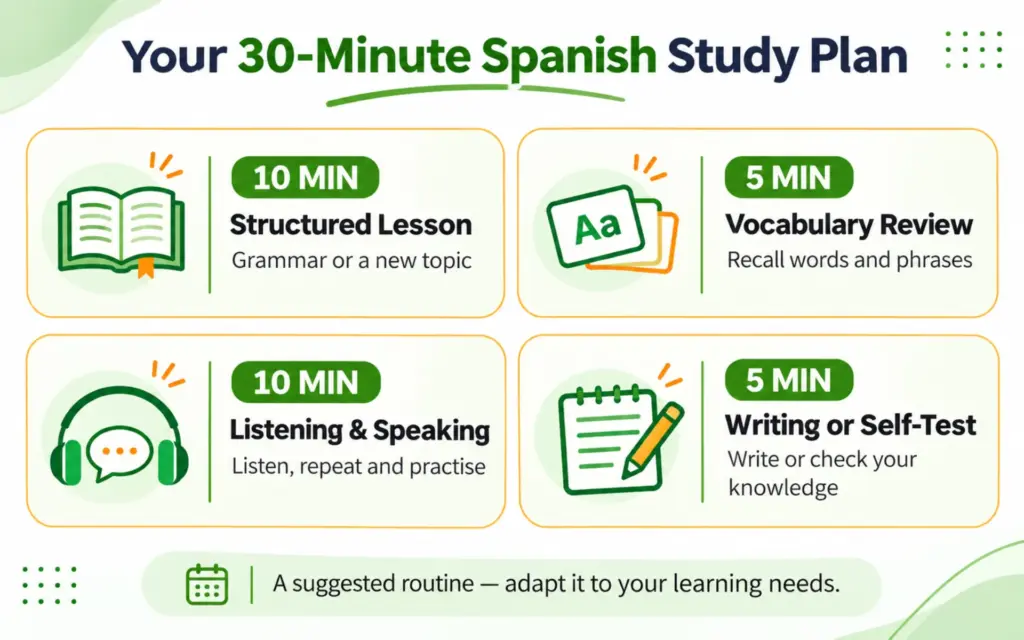
You can adapt this routine to your goals.
If pronunciation is difficult, spend more time listening and repeating. If you already understand basic grammar but struggle to speak, prioritise conversation practice.
Once a week, review what you’ve learned. Revisit challenging topics, listen to a familiar recording or try writing a short paragraph without checking your notes.
Consistency matters, but 30 minutes is a suggested starting routine rather than a guaranteed path to a particular level.
How to Track Your Spanish Learning Progress
Progress isn’t only about how many lessons you’ve completed. It’s also about what you can understand and communicate independently.
Set Small Weekly Learning Goals
Choose practical tasks that demonstrate improvement.
For example, you could aim to introduce yourself without notes, describe your daily routine, understand the main idea of a short recording or write a paragraph about a familiar topic.
At the end of each week, check whether you can complete your chosen activity with less support than before.
Keep a short record of what you can do confidently and what still needs practice.
Review Your Skills Against CEFR Milestones
Compare your abilities with the A1, A2 and B1 descriptors.
If you can read simple sentences but struggle to understand spoken questions, you may need more listening practice rather than additional grammar lessons.
Self-assessment is useful for planning, although it doesn’t replace a formal language proficiency assessment when one is required.
Common Mistakes to Avoid When Learning Spanish
Even motivated learners can develop habits that slow their progress.
- Memorising vocabulary without using it
Remembering a translation doesn’t always mean you can use the word naturally. Practise new vocabulary in sentences and everyday situations.
- Studying grammar without speaking
Grammar exercises build understanding, but conversation practice helps you apply that knowledge. Speak aloud regularly, even when you make mistakes.
- Ignoring listening and pronunciation
Reading alone won’t prepare you for the speed and rhythm of spoken Spanish. Include short recordings and repetition from the beginning.
- Expecting instant fluency
Learning another language takes sustained effort. Unrealistic expectations can make normal challenges feel like failure. Focus on achievable goals and recognise gradual improvement.
If your motivation drops, review your original learning goal and make your next task smaller. Completing a short practice session is often more useful than abandoning the routine because you cannot study for an hour.
How to Choose the Best Spanish Learning Resources
The best Spanish learning resources are those that match your current level, goals and preferred study methods.
Look for materials that explain concepts clearly, progress logically and provide opportunities to practise.
A beginner may benefit from structured lessons covering pronunciation, vocabulary and grammar. Someone with basic knowledge might need more conversations, listening activities and feedback.
Online courses can offer a clear sequence of topics, while podcasts, dictionaries, graded readers and language exchanges can support independent practice.
Consider whether your chosen resources develop all four language skills and whether you can review earlier material when necessary.
No single resource needs to do everything. A balanced combination is often more practical than constantly switching between new apps and study methods.
Final Thoughts: Start Learning Spanish Step by Step
Learning Spanish becomes more manageable when you follow a clear sequence and practise consistently. Begin with pronunciation and useful expressions, build your understanding of grammar, and gradually introduce longer conversations, reading and writing.
As your skills develop, use CEFR milestones to review your progress and identify what to learn next. Remember that small, regular practice sessions can contribute to meaningful progress over time.

Ready to begin your learning journey? Alpha Academy’s Complete Spanish Online Course – Beginner to Intermediate offers structured online lessons covering pronunciation, vocabulary, grammar and everyday Spanish communication. With 18 hours and 27 minutes of listed learning content and one year’s course access, you can study at your own pace while developing a foundation for further language learning.
Explore the course curriculum and take your next step towards more confident Spanish communication.
Frequently Asked Questions About Learning Spanish
Start with a structured beginner learning plan covering pronunciation, common vocabulary and simple grammar. Practise listening, speaking, reading and writing regularly. Use beginner-friendly lessons, audio resources and vocabulary review tools, and track your progress through practical communication goals.
The numbers are uno (one), dos (two), tres (three), cuatro (four), cinco (five), seis (six), siete (seven) and ocho (eight). Practise saying them aloud and using them in simple counting activities.
Five useful beginner Spanish words are hola (hello), gracias (thank you), por favor (please), sí (yes) and adiós (goodbye). Learning these common expressions is a practical starting point for everyday communication.
The 80/20 rule suggests prioritising the vocabulary, phrases and grammar that provide the most practical value. For example, focus on common verbs, questions and everyday expressions before studying uncommon words. It is a learning strategy, not a guaranteed formula for fluency.
The time needed depends on your previous language knowledge, study frequency, practice opportunities and target proficiency. Basic conversational skills may develop well before intermediate proficiency. Regular practice and realistic goals are more useful than expecting the same timeline for every learner.
Recent Posts
Online Speech Therapist Training A Beginners Career Guide
August 24, 2026
Stop Guessing SEN: Get a Level 3 Teaching Assistant Diploma Now
August 13, 2026

Top 10 Technologies to Gain a Competitive Advantage in 2026
August 5, 2026

Aquatic Level 4: What It Takes to Be a Fish Expert in UK
August 4, 2026

The Ultimate Guide to Mastering Deep Oven Cleaning
August 4, 2026
November 5, 2026


