
A healthcare appointment should be straightforward, but for some autistic people, the environment or communication can make it difficult. Bright lights, unexpected changes and unclear instructions may all create unnecessary challenges.
Barriers in health and social care are difficulties that prevent people from accessing services, understanding information or receiving appropriate support. For autistic people, these often involve sensory environments, communication differences and inflexible care arrangements.
Understanding these challenges can help care workers provide more inclusive and person-centred support. For those looking to build their knowledge and skills, the Level 3 Diploma in Health and Social Care offers a useful starting point for learning more about individual care needs.
Table of Contents
What Are Barriers in Health and Social Care for Autistic People?
Barriers are obstacles within services, environments or interactions that make healthcare and social support less accessible.
Autism is a form of neurodivergence that can influence communication, sensory experiences and how people process information. However, autistic people have different abilities, preferences and support needs.
A crowded NHS waiting room, for example, might cause sensory distress for one autistic person but not another. Similarly, someone may prefer written instructions rather than verbal explanations.
The key is recognising individual needs instead of assuming every autistic person experiences the same difficulties.
Diploma in Autism
Understand autism, from diagnosis and behaviour to communication and support strategies. Build the confidence to support autistic children and adults at home, in school or in care settings.
Enrol NowWhat Are the 7 Main Barriers in Health and Social Care for Autistic People?
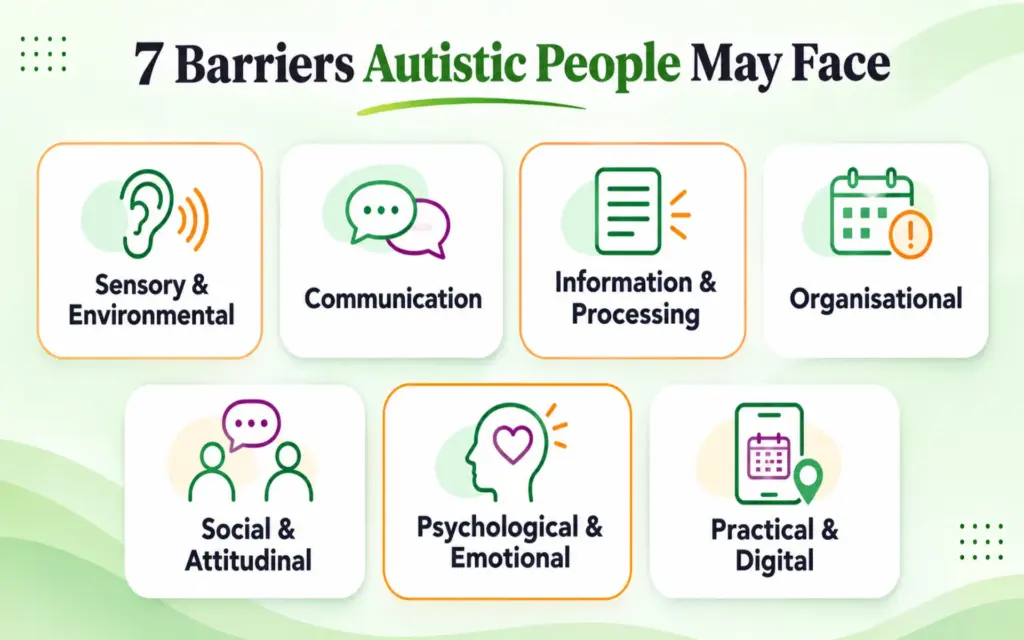
The following seven categories provide a practical way to understand common difficulties. They are not a single officially prescribed classification.
1. Sensory and Environmental Barriers
Bright lighting, loud conversations, strong smells and crowded spaces can make healthcare environments uncomfortable or overwhelming.
An autistic patient may struggle to remain in a noisy hospital waiting room, even when they need medical attention.
Quieter waiting areas, reduced lighting and opportunities to take breaks may help. The NICE guidance on supporting autistic adults recommends considering sensory needs and adapting care environments where appropriate.
2. Communication Barriers
Some autistic people prefer direct language, additional processing time or written communication.
Medical jargon, rapid questioning and vague instructions may create misunderstandings. For instance, saying “we’ll see you shortly” can be confusing when no approximate time is provided.
Healthcare professionals should explain procedures clearly, avoid unnecessary jargon and check understanding without making assumptions.
Some autistic people may also be Deaf and use British Sign Language (BSL) to communicate. Learning basic signing skills through a course such as the British Sign Language (BSL) Certificate Course Level 1 & 2 can help care workers communicate more inclusively, although professional interpreters may still be needed in healthcare settings.
3. Information and Processing Barriers
Lengthy forms, complicated instructions and too much information at once may be difficult for some autistic individuals to process.
For example, a patient receiving several treatment instructions during a short consultation might find it easier to review them afterwards.
Written summaries, visual information and clearly organised explanations can improve understanding.
Care workers should ask which format the person prefers rather than automatically using simplified information.
4. Organisational Barriers
Unpredictable appointments, sudden changes, long waits and unfamiliar staff can make care more challenging.
An autistic person who has prepared for a specific appointment may find an unexpected change of clinician particularly stressful.
Providing advance information, explaining delays and maintaining continuity where possible can reduce uncertainty.
Broader difficulties obtaining services are another important issue.
5. Social and Attitudinal Barriers
Misunderstanding autism can lead to unfair assumptions about someone’s behaviour or abilities.
For example, avoiding eye contact does not necessarily mean a person is uninterested or refusing to cooperate.
Staff should respect different communication styles and recognise that autistic people can express discomfort, understanding and preferences in different ways.
Inclusive care begins with listening rather than judging.
6. Psychological and Emotional Barriers
Previous negative experiences, uncertainty and anxiety can affect someone’s confidence in healthcare settings.
An autistic person who previously felt misunderstood during an appointment may feel reluctant to return.
Trust can improve when professionals explain what will happen, respect personal boundaries and allow sufficient time for questions.
Emotional support should reflect the individual’s preferences rather than assumptions about what will be reassuring.
7. Practical and Digital Barriers
Online-only booking systems, telephone appointments and unfamiliar administrative processes can create additional difficulties.
Some autistic people find telephone conversations challenging, while others prefer them to face-to-face interactions.
Offering different booking and communication options helps people choose suitable arrangements.
Transport, financial circumstances and other practical difficulties may also affect access to services.
Common Barriers and Possible Solutions
| Barrier | Healthcare example | Possible solution |
|---|---|---|
| Sensory | Noisy waiting room | Quieter waiting space |
| Communication | Unclear medical instructions | Direct language and written information |
| Information | Complicated forms | Accessible formats |
| Organisational | Unexpected appointment changes | Advance notice |
| Social | Assumptions about behaviour | Autism-aware communication |
| Emotional | Anxiety about procedures | Clear explanations and reassurance |
| Digital | Telephone-only booking | Alternative booking methods |
These adjustments should always be discussed with the individual.
Level 3 Diploma in Health and Social Care
Build essential care skills in personal, mental, elderly and child health. Gain the knowledge to start or grow your career as a care assistant, support worker or healthcare assistant.
Enrol NowHow Do Barriers Affect the Quality of Care?

Unaddressed barriers can affect communication, trust and participation in treatment decisions.
For instance, an autistic patient experiencing sensory distress may find it harder to describe symptoms during an appointment. If staff misinterpret that distress, important information could be overlooked.
Poor communication can also leave individuals uncertain about medication instructions, follow-up appointments or available support.
Care assistants and healthcare support staff can make a real difference by recognising individual needs and communicating concerns clearly. Building these skills through learning opportunities such as the Nursing Assistant Training Diploma Level 3 can help develop a better understanding of patient care and communication.
Online Nursing Assistant Training Diploma Level 3
Learn the core skills of a nursing assistant, from infection control and hygiene to mobility, nutrition and pain management. Build the confidence to support patients safely in healthcare settings.
Enrol NowHow Can Health and Social Care Workers Reduce Barriers?
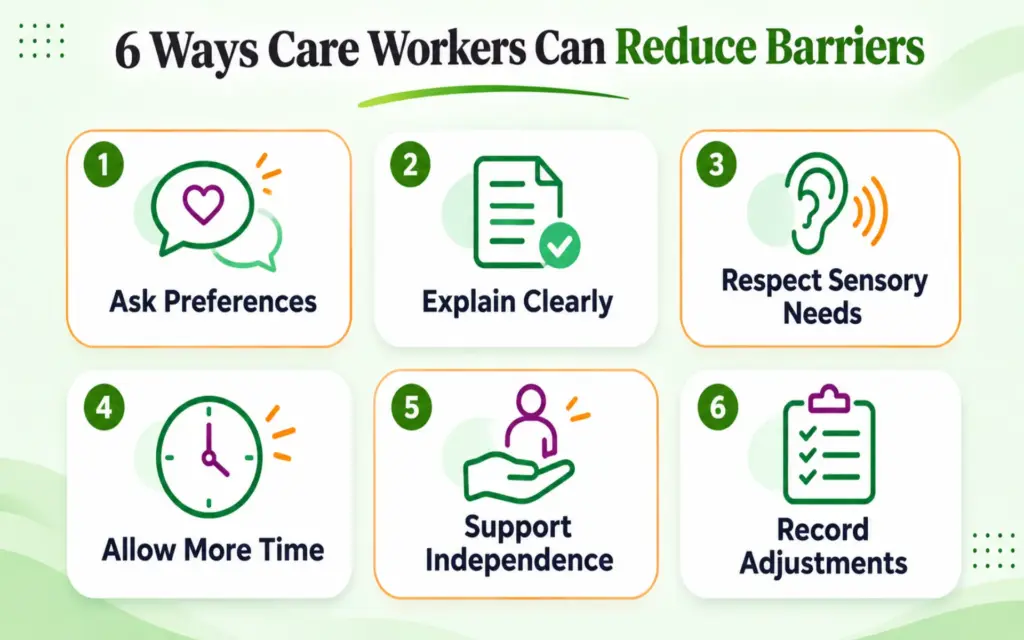
Reducing barriers does not always require major changes. Sometimes a small adjustment makes an appointment significantly more accessible.
What Individual Care Workers Can Do
Practical approaches include:
- Ask about preferences. Find out how the person wishes to communicate and receive information.
- Explain procedures clearly. Describe what will happen before examinations or care activities.
- Respect sensory needs. Consider noise, lighting, personal space and opportunities for breaks.
- Allow processing time. Avoid rushing responses or repeatedly asking questions.
- Support independence. Involve the autistic person directly in decisions about their care.
- Record relevant needs. Follow workplace procedures so agreed adjustments are communicated appropriately.
Developing autism awareness can support these practices. Alpha Academy’s Diploma in Autism introduces autism, communication differences and support approaches through online learning.
What Care Providers and Managers Can Do
Organisations can support staff by reviewing accessibility, providing appropriate training and offering flexible communication options.
They should also ensure that reasonable adjustments are identified, recorded and reviewed.
Feedback from autistic service users is particularly valuable because accessibility improvements should reflect people’s actual experiences.
UK Requirements for Accessible and Person-Centred Care
In Great Britain, the Equality Act 2010 requires service providers to make reasonable adjustments for disabled people where the duty applies. The government guidance on reasonable adjustments explains this anticipatory legal duty.
In England, the NHS Accessible Information Standard requires NHS and adult social care organisations to identify, record, flag, share, meet and review relevant information and communication support needs.
Additionally, CQC Regulation 9 requires registered providers in England to deliver person-centred care that reflects individual needs and preferences.
These requirements concern providers’ responsibilities. Individual workers must also follow their professional duties, training and workplace procedures.
Frequently Asked Questions About Learning Spanish
For autistic people, seven useful categories are sensory, communication, information-processing, organisational, social, emotional and practical barriers. Different educational resources may group these differently.
Common difficulties include sensory overload, unclear communication, unpredictable appointments, inaccessible information and misunderstanding of individual needs.
Some classifications use eight categories by separating physical barriers from sensory barriers or digital barriers from other practical difficulties. There is no universal eight-category list.
Five broad groups may include physical and sensory, communication and information, social and cultural, psychological, and organisational barriers. These can be divided into more detailed categories depending on the context.
Recent Posts