
If you’ve ever sat with a sick relative on a hospital ward and watched the person who actually washed them, fed them, and stayed calm through a difficult night, you’ve probably met a nursing assistant. Many people assume this role always requires years of university training, but that is not usually the case for entry-level Healthcare Assistant (HCA) or Healthcare Support Worker (HCSW) roles.
In the UK, “Nursing Assistant” is commonly used to describe roles such as Healthcare Assistant (HCA) or Healthcare Support Worker (HCSW) , and do not always have to go through degree training. You usually do not need a nursing degree, but employers may expect suitable literacy and numeracy skills, right-to-work documents, pre-employment checks, occupational health clearance, employer-led induction training and the right attitude to hands-on care.
This article explains who’s eligible, what the actual entry points are throughout the NHS and the private care system and what to expect when you arrive at ward level.
What a Nursing Assistant Actually Does
Before we start to think about who can become one, it is important to think about what the job entails on a day-to-day basis, as this will inform who may be a good fit for the role.
In the UK, a Nursing Assistant is known as a Healthcare Assistant (HA) or a Healthcare Support Worker (HWS) who works under the guidance of a Registered Nurse or other competent clinician. They do not make clinical decisions independently or prescribe medication or diagnose conditions. They provide essential day-to-day support on wards, in care homes and in community care homes, hospital wards, and community care settings. .
Table of Contents
Nursing Assistant Training Diploma Level 3
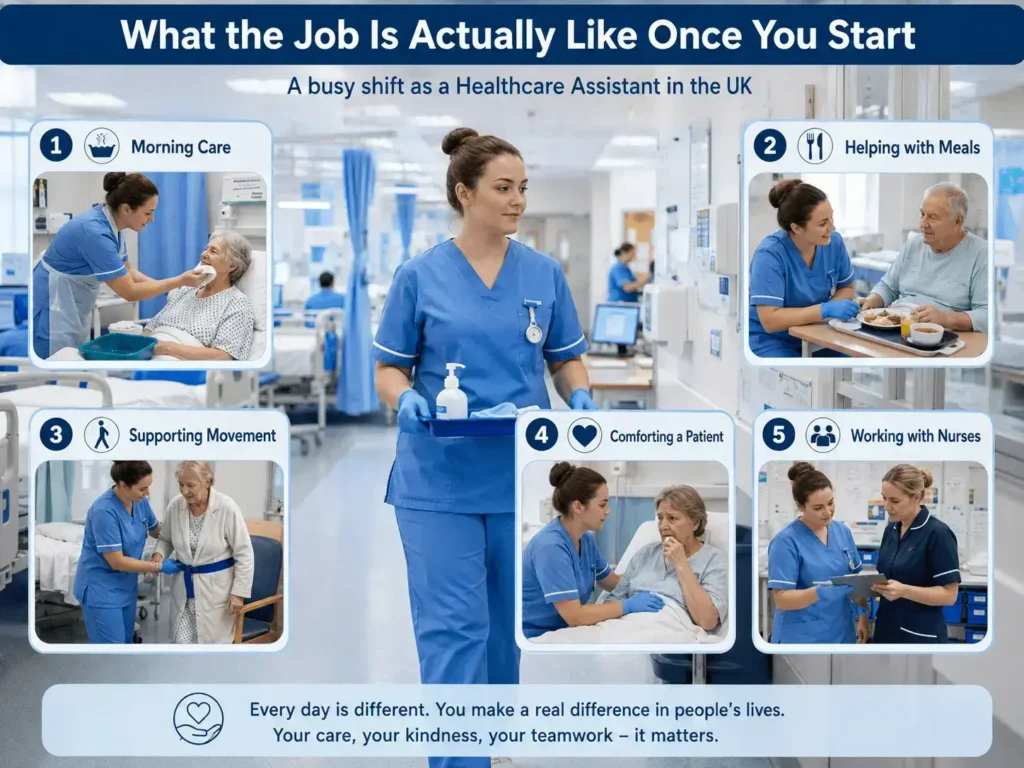
A typical shift might include:
Typical Duties of a Nursing Assistant
- Assistance with washing, dressing, cleaning and grooming.
- Helping with feeding and checking food and fluid consumption.
- Assisting with mobility, such as helping an individual to sit up, walk a few steps, or move from bed to chair.
- Taking and recording basic observations, such as temperature, pulse and blood pressure, where trained and authorised to do so, and reporting any changes to the nursing team.
- Ensuring patient comfort, tranquillity and security between clinical interventions.
- Carrying out physically challenging and emotionally demanding work with care, patience and professionalism.
NHS England describes Healthcare Support Worker roles as accessible entry points into healthcare, with no fixed national entry requirements. However, employers still assess personal values, communication skills, teamwork and willingness to learn.
The difference between a Health Care Assistant and a Registered Nurse is almost entirely one of the depth and extent of training and clinical responsibility. After a three- or four-year degree course, a registered nurse is qualified to practise independently after studying all aspects of pharmacology, advanced anatomy and independent clinical judgement. A Healthcare Assistant, in contrast, will usually have a formal induction and a brief vocational training that emphasises the practical and hands-on aspects of looking after others rather than significant amounts of medical theory. Both are hugely important on a ward, but represent different levels of clinical importance.
That gap in required training is also why the job suits such a wide range of people. It’s not necessary to have always dreamed of working in a health care career. Many HCAs came from completely different backgrounds such as retail, hospitality or working in hospital stores and found that more fulfilling and practical care was better for them than sitting at a desk, working on a computer
Who Can Actually Become One?
To be honest, almost anyone with a willingness to learn the job and meet a few basic requirements. There are no specific qualifications required in order to become a Healthcare Support Worker, as outlined in NHS England’s own guidance – however, employers will take a critical look at your personal skills and values as well as what qualifications you may have.
-
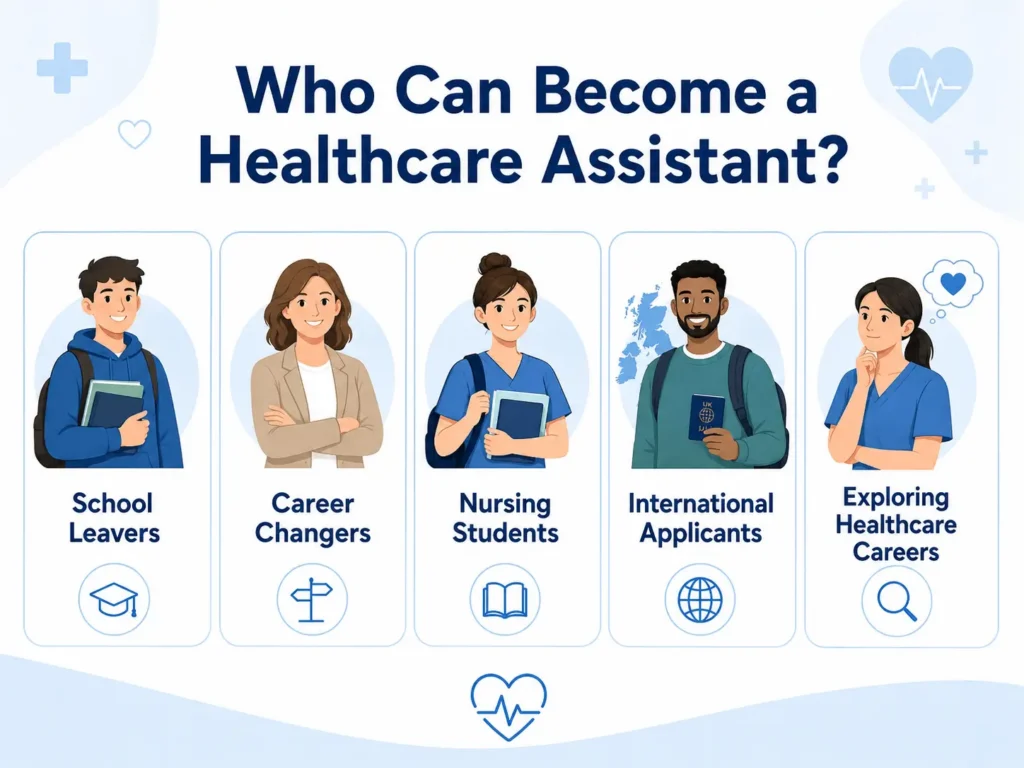
School Leavers
It is not necessary to have A-Levels or a university offer for an entry-level Healthcare Assistant (HCA) position. There are many employers, such as NHS trusts, that will accept applicants straight from secondary school. Others just require GCSEs (or equivalent) in English and maths as parts of the job involve reading care plans, making accurate observations and making good communication with the rest of the team. Even if you do not have these, it is still worth applying, as some employers or training providers may support applicants to improve literacy, numeracy and workplace communication skills.
-
Career Changers
This is a very popular pathway to the profession. Many of those who have worked in retail, hospitality, warehouse or have returned to the workforce after a break of many years are often relocating to Healthcare Assistant (HCA) because of the short, hands-on training and lack of the need to sacrifice years of income for a full-time course.
-
People Already Studying Towards Nursing
Many forget that you DO NOT need to make a choice between studying nursing and working as a Healthcare Assistant. It is common for a nursing degree student to undertake work experience in a ward as a Healthcare Assistant (HCA) either before or whilst completing the nursing degree; this could be via a nursing degree apprenticeship or through a traditional nursing degree pathway.
This is really helpful! It is about being able to start a degree apprenticeship and earn a wage whilst gaining valuable hands-on clinical experience, instead of waiting to register to start on a ward.
-
Migrants and International Applicants
The Healthcare Assistant (HCA) pathway has become a popular route for recently immigrated workers to the UK to enter the healthcare sector. The practical entry requirements are less stringent than those for degree-level clinical posts, as the focus is on competence and induction training, although right-to-work checks, references and sometimes a simple English language test may apply, depending on the employer.
-
People Who Want to Try Healthcare Before Committing
Individuals who wish to explore healthcare but would not like to join a programme. Others pursue a Healthcare Assistant (HCA) role only to discover if hands-on care is a right fit for them before determining if a nursing or related degree is pursued. It can be a useful way to test whether hands-on care is right for you – you can discover if the job is the right one for you, without spending years, and a lot of money, in the wrong industry.
What You'll Actually Need to Apply
While there’s no degree requirement, that doesn’t mean there are zero requirements. Here are some things that most NHS trusts (and private care providers) do expect:
A reasonable standard of literacy and numeracy.
Some employers may ask for GCSEs or equivalent in English and maths, while others may focus more on personal values, communication skills and willingness to learn.
Background and safety checks.
As you will be working with vulnerable individuals, you will likely need to undertake a DBS check, reference checks with regards to your work history and checks over your right to work in the UK. These usually have a deadline to be met before you can apply, and prepare your ID, address history and references early. In many cases, the employer will start the DBS process after a conditional job offer.
Completion of the Care Certificate, usually after starting.
Most employers do not require this before you take up your job, but do have it as a planned induction process after you have been accepted. The Care Certificate was updated in March 2025 and now includes 16 standards. and now addresses sixteen standards which include safeguarding, communication, infection control and basic life support. The Care Certificate is not a regulated academic qualification, but it is widely used as an induction framework for health and social care support workers. The standards were updated in March 2025 and now include 16 standards.
Occupational health clearance.
Many NHS trusts and care providers require proof of immunisation status and a basic health screening before you start on a ward, in line with standard infection control practice across hospitals and care homes.
None of these requirements demand a university transcript. They demand reliability, character, and a genuine commitment to patient safety.
A useful point to note is that the sequence of tasks is important; for some applicants, sorting things out in the correct order is a surprise. It can take some weeks for a DBS check to be completed as well as verifying references and many employers will not confirm a start date until it has been cleared. For people applying for jobs with Healthcare Assistant (HCA), it is much better to start the DBS process as soon as you begin searching for your new job, than wait until after you have received a job offer. One of the most frequent reasons for a job offer being postponed weeks upon weeks is this delay.
Nursing Assistant Diploma
Training Routes: What's Actually Out There
In the UK, there is no specific legal qualification requirement for Healthcare Assistants, unlike certain other health-related roles. Instead, the route into the profession usually depends on the employer and may involve a combination of workplace training, vocational qualifications, or an apprenticeship.
| Route | What It Involves | Typical Setting |
|---|---|---|
| On-the-job induction + Care Certificate | Structured workplace training covering 16 core standards, usually completed during the first weeks of employment. | NHS trusts and most care homes |
| BTEC or NVQ in Health and Social Care | A vocational qualification that may be studied before starting work or alongside employment. | Further education colleges |
| Healthcare Support Worker Apprenticeship | Paid, on-the-job training combined with structured study, leading to a recognised qualification. | NHS organisations and larger care providers |
What the Job Is Actually Like Once You Start
Training and induction is one thing. The job itself is another, and it’s worth being honest about it. Imagine a working shift early in the morning of a crowded hospital ward. You can expect to be at the hospital at 7am, and in the first hour, wash and dress a number of patients, eat breakfast across a bay whose mobility and dietary requirements vary widely, and sit for a few minutes to comfort a patient who is feeling anxious about an upcoming procedure. A staff nurse sees a need in the middle of the morning for you to assist a patient to move from a difficult position and to monitor him for any early signs of skin breakdown. This is by no means glamorous. Much of it is physically tiring. For the right person, it’s also very meaningful work, because you’re the person that’s there every day, and you’re patient and dignified towards him.
That emotional centre is why most employers pay extra scrutiny to a candidate’s character traits, such as empathy and staying calm under pressure, more than academic credentials. The Care Certificate can include the learning of safeguarding procedures and basic life support. Training can teach safe procedures, but compassion, patience and respect for dignity are personal qualities that employers expect from the start.
Common Mistakes People Make When Starting Out
After observing how the pathway functions in practice, there are a number of patterns that repeatedly appear with people who have difficulties in their first few months and most of these are easily avoidable.
The first is the underestimation of the physical requirements. Moving and handling training, which includes the safe ways to move and handle patients, is covered for a reason and for those who believe it’s basic, it is a quick way to get hurt in the first year of practice. Don’t skip this part of the induction, even if it seems like repetition.
The second is treating the role as a waiting room rather than a job in its own right. Some people treat the role only as a stepping stone and forget that it is an important care role in its own right, and treat the position as if it were a separate one. Patients and supervising nurses notice the difference between someone who’s fully present and someone who’s just clocking hours, and it tends to show up later in references and performance reviews.
A smaller but genuinely useful tip is to ask your mentor or supervisor for honest feedback early on, rather than waiting for a formal review. Most experienced nurses will gladly share with Healthcare Assistant (HCA) what they are doing well and what they need to focus on, particularly if asked specifically; however, continuous positive feedback without feedback will not help any nurse improve their skills quickly.
Pay and Progression
The salary of Healthcare Assistants working in the NHS will normally follow the Agenda for Change pay system and will generally be on Band 2 as a minimum level, with some more specialist or senior Healthcare Assistant (HCA) roles on Band 3. Costs for private care are more variable and depend on the employer, geographic location and shift schedule. Pay scales for the NHS are reviewed each year and the pay for the last few years has been tied to above inflation rates on each of the pay bands of the Agenda for Change.
A common question is whether starting without a degree limits future progression. In many cases, it does not.
Many Healthcare Assistant (HCA)s progress to senior positions in healthcare as they gain experience and additional training, and are likely to be more responsible and fall within a higher salary band. It then provides a clear pathway to the Nursing Associate, a regulated career that is typically gained via an apprenticeship. Nursing Associates are more clinically accountable than HCAs, but remain under the level of a fully registered Nurse.
In addition, some people choose to go on to registered nurse training, either via a nursing degree apprenticeship (while working in the job market) or a traditional university course. Healthcare Assistant (HCA) experience can also be used to build a foundation for university applications to other degree-level healthcare professions, with academic evidence, including occupational therapy, podiatry or midwifery.
In other words, the fact that a degree is not required for entry does not mean the career ceiling is low. It means the Healthcare Assistant (HCA) role can be an accessible first step into healthcare, with opportunities to progress through experience, training and further study.
Final Thoughts
The truth of the matter is that being a Healthcare Assistant is not for everyone. The Healthcare Assistant role can be an accessible doorway into healthcare for school leavers, career changers, nursing students, international applicants with the right work status and people returning to work.
The real difference-maker is whether they can pass the background checks and whether they can complete the Care Certificate induction and then show up with real patience for people on some of the hardest days of their lives.
If that sounds like you, the next sensible step is simple: search for current Healthcare Assistant job openings on NHS Jobs, or other care providers in your area, to see what each individual advert is looking for, and to get your DBS application underway early, to avoid delaying a start date when you’ve been offered a position. After a brief induction, you can start making a real impact on the ward.
Nursing Assistant Training Diploma Level 3 Online Course
FAQs -Nursing Assistant Without a Degree: Who Qualifies in the UK?
Not formally. NHS England’s own guidance confirms there are no set entry requirements for Healthcare Support Worker roles. That said, many employers prefer GCSEs (or equivalent) in English and maths, and a relevant vocational qualification such as a BTEC or NVQ in Health and Social Care can strengthen your application, even if it isn’t compulsory.
There’s no fixed timeline, since most training happens on the job rather than before you’re hired. Once you’re offered a role, the main delay tends to come from background checks – DBS clearance, references, and right-to-work confirmation – which can take a few weeks. After that, you’ll typically complete the Care Certificate as part of your induction in your first weeks of employment.
Yes, and many people do exactly this. Working as a Healthcare Assistant alongside a nursing degree or nursing degree apprenticeship is a common way to gain paid clinical experience before or during formal registration training, rather than waiting until you qualify to set foot on a ward.
No. The Care Certificate is an induction framework, not a regulated academic qualification. However, it is widely used across health and social care to support safe entry-level practice, and not a formally regulated qualification in the way an NVQ or degree is. Most employers still treat it as the baseline standard for safe practice, so completing it is expected, but it sits alongside rather than instead of other vocational routes like a BTEC or NVQ.
Yes. A well-worn progression route runs from Healthcare Assistant (HCA) to senior Healthcare Assistant, then often to Nursing Associate, a role regulated by the Nursing and Midwifery Council and usually reached through an apprenticeship. From there, some people go on to registered nurse training via a university degree or a nursing degree apprenticeship, using their Healthcare Assistant (HCA) experience as a genuine head start.
Recent Posts