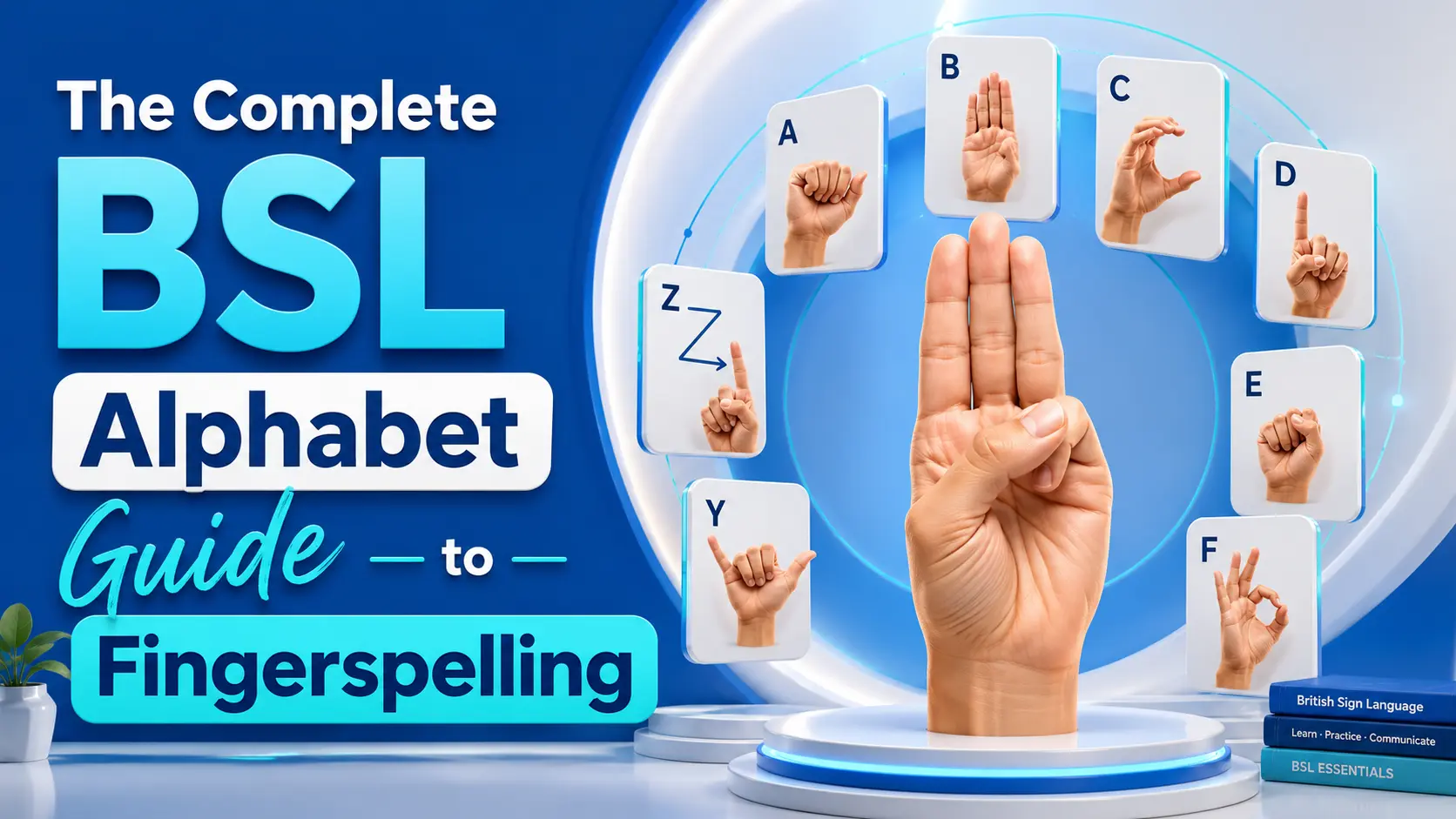
British Sign Language is a complete visual language used by thousands of Deaf people across the UK. For anyone beginning to learn BSL, the alphabet is one of the most practical places to start. It allows you to fingerspell names, places, brands and unfamiliar words when you do not yet know the appropriate sign.
Unlike the one-handed alphabet used in American Sign Language, the BSL alphabet uses both hands to form letters clearly and consistently. Learning these hand shapes helps develop coordination, visual recognition and confidence in everyday communication.
This complete BSL alphabet guide explains how two-handed fingerspelling works, how to form vowels and consonants correctly, and how to improve your speed and accuracy through regular practice. You will also learn how to read fingerspelling, avoid common beginner mistakes and use the manual alphabet naturally within real BSL conversations.
Table of Contents
How BSL Fingerspelling Differs from Other Sign Languages
British Sign Language, or BSL, uses its own distinct two‑handed way of fingerspelling. This is quite different from other sign languages like American Sign Language, Irish Sign Language, or French Sign Language. If you learn the proper BSL method right from the start, you’ll build solid, correct habits and avoid mixing things up , which means you’ll be understood clearly when you talk with people who use BSL every day.The Core Rules of Two-Handed BSL
The two-handed BSL alphabet works in a steady, consistent way, you use your stronger hand to form each letter, while the other acts as a fixed base. Try to keep both hands around chest level, with your arms relaxed, palms turned gently in towards your body, and only make small, smooth movements. If you keep your hands in the right place and form each shape clearly every time, people will find it much easier to follow what you are spelling out.Vowels: The Foundation of the BSL Alphabet
The five vowels follow a simple, logical pattern that makes them easy to memorise. The base hand stays open, palm facing in, fingers slightly apart and pointing upwards. The active hand uses just the index finger to touch specific points on the base hand.- A: Touch the tip of the base thumb.
- E: Touch the tip of the base index finger.
- I: Touch the tip of the base middle finger.
- O: Touch the tip of the base ring finger.
- U: Touch the tip of the base little finger.
Consonants: Shape and Position
The consonants in BSL follow clear, consistent patterns , each one uses its own specific hand shape, position, and sometimes a small movement to stand for the letter. Some are held still, while others, like J and Z, need a smooth, controlled motion to get them right. Once you understand how each shape connects to the letter you already know, it becomes much easier to remember them and form each sign correctly every time.BSL Alphabet Quick Reference Table
Below is a summary of each letter, its formation, and a simple description to help you recall it easily. This table brings together everything covered so you can check your progress at a glance.| Letter | Hand Formation | Short Description |
|---|---|---|
| A–U | Vowel pattern | Index finger touches the tip of the base thumb through to the little finger. |
| B | Both hands open, palms facing | Fingers are together and touching along the sides. |
| C | Curved hands facing each other | Forms the outline of the letter. |
| D | Base index up; active “C” shape | Curves around the tip of the base index finger. |
| F | Two fingers extended on both hands | The active fingers rest across the base fingers. |
| G | Loose fists touching | The active fist rests on top of the base fist. |
| H | Two index fingers parallel | The fingers touch along their full length. |
| J | Start as I, then curve down | Traces the shape of the letter. |
| K | Base index up; active V-shape | Touches the knuckle of the base index finger. |
| L | Base palm open; active L-shape | Rests on the edge of the base hand. |
| M | Three fingers pressed flat | Pressed against the open base palm. |
| N | Two fingers pressed flat | Pressed against the open base palm. |
| P | Base index up; active O-shape | Surrounds the tip of the base index finger. |
| Q | Circle formed by thumb and index finger | The active index finger hooks underneath. |
| R | Index finger pressed to palm | Pressed against the centre of the open base hand. |
| S | Little finger pressed to palm | The other fingers are curled in. |
| T | Index finger touches knuckle | Touches the joint of the base index finger rather than the tip. |
| V | V-shape resting flat | Rests across the open base palm. |
| W | Index fingers crossed | The other fingers are tucked in. |
| X | Bent index finger touches palm | The fingertip is pressed firmly down. |
| Y | Thumb and little finger extended | Rests on the base palm. |
| Z | Zigzag movement | The letter shape is traced in the air above the base hand. |
How to Read Fingerspelling
Knowing how to form each letter yourself is only half the skill. You also have to learn how to read them when someone else is signing , and that usually feels much trickier at first. Why? Because you’re looking at the back of their hands, while they themselves see the front.
The best approach is to focus on the overall shape, instead of trying to work out every single letter one by one. As you keep practising, you’ll naturally start recognising whole words at a glance, rather than spelling them out in your head. This happens automatically once your brain gets used to the most common patterns.
Context makes a big difference too. If you’re chatting about travel, for example, and someone spells out B-A-R-C-E-L-O-N-A, what you’re already talking about will help you fill in the blanks , even if one or two letters aren’t perfectly clear. And don’t worry if you feel slow to start with; it’s completely normal. Most people take months before they can read fingerspelling as fast as they can produce it themselves.
Common Mistakes to Avoid
Even with good intentions, beginners often make the same errors. Being aware of them helps you correct your technique early.
- Changing hands: Switching which hand is active or base makes shapes confusing. Pick one arrangement and stick to it.
- Holding hands too high or low: Hands near the face can look like facial expressions; hands too low are hard to see. Chest height is ideal.
- Moving too fast: Speed comes with practice. Fast, blurred shapes are impossible to read. Clarity is always more important.
- Blocking your mouth or face: In BSL, facial expressions carry meaning. Keep your hands clear so your face remains visible.
Building Speed and Accuracy
Once you can form each letter accurately, the next goal is to work up speed while keeping every movement clear and easy to follow. Begin with short, straightforward words ,your own name, local places, or terms you use regularly in daily life.
As you make each sign, say the letter quietly to yourself or think it through. This helps connect the written, spoken and signed forms in your mind, making recall much easier. You can also test your grasp by spelling words forwards and then backwards; this quickly highlights which letters still feel less familiar.
Recording yourself for a short time is a simple but effective way to track improvement. When you watch the footage back alongside a trusted guide or example, you will often spot small inconsistencies you cannot feel while you are signing.
How Fingerspelling Fits into Full BSL
Fingerspelling works as a supporting tool within British Sign Language, it never stands in place of the language itself. In regular conversation, you use it only for certain words, rather than spelling out every single term in what you want to say.
Common uses include proper names, brand titles, or specialist terms that do not yet have a widely recognised sign. You will also find that words spelled out often eventually develop their own shorter, more natural forms as they come into frequent use.
Mastering the manual alphabet gives you a reliable fallback. If you ever forget or do not know the sign for something, you can always spell it out instead. This extra flexibility builds confidence and lets you take part in discussions much earlier in your learning journey.
Practise Routines for Long-Term Success
What really makes a difference isn’t how long you practice, but how consistent you are. A short session every day works far better than one long, tiring session done just once a week. Even ten to fifteen minutes each day is enough to keep your muscle memory sharp and active.
Here are three simple habits you can easily build into your daily routine:
- Start every practice session by going over the vowel patterns first.
- Learn just five new words each day, and say their spelling out loud as you work through them.
- Watch videos or practise with other learners to get used to reading fingerspelling, this helps train your eyes to recognise shapes quickly.
After a few weeks of sticking to this, you’ll start to notice real progress. The movements and shapes will feel much more natural, and you’ll find yourself needing far less time to think through each individual letter.
Accessing Reliable Learning Resources
Stick to learning resources put together by well‑known, trusted BSL organisations, this way you can be sure you’re picking up proper British Sign Language, and not mixing it up with other types of sign language used around the world. It also makes a big difference to watch people who use BSL as their first language, and join local Deaf groups or online communities. These are great ways to build your confidence with fingerspelling and see exactly how it fits into real, everyday conversations.
Final Thought
Getting to know the BSL alphabet is such an important first step when you’re learning British Sign Language. It’s best to practise often, and focus first on making clear, correct hand shapes before worrying about how fast you can sign. Take your time and keep at it, and soon enough fingerspelling will feel easy and natural ,opening the door to much more inclusive and respectful communication.
Certificate in British Sign Language (BSL) Level 1 & 2
Frequently Asked Questions on The Complete BSL Alphabet Guide to Fingerspelling
The BSL alphabet is a two-handed manual alphabet used to spell individual letters in British Sign Language. It is commonly used for names, places, brands and words that do not have an established sign.
No. British Sign Language generally uses two hands for fingerspelling, while American Sign Language uses a one-handed alphabet. BSL and ASL are separate languages with different signs, grammar and vocabulary.
Use your dominant hand as the active hand and your other hand as the base. Keep this arrangement consistent, as switching hands can make the letters difficult for another person to recognise.
Hold your hands at approximately chest height, with your arms relaxed and your palms facing gently towards your body. This position keeps the signs visible without covering your face.
The vowels are formed by touching different fingertips on the open base hand. The active index finger touches the thumb for A, index finger for E, middle finger for I, ring finger for O and little finger for U.
Many learners can memorise and form the letters within two or three weeks of regular practice. However, reading fingerspelling quickly and using it naturally may take several months.
When reading fingerspelling, you see the signer’s hands from a different angle. The letters may also be formed quickly, so beginners often need time to recognise the overall shapes and common spelling patterns.
Accuracy should always come first. Form each letter clearly and consistently before trying to increase your speed. Signing too quickly can make the hand shapes blurred and difficult to understand.
No. BSL mainly uses signs that represent complete words, concepts and ideas. Fingerspelling is normally used for proper names, unfamiliar terms, brand names and words without a recognised sign.
Practice for around ten to fifteen minutes each day. Begin with the vowels, spell familiar words such as your name and local places, record yourself and practise reading fingerspelling from fluent or native BSL users.
Recent Posts