
Learning Spanish is an exciting goal, whether you want to travel, communicate with more people or develop a valuable new skill. But before getting started, you probably have one important question: how long does it take to learn Spanish?
The answer depends on your goals. You could learn useful travel phrases within a few weeks, develop basic conversational skills over several months and continue improving towards advanced proficiency through regular practice.
Your progress also depends on how much time you dedicate to learning, your previous language experience and how often you practise speaking and listening.
This guide breaks down realistic Spanish learning timelines, explains what different proficiency levels mean and helps you choose a study routine that fits your lifestyle.
Table of Contents
How Long Does It Take to Learn Spanish?
For most English-speaking beginners, learning basic Spanish can take a few months of consistent study. Becoming comfortable with everyday conversations generally requires a longer commitment, while developing advanced proficiency can take several years of part-time learning.
One useful benchmark comes from the US Foreign Service Institute (FSI). Its foreign language training estimates suggest approximately 30 weeks, or 750 classroom hours, for English-speaking diplomats to reach general professional proficiency in Spanish through intensive training.
This represents a structured, full-time learning environment. People studying independently or alongside work may follow a different timeline.
It helps to distinguish between three learning goals:
- Basic Spanish: Introducing yourself, asking simple questions, ordering food and understanding familiar expressions.
- Conversational Spanish: Discussing everyday topics, sharing experiences and managing common social situations.
- Advanced Spanish: Understanding complex discussions, explaining detailed ideas and communicating effectively in professional or academic settings.
The most useful starting point is deciding what you want to achieve. Someone preparing for a holiday in Spain will have different language goals from someone hoping to use Spanish regularly at work.
Limited Time Offer
Complete Spanish Online Course
Beginner to IntermediateGo from the alphabet and greetings to past, present and future tenses. Build the vocabulary and confidence to speak Spanish in everyday situations.
- 18+ Hours of Video
- No Prior Spanish Needed
- 4 Core Modules
- 1 Year Access
$19.99$319You save $299.01
Enrol Now
- 14-Day Money-Back Guarantee
- Self-Paced Learning
- Accredited Certificate Available
Save93%OFF
Spanish Learning Timelines by Level (A1 to C2)
The Common European Framework of Reference for Languages (CEFR) provides a recognised way to describe language proficiency.
Developed by the Council of Europe, it identifies six levels, from A1 to C2. Each level describes the communication skills a learner can demonstrate.
The following table summarises the official CEFR language proficiency levels.
| CEFR level | Proficiency | What you can typically do |
|---|---|---|
| A1 | Beginner | Introduce yourself, use familiar phrases and answer simple questions |
| A2 | Elementary | Manage routine conversations about everyday activities |
| B1 | Intermediate | Discuss familiar subjects, describe experiences and manage common travel situations |
| B2 | Upper intermediate | Communicate more fluently and discuss a wider range of topics |
| C1 | Advanced | Understand demanding material and express complex ideas effectively |
| C2 | Proficient | Understand complex language and communicate with considerable precision |
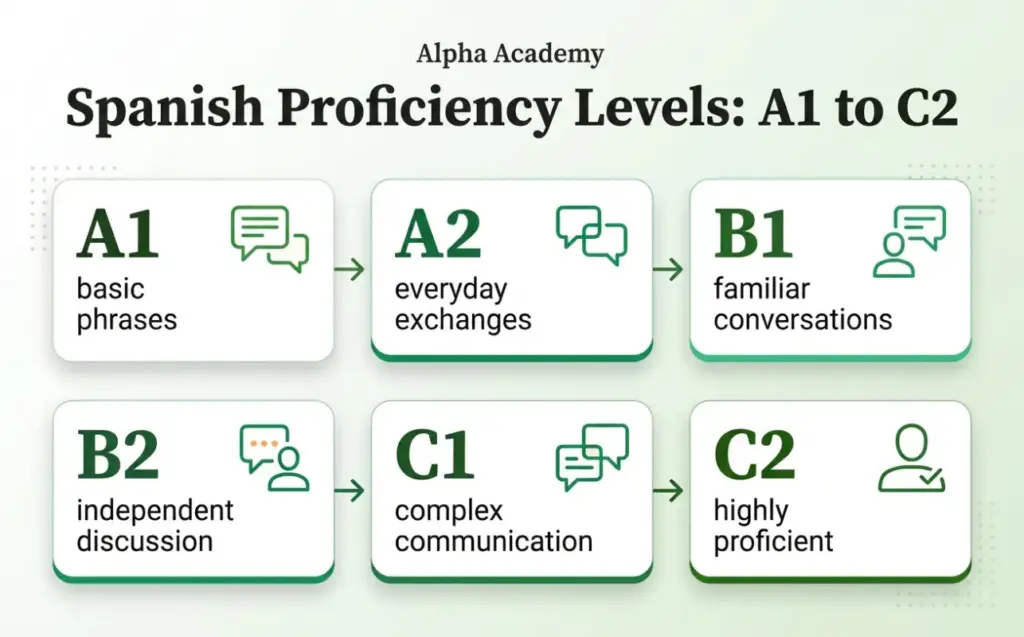
These levels provide useful learning milestones. The time required to reach each one depends on your existing knowledge, study commitment and opportunities to practise.
A1–A2: Beginner Spanish
At A1, you begin building the foundations of Spanish communication.
You learn common greetings, numbers, basic vocabulary and simple sentence structures. For example, you might introduce yourself, order a drink or ask someone where they live.
At A2, you can communicate about more familiar everyday situations, including shopping, travel, hobbies and family.
You also become more comfortable using common verbs and forming simple questions.
An important part of beginner grammar is recognising the difference between ser and estar. Both can mean ‘to be’ in English, but they are used in different situations.
Learning these basic grammatical patterns helps you construct sentences more naturally and prepares you for longer conversations.
B1–B2: Intermediate Spanish
At B1, you can understand the main points of clear conversations about familiar subjects. You may also describe experiences, explain plans and communicate in many situations while travelling.
For example, you might discuss your weekend, explain a problem at a hotel or describe a memorable experience.
B2 represents a further step towards independent communication.
At this stage, learners can discuss a wider range of subjects, express opinions and participate more spontaneously in conversations.
Developing confidence with Spanish verb tenses becomes increasingly important. Moving between present, past and future events allows you to describe experiences and explain your ideas more precisely.
Regular listening and speaking practice helps turn this grammatical knowledge into practical communication.
C1–C2: Advanced Spanish
At C1, learners can understand demanding texts, communicate spontaneously and adapt their language to different situations.
This may include professional discussions, academic subjects and conversations involving more complex ideas.
C2 represents highly developed language proficiency. Learners can understand a wide variety of spoken and written Spanish and communicate subtle meanings with precision.
Reaching these levels usually involves extensive exposure to Spanish through reading, listening, speaking and writing.
It is also worth remembering that language development continues beyond formal proficiency levels. Even experienced speakers keep expanding their vocabulary and refining their communication skills.
How Many Hours a Week Should You Study Spanish?
Your weekly study commitment influences how quickly you build your Spanish knowledge.
For UK adults balancing employment, family responsibilities and other commitments, choosing a manageable learning routine is often the most practical approach.
A realistic schedule gives you regular opportunities to practise without making language learning difficult to maintain.
Comparing 15 Minutes, 30 Minutes and One Hour a Day
The following table shows how different study routines add up over six months
| Study routine | Hours per week | Hours over 6 months |
|---|---|---|
| 15 minutes daily | 1.75 | 45.5 |
| 30 minutes daily | 3.5 | 91 |
| 1 hour daily | 7 | 182 |
| 1 hour, five days weekly | 5 | 130 |
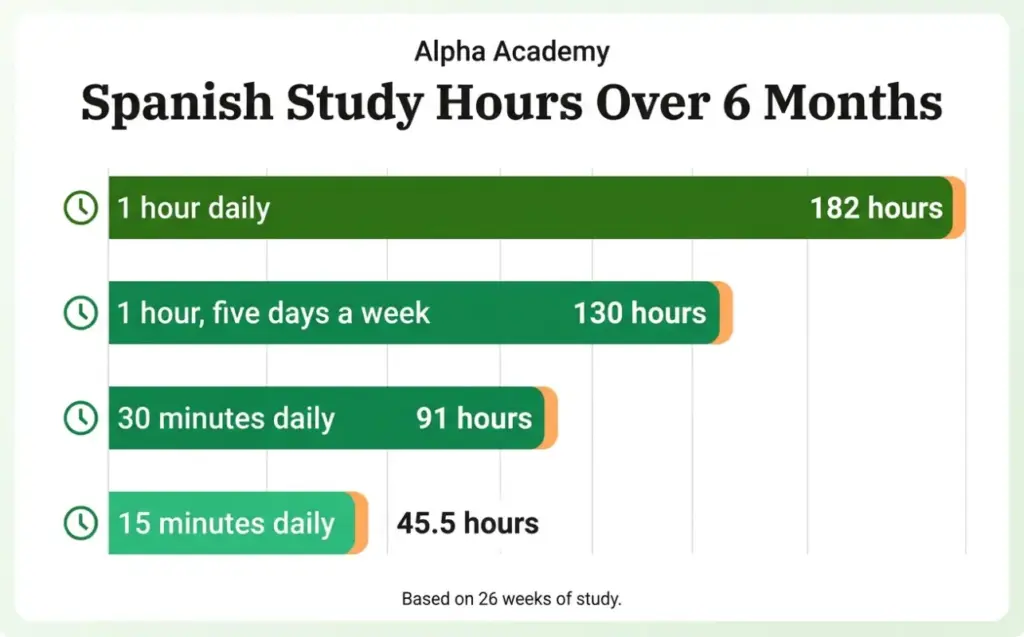
Calculations assume 26 weeks of consistent study. These figures represent total study time rather than guaranteed proficiency outcomes.
Studying for 30 minutes daily gives you approximately 91 hours over six months, or 182 hours over a full year.
That creates valuable opportunities to develop vocabulary, improve listening comprehension and practise speaking.
However, the activities you choose also matter. Spending 30 minutes actively practising Spanish phrases develops different skills from spending the same time watching a grammar lesson.
Combining both approaches can help you develop a more balanced understanding of the language.
Choose a Realistic Weekly Commitment
Start with a schedule that fits naturally into your day.
For example, someone working full-time might review vocabulary during a lunch break, listen to Spanish audio while commuting and complete a longer lesson at the weekend.
If you are preparing for a holiday, you could prioritise practical conversations involving transport, restaurants, shopping and directions.
A step-by-step Spanish learning plan can help you organise these activities into manageable stages, from beginner vocabulary to more advanced communication.
The key is to choose a consistent routine and adjust it as your confidence develops.
Can You Learn Spanish in 3, 6 or 12 Months?
Three months, six months and one year are popular learning targets. Each timeframe can provide opportunities to develop useful Spanish skills, depending on your study routine.
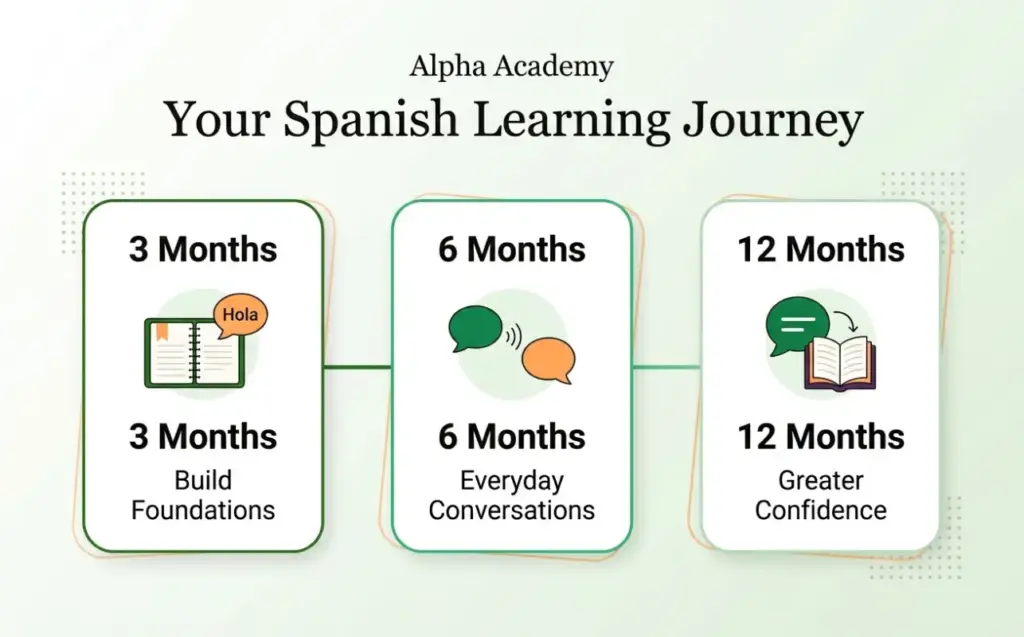
After Three Months
With regular practice, a beginner may become familiar with basic vocabulary, everyday expressions and simple sentence structures.
You might be able to:
- Introduce yourself and discuss basic personal information.
- Ask simple questions.
- Understand common greetings and expressions.
- Recognise familiar words in short conversations.
Your progress will depend on how regularly you practise and whether you include speaking and listening alongside vocabulary study.
After Six Months
Six months of consistent learning can help you build a broader vocabulary and become more comfortable with familiar conversational topics.
You may begin discussing daily routines, hobbies, travel plans and personal experiences in simple Spanish.
This is also a useful stage for strengthening pronunciation, improving listening comprehension and practising conversations without relying entirely on written notes.
After Twelve Months
A year of regular study provides time to reinforce earlier knowledge and develop more independent communication skills.
Depending on your learning intensity, you may become more confident discussing familiar subjects, understanding everyday conversations and expressing opinions.
Consider two learners who both study Spanish for a year.
One spends 15 minutes daily reviewing vocabulary, while the other studies for an hour and regularly practises speaking.
Although both have studied for twelve months, their accumulated learning hours and practical experience will differ considerably.
Measuring what you can communicate is often more useful than counting how many months you have studied.
What Affects How Quickly You Learn Spanish?
Several factors influence how efficiently you develop new language skills.
Your Starting Point and Learning Goals
Your existing knowledge makes a difference.
Someone who studied Spanish at GCSE may already recognise common vocabulary, sentence structures and grammatical rules.
A complete beginner will start by building these foundations.
Knowing another language, particularly a related language such as French or Italian, may also help you recognise familiar vocabulary or grammatical patterns.
Your goals influence your learning priorities.
For example, learning Spanish for a holiday may involve practising everyday phrases and listening skills. Using Spanish in a professional environment may require more specialised vocabulary and confident communication.
English speakers may encounter some challenges when learning Spanish, including verb conjugation, grammatical gender and pronunciation.
These become more familiar as you encounter them regularly through lessons and conversations.
Practice Quality and Language Exposure
The way you practise can be just as important as the amount of time you spend studying.
Reading vocabulary lists helps you recognise words, while speaking practice develops your ability to recall and use them in conversation.
A balanced learning routine might include:
- Listening to short Spanish conversations.
- Practising pronunciation aloud.
- Revising previously studied vocabulary.
- Reading simple Spanish texts.
- Using new expressions in meaningful sentences.
Regular exposure to spoken Spanish can also help you become more familiar with natural pronunciation, sentence patterns and everyday expressions.
How to Make Progress With Limited Study Time
Even a busy weekly schedule can provide opportunities to practise Spanish.
The aim is to use your available learning time effectively.
Use Short, Focused Practice Sessions
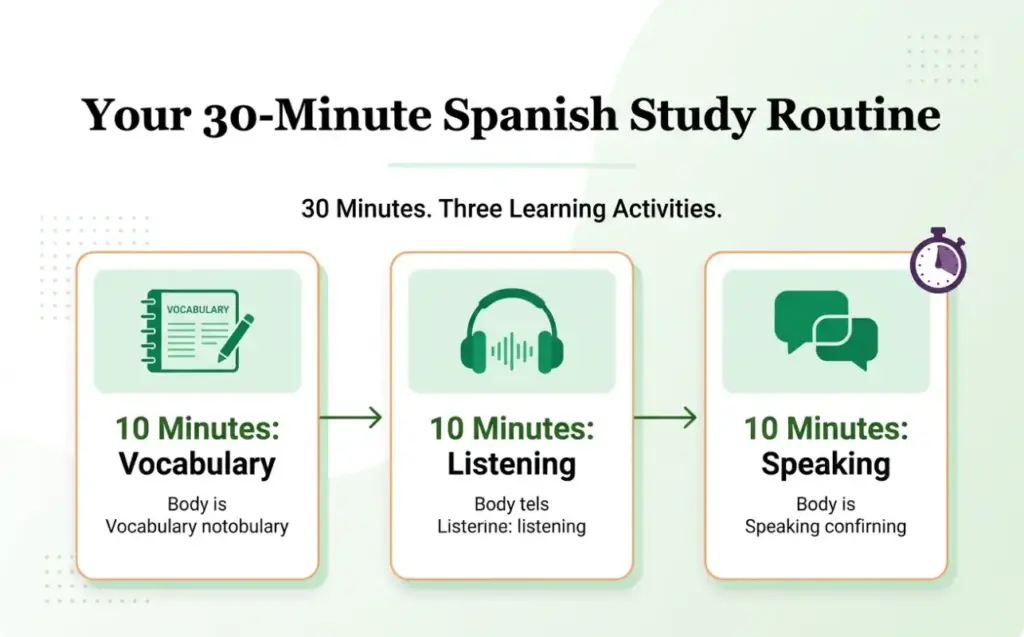
A 30-minute study session could include:
- 10 minutes: Review familiar vocabulary and expressions.
- 10 minutes: Listen to a short Spanish conversation.
- 10 minutes: Practise speaking or constructing sentences.
Choose topics that connect with your interests and learning goals.
For example, after studying food vocabulary, practise ordering a meal in Spanish. After learning travel expressions, try asking for directions or buying a train ticket.
Revisiting earlier material also helps you use familiar language more confidently.
Combine Structured Lessons With Real Practice
Structured lessons provide a clear sequence for developing vocabulary, grammar and communication skills.
For learners who prefer a flexible approach, Alpha Academy’s Complete Spanish Online Course – Beginner to Intermediate covers pronunciation, everyday vocabulary, common verbs and essential Spanish grammar.
The course includes approximately 18 hours and 27 minutes of learning content and allows learners to study at their own pace.
Combining structured lessons with independent listening, speaking and revision can help you apply what you study in real conversations.
Your choice of learning method should reflect your goals, available time and personal preferences.
How Do You Know You’re Making Progress in Spanish?
Progress becomes easier to recognise when you focus on practical communication skills rather than completed lessons alone.
Ask yourself:
- Can I introduce myself without reading prepared sentences?
- Can I understand familiar questions spoken clearly?
- Can I describe something that happened recently?
- Can I maintain a short conversation on an everyday topic?
- Can I understand increasingly detailed written or spoken Spanish?
These questions help you recognise improvements in your vocabulary, listening comprehension and speaking confidence.
The Council of Europe’s CEFR self-assessment grid provides additional descriptions that can help you evaluate your abilities.
As your skills improve, you can introduce more demanding learning materials, set new communication goals and consider choosing an intermediate Spanish course that suits your current level.
Conclusion
Learning Spanish becomes more manageable when you focus on realistic goals and regular practice. Whether you study for 15 minutes or an hour each day, aim to develop practical communication skills, review your progress and gradually build your confidence.
Every consistent learning session brings you another opportunity to use Spanish more naturally.
Frequently Asked Questions About Learning Spanish
Yes. Studying Spanish for 30 minutes daily can support steady progress when you practise consistently. Over 52 weeks, this adds up to 182 hours. Include vocabulary, listening, speaking and revision to develop different language skills.
You may learn useful travel phrases within a few weeks of focused study. Start with greetings, directions, transport, shopping and ordering food. Practising short conversations can help you use these phrases more confidently during your trip.
Yes. You can develop strong Spanish communication skills through online lessons, conversations, Spanish-language media and regular independent practice. Consistent exposure and opportunities to communicate are valuable wherever you live.
Reaching B1 Spanish can take several months to a few years, depending on your starting level, weekly study hours and speaking practice. At B1, you can discuss familiar subjects, describe experiences and manage many everyday situations with greater independence.
Yes, six months of consistent study can help you develop useful Spanish communication skills. You may become comfortable with basic conversations, everyday vocabulary and common grammar. Your progress depends on how regularly you study and practise speaking.
Knowing French may make learning Spanish easier because both languages share Latin roots and have similarities in vocabulary and grammar. However, pronunciation, sentence structures and verb usage still require practice.
Becoming conversational in Spanish may take several months to a year or longer, depending on your study routine and what you consider conversational. Regular speaking and listening practice can help you discuss familiar topics with increasing confidence.
Adults can make strong progress in Spanish, particularly when they use structured lessons and regular practice. Previous learning experience and clear goals can help. Learning speed varies between individuals, so consistent practice is more useful than comparing yourself with younger learners.
Recent Posts
Ser vs Estar: When to Use Each (With Simple Rules and Examples)
November 5, 2026

Online Speech Therapist Training A Beginners Career Guide
August 24, 2026
Stop Guessing SEN: Get a Level 3 Teaching Assistant Diploma Now
August 13, 2026

Top 10 Technologies to Gain a Competitive Advantage in 2026
August 5, 2026
November 10, 2026


