
Planning a trip to Germany? These 50 basic German phrases cover greetings, ordering food, asking for directions, shopping and everyday conversations. Each phrase includes an English translation and practical guidance to help beginners communicate more confidently while travelling.
A few basic German phrases can make a real difference when travelling. Whether you’re ordering coffee in Berlin, checking into a hotel in Munich or asking for directions, knowing what to say makes everyday conversations easier.
These 50 basic German phrases cover greetings, introductions, transport, restaurants, shopping and asking for help. Each phrase includes an English translation and practical guidance on when to use it, with simple example conversations to help you practise.
If you’re starting from scratch, a beginner’s guide to learning German can help you build your vocabulary and practise simple conversations.
Table of Contents
Before You Start: Two Things to Know About German Phrases
Formal and Informal German
German has two common ways of addressing someone:
- Sie is the formal ‘you’, often used with strangers, customers and in professional situations.
- du is the informal ‘you’, generally used with friends, family and people who address each other casually.
When speaking to hotel staff or someone you’ve just met, Sie is usually a polite choice.
A Quick Note on German Pronunciation
German pronunciation has a few distinctive features. For example, ‘w’ generally sounds like English ‘v’, while ‘sch’ sounds like ‘sh’.
The letters ä, ö and ü represent specific vowel sounds. The letter ß is pronounced like ‘ss’.
For speaking practice, it’s worth spending some time practising unfamiliar German sounds before using longer expressions in conversation.
50 Basic German Phrases for Everyday Life and Travel
Learning basic German phrases becomes easier when you connect them to everyday situations. Whether you’re greeting someone, ordering a meal or asking for directions, these 50 expressions can help you communicate more comfortably.
Each phrase includes its English meaning and a brief explanation where useful, so you can recognise when and how to use it.
German
Phrasebook
PDF
Phrasebook
FREE GERMAN TRAVEL RESOURCE
50 Essential German Travel Phrases – Free Printable Phrasebook
Heading to Germany? Take 50 useful German expressions with you, including English translations, pronunciation tips, everyday conversations and a printable pocket cheat sheet.
- 50 German phrases
- English translations
- Travel conversations
- Pocket cheat sheet
- 15-page illustrated PDF
1. German Greetings and Polite Expressions
Greetings are a good place to start. You’ll hear these expressions in shops, cafés, hotels and everyday conversations.
- Hallo — Hello. A friendly greeting suitable for casual situations.
- Guten Morgen — Good morning. Used when greeting someone in the morning.
- Guten Tag — Good day or hello. A polite greeting commonly used during the daytime.
- Guten Abend — Good evening. Used when greeting someone later in the day.
- Tschüss — Bye. A casual way to say goodbye to friends or people you know.
- Auf Wiedersehen — Goodbye. A more formal expression suitable for professional or polite conversations.
- Bitte — Please or you’re welcome. Used when making requests, responding to thanks or handing something to someone.
- Danke schön — Thank you very much. A polite way to express appreciation.
When should you use them?
Use Hallo and Tschüss for casual interactions. Guten Tag and Auf Wiedersehen are appropriate when speaking more formally.
Remember that Bitte can mean different things depending on the conversation. For example, after someone says Danke, you can reply with Bitte to mean ‘you’re welcome’.
2. Introducing Yourself and Making Small Talk
Once you’ve greeted someone, the next step is introducing yourself. These common German phrases can help you start a simple conversation.
- Ich heiße … — My name is … Use this expression to introduce yourself.
- Wie heißen Sie? — What’s your name? A polite, formal way to ask someone’s name.
- Ich komme aus … — I’m from … Use this phrase to tell someone where you come from.
- Freut mich, Sie kennenzulernen. — Pleased to meet you. A polite expression when meeting someone for the first time.
- Wie geht es Ihnen? — How are you? A formal way to ask how someone is feeling.
- Mir geht es gut, danke. — I’m well, thank you. A simple response when someone asks how you are.
- Sprechen Sie Englisch? — Do you speak English? Useful when you need help communicating.
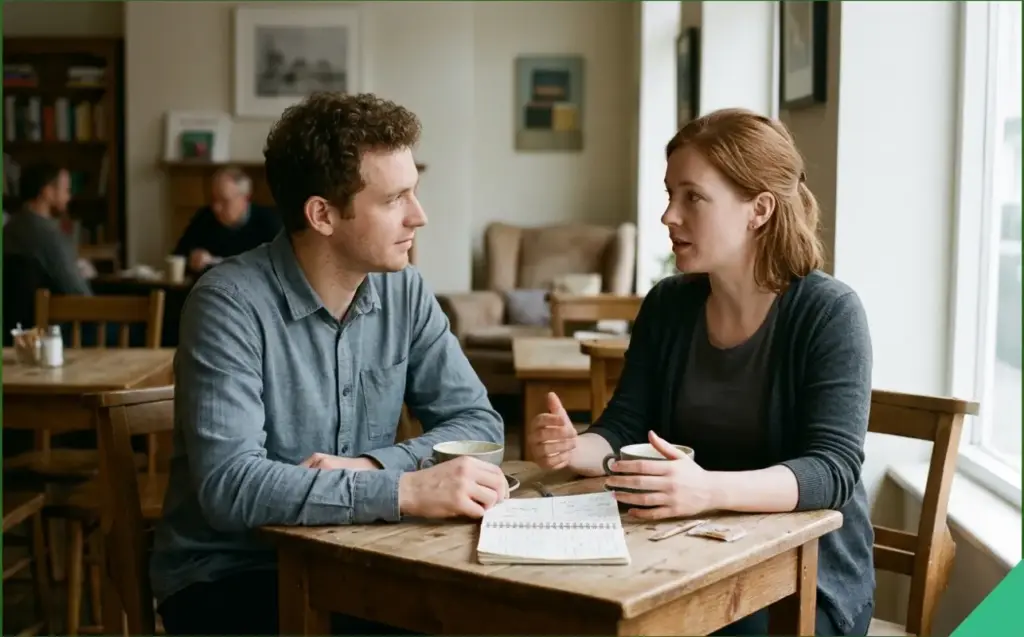
Example conversation:
Person A: Guten Tag! Wie heißen Sie?
(Hello! What’s your name?)
Person B: Ich heiße Anna. Und Sie?
(My name is Anna. And you?)
Person A: Ich heiße David. Freut mich!
(My name is David. Nice to meet you!)
These expressions are useful for simple introductions and personal conversations. Introducing yourself and asking basic questions are also associated with beginner language ability in the Council of Europe’s A1 language-level descriptors.
Introducing yourself and asking simple questions are useful beginner skills. You can also see what you can say at the German A1 level as you build your confidence.
For a more structured introduction to everyday conversations, you could also consider German language lessons for beginners.
3. Asking Questions and Making Yourself Understood
When speaking German, you may sometimes need someone to repeat a sentence or explain something more clearly. These expressions help you keep the conversation going.
- Entschuldigung — Excuse me or sorry. Use it to get someone’s attention or apologise politely.
- Ich verstehe nicht. — I don’t understand. Helpful when you’re unsure what someone has said.
- Können Sie das bitte wiederholen? — Could you repeat that, please? A polite request when you haven’t heard something clearly.
- Können Sie bitte langsamer sprechen? — Could you speak more slowly, please? Useful when someone is speaking too quickly.
- Was bedeutet das? — What does that mean? Use this to ask for the meaning of an unfamiliar word or expression.
- Wie sagt man … auf Deutsch? — How do you say … in German? Helpful when learning new vocabulary.
- Können Sie mir helfen? — Can you help me? A polite way to request assistance.
Example situation:
If someone gives you directions too quickly, you can say:
Können Sie bitte langsamer sprechen?
(Could you speak more slowly, please?)
This gives the other person an opportunity to explain things at a more comfortable pace.
4. German Phrases for Directions and Public Transport
Knowing a few German travel phrases can be particularly useful when using public transport, looking for a station or navigating an unfamiliar city.
- Wo ist der Bahnhof? — Where is the train station? Useful when looking for railway connections.
- Wo ist die nächste Haltestelle? — Where is the nearest stop? Use this when looking for a bus or tram stop.
- Wie komme ich zum Stadtzentrum? — How do I get to the city centre? Helpful when asking for directions.
- Eine Fahrkarte nach Berlin, bitte. — A ticket to Berlin, please. Use this when purchasing a ticket.
- Wann fährt der Zug ab? — When does the train depart? Helpful when checking departure times.
- Ist das der richtige Zug? — Is this the right train? Use this to confirm you’re boarding the correct service.
- Wo kann ich ein Taxi bekommen? — Where can I get a taxi? Useful when arranging local transport.
- Wo ist die Toilette? — Where is the toilet? A practical question in stations, cafés and public places.
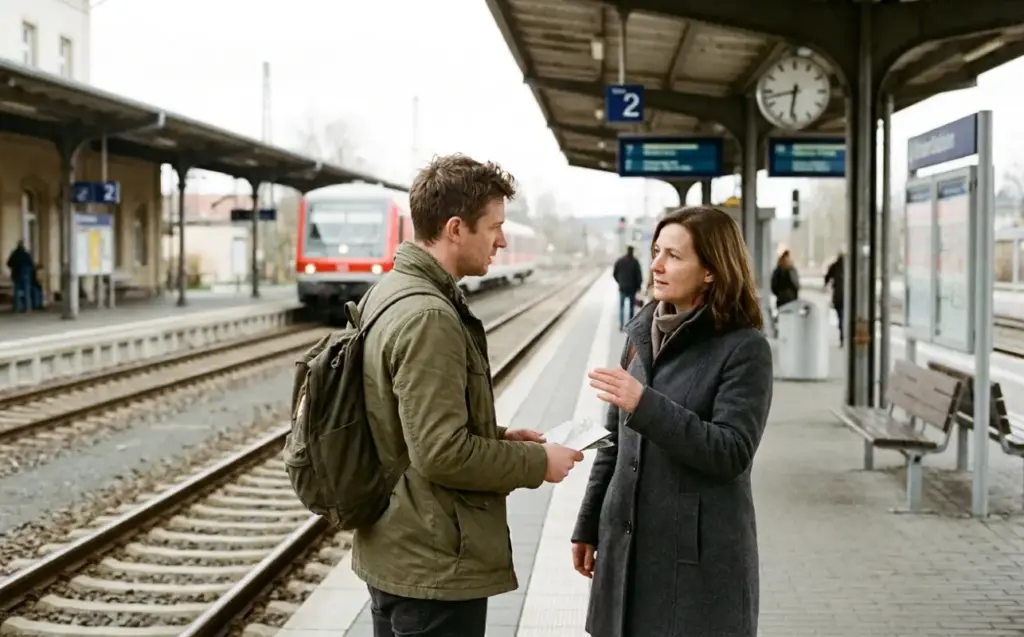
Useful example:
If you’re travelling to Hamburg rather than Berlin, you can say:
Eine Fahrkarte nach Hamburg, bitte.
(A ticket to Hamburg, please.)
You can replace the destination name to make this expression useful for different journeys.
5. Ordering Food and Drinks in German
Restaurants and cafés provide great opportunities to practise everyday German phrases. These expressions can help you order food, ask questions and pay for your meal.
- Einen Tisch für zwei, bitte. — A table for two, please. Useful when entering a restaurant.
- Die Speisekarte, bitte. — The menu, please. A polite way to request a menu.
- Ich hätte gern … — I would like … Use this expression when ordering food or drinks.
- Haben Sie vegetarische Gerichte? — Do you have vegetarian dishes? Helpful when checking available food options.
- Ohne Fleisch, bitte. — Without meat, please. Use this when requesting food without meat.
- Ein Wasser, bitte. — A water, please. A simple way to order water.
- Die Rechnung, bitte. — The bill, please. Use this when you’re ready to pay.
- Kann ich mit Karte bezahlen? — Can I pay by card? Helpful when checking payment options.
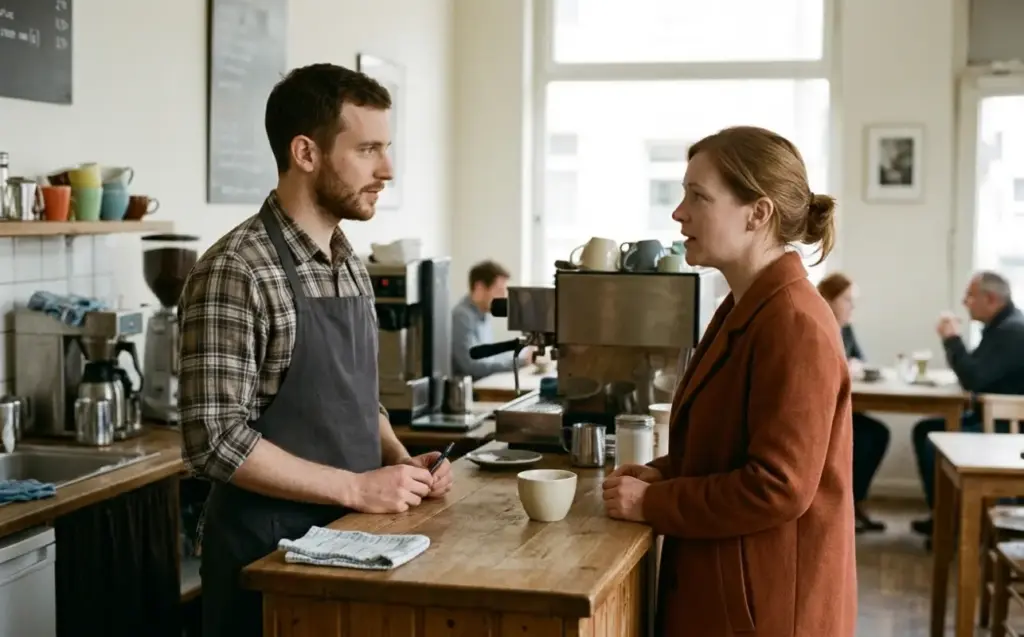
Example conversation:
Customer: Ich hätte gern einen Kaffee, bitte.
(I would like a coffee, please.)
Waiter: Gerne!
(Certainly!)
Customer: Danke schön!
(Thank you very much!)
Notice the expression eine Kaffee. If you’re curious about how German cases affect sentence structure, this is a useful example of how articles change.
6. German Phrases for Hotels and Shopping
Checking into a hotel, asking about breakfast or buying something in a shop are common travel situations. These phrases can help you manage them.
- Ich habe eine Reservierung. — I have a reservation. Use this when arriving at a hotel or another place you’ve booked.
- Ich möchte einchecken. — I would like to check in. A polite way to tell hotel staff you’re ready to check in.
- Wann gibt es Frühstück? — When is breakfast? Helpful when checking breakfast arrangements.
- Wo ist mein Zimmer? — Where is my room? Use this when asking for directions to your room.
- Wie viel kostet das? — How much does that cost? Useful when asking about an item’s price.
- Haben Sie das in einer anderen Größe? — Do you have that in another size? Particularly useful when shopping for clothes.
- Ich nehme das. — I’ll take that. Use this when you’ve decided to purchase something.
Useful example:
Imagine you’re looking at something in a market. You can point to the item and ask:
Wie viel kostet das?
(How much does that cost?)
This expression works for many different products, making it particularly useful when shopping.
7. German Phrases for Emergencies and Asking for Help
These expressions can help you communicate important needs while travelling.
- Hilfe! — Help! Use this when you need immediate assistance.
- Ich brauche einen Arzt. — I need a doctor. Useful when requesting medical assistance.
- Rufen Sie bitte einen Krankenwagen. — Please call an ambulance. A direct request for emergency medical help.
- Wo ist die nächste Apotheke? — Where is the nearest pharmacy? Helpful when looking for a pharmacy.
- Ich habe meinen Pass verloren. — I’ve lost my passport. Useful when explaining that your passport is missing.
Useful example:
If you need medical assistance, you can tell someone:
Ich brauche einen Arzt.
(I need a doctor.)
Speaking clearly and using a short, direct expression can help you communicate your needs.
Limited Time Offer
Learn German Online Course
Complete Beginners Level · A1 to A2+Start from scratch with essential vocabulary, pronunciation and basic grammar. Learn to introduce yourself, ask everyday questions and hold simple conversations in German.
- 16+ Hours of Video
- No Prior German Needed
- 59 Lessons
- 1 Year Access
$19.99$430.65You save $410.66
Enrol Now
- 14-Day Money-Back Guarantee
- Self-Paced Learning
- CPD-Accredited Certificate Available
Save95%OFF
How to Practise Basic German Phrases Every Day
The best phrases to practise are the ones you’re most likely to use. You can begin with greetings, then move towards ordering food or asking questions.
If you’re curious about what makes German challenging for English speakers, start by getting comfortable with everyday expressions and familiar sentence patterns.
Try these five simple steps:
- Choose five phrases related to one situation.
- Say them aloud and listen to native-speaker pronunciation.
- Cover the translations and recall their meanings.
- Create short conversations using phrases you’ve practised.
- Review regularly and introduce new expressions gradually.
A consistent routine can help you become more comfortable with familiar expressions.
As your vocabulary grows, you may also want to consider how long it takes to learn German at different levels when planning your next learning goals.
Learning a language can also complement other professional skills, particularly if you’re thinking about skills that could support future career opportunities.
Start Using Your German Phrases in Real Conversations
Learning these 50 basic German phrases gives you a practical starting point for greetings, everyday questions and travel conversations.
For more structured beginner lessons, Alpha Academy offers the Learn German Language: Complete Beginners Level Course, which you can consider alongside your independent practice.
If you’d like to build on these phrases, Alpha Academy offers structured German lessons for beginners that you can consider alongside your independent practice.
Choose a few expressions that suit your daily activities or travel plans, practise them regularly and enjoy putting your German into use.
Frequently Asked Questions
Some of the most common German phrases include Hallo (Hello), Guten Morgen (Good morning), Danke (Thank you), Bitte (Please/You’re welcome), and Entschuldigung (Excuse me/Sorry). These expressions are useful in everyday conversations, whether you’re greeting someone, shopping or travelling.
You can say Es tut mir leid to express a sincere apology in German. Entschuldigung also means “sorry” or “excuse me” and is commonly used for minor mistakes, interruptions or getting someone’s attention. Both are useful expressions for beginners.
Yes, Danke schön is a common and polite way to say “thank you very much” in German. You can also say Danke for a simple “thank you” or Vielen Dank when expressing greater appreciation. A natural response is Bitte or Gern geschehen, meaning “you’re welcome”.
Yes, Ich heiße is grammatically correct and means “My name is”. For example, Ich heiße Anna means “My name is Anna”. It’s one of the most useful expressions for introducing yourself. You can also say Mein Name ist Anna, which has the same meaning.
The most common ways to say goodbye in German are Tschüss and Auf Wiedersehen. Tschüss is friendly and informal, while Auf Wiedersehen is more formal. You can also say Bis morgen (See you tomorrow) or Bis bald (See you soon), depending on when you expect to meet again.
Basic German can be approachable for English speakers because the two languages share some vocabulary and linguistic roots. Starting with greetings, everyday expressions, and short conversations can make learning more manageable. Regular listening and speaking practice will help you become familiar with German pronunciation and sentence patterns.
Recent Posts

How Long Does It Take to Learn German? Hours by CEFR Level
November 18, 2026

Deaf Awareness in the Workplace: Practical UK Guide
November 16, 2026

Intermediate Spanish Course Online: What to Look For Before You Enrol
November 13, 2026
Spanish Tenses Explained: Present, Past and Future Made Simple
November 12, 2026
Is Spanish Hard to Learn for English Speakers?
November 11, 2026
November 18, 2026


