

A quick conversation, a team meeting or a simple instruction can become frustrating when communication isn’t accessible. For Deaf and hard-of-hearing employees, everyday workplace interactions may involve barriers that colleagues don’t always notice.
The good news is that employers and staff can make meaningful improvements by changing how they communicate and considering individual needs.
Deaf awareness in the workplace means understanding the communication needs of Deaf and hard-of-hearing colleagues and taking practical steps to make work accessible. It involves respectful communication, appropriate workplace adjustments and an inclusive culture where employees can participate equally in meetings, training and everyday activities.
Table of Contents
What Is Deaf Awareness in the Workplace?
Deaf awareness means recognising communication barriers and responding in ways that respect people’s individual needs. It is about creating an environment where Deaf and hard-of-hearing employees can communicate, contribute and access the same workplace opportunities as their colleagues.
Not everyone experiences deafness or hearing loss in the same way. Some people use British Sign Language (BSL), while others communicate through speech, lipreading, written messages or assistive technology.
People also have different preferences about the terms used to describe them. Respecting those preferences is part of inclusive communication.
According to RNID’s communication guidance, asking someone how they prefer to communicate is an important starting point.
Deaf awareness is not simply about knowing sign language. It also involves understanding accessibility, respecting individual preferences and removing unnecessary workplace barriers.
How to Communicate With Deaf Colleagues: 7 Practical Tips
Knowing how to communicate with deaf colleagues can make everyday interactions easier and more comfortable. These seven approaches are useful starting points, although individual preferences should always come first.
1. Ask About Communication Preferences
Rather than assuming what someone needs, ask them directly.
One colleague may prefer written instructions, while another may use BSL or find face-to-face communication helpful. A simple question such as, “What’s the best way for us to communicate?” encourages respectful discussion.
2. Get Their Attention Before Speaking
Make sure your colleague knows you are addressing them before starting a conversation.
A small wave or another agreed visual gesture may help. Avoid calling across a room and assuming they have heard you.
3. Face the Person and Speak Naturally
Keep your face visible when speaking, particularly if your colleague uses lipreading.
Speak clearly at a natural pace. Shouting, exaggerating mouth movements or turning away can make communication more difficult.
4. Reduce Background Noise
Busy offices, classrooms and staff rooms can present communication challenges.
Where possible, move conversations to quieter areas, close unnecessary doors or reduce competing sounds. Ask your colleague whether these changes are helpful.
5. Take Turns During Conversations
Group discussions can become difficult to follow when several people speak simultaneously.
Encourage colleagues to speak one at a time, particularly during meetings. This also makes discussions easier to follow when captions or interpreters are being used.
6. Share Important Information in Writing
Written communication can support spoken conversations.
Meeting notes, clear instructions, messages and written action points help employees review important details without relying entirely on verbal information.
7. Be Patient and Check Understanding
If something isn’t clear, try rephrasing it rather than repeating the same words more loudly.
Checking that instructions are accessible is useful, but avoid repeatedly testing whether a Deaf colleague has understood. Communication should be a shared responsibility.
Practical example: If a colleague misses an action point during a meeting, provide a written summary and agree on a more accessible approach for future discussions.
Limited Time Offer
British Sign Language (BSL) Certificate
Level 1 & 2 · Beginner to IntermediateLearn fingerspelling, everyday signs and basic conversation in British Sign Language, then build towards intermediate skills, all at your own pace.
- Level 1 & 2 in One
- No Prior BSL Needed
- Fingerspelling & Everyday Signs
- 1 Year Access
$19.99$430.65You save $403.66
Enrol Now
- 14-Day Money-Back Guarantee
- Self-Paced Learning
- CPD-Accredited Certificate Available
Save94%OFF
How Employers Can Support Deaf Employees at Work
Supporting deaf employees in the workplace involves more than encouraging colleagues to communicate politely. Employers should consider how everyday systems, meetings and working arrangements affect accessibility.
Make Meetings and Everyday Communication Accessible
Meetings should allow everyone to participate.
Employers can discuss suitable arrangements with employees and consider measures such as:
- Providing meeting agendas beforehand.
- Arranging appropriate captioning or BSL interpreting support.
- Encouraging one person to speak at a time.
- Ensuring participants remain visible during video meetings.
- Sharing written decisions and action points afterwards.

Automatic captions can help in some circumstances, but accuracy varies. They may not provide sufficient support for every employee or situation.
RNID offers guidance on making working environments accessible and inclusive, including communication arrangements and workplace support.
Support Recruitment, Induction and Staff Development
Workplace inclusion should begin before someone’s first day.
Employers should consider accessible interviews, induction materials and training arrangements. GOV.UK’s guidance on applying for jobs explains that communication support may be available for interviews.
Managers should also consider accessibility during appraisals, professional development activities and other opportunities.
Build an Inclusive Workplace Culture
A deaf-friendly workplace is one where employees feel comfortable discussing communication barriers without being singled out.
Managers can encourage respectful communication, provide appropriate staff awareness activities and invite feedback about accessibility.
Individual arrangements should be reviewed when responsibilities, working environments or communication needs change.
PDF
FREE DOWNLOAD · FILLABLE PDF
Free Deaf-Friendly Workplace Toolkit
Make your workplace more accessible with practical checklists and editable templates for inclusive communication, accessible meetings and reasonable adjustments.
- 20-point workplace checklist
- Fillable templates
- Accessible meetings guide
- 14-page PDF
Reasonable Adjustments for Deaf Employees in the UK
Workplace accessibility is not only a matter of good practice. Employers also have legal responsibilities in certain circumstances.
What Does UK Employment Law Require?
Under the Equality Act 2010, employers in England, Scotland and Wales must make reasonable adjustments for disabled workers and applicants where the relevant legal conditions apply.
These adjustments aim to remove or reduce disadvantages connected with disability.
According to Acas guidance on reasonable adjustments, what is reasonable depends on the individual’s circumstances, how effectively an adjustment addresses the barrier and practical considerations.
Northern Ireland has separate disability discrimination legislation, including the Disability Discrimination Act 1995. Its employment protections are explained in nidirect’s disability discrimination guidance.
Not every Deaf or hard-of-hearing employee will need the same adjustments. Employers should discuss individual circumstances rather than relying on assumptions.
Examples of Reasonable Adjustments
The following examples show how employers might address common communication barriers.
| Workplace Barrier | Possible Adjustment |
|---|---|
| Difficulty following spoken meetings | BSL interpreting, suitable captioning or communication support |
| Background noise affecting communication | Quieter meeting spaces or appropriate listening equipment |
| Missing important announcements | Written messages or accessible visual notifications |
| Difficulty detecting audible emergency alarms | Suitable visual or other accessible emergency arrangements |
| Barriers during online meetings | Agreed captioning, clear turn-taking and written summaries |
These are possible adjustments, not automatic legal requirements in every workplace.
For example, an employee who relies on BSL may need interpreting support for certain meetings, while another employee may find written information or assistive listening technology more suitable.
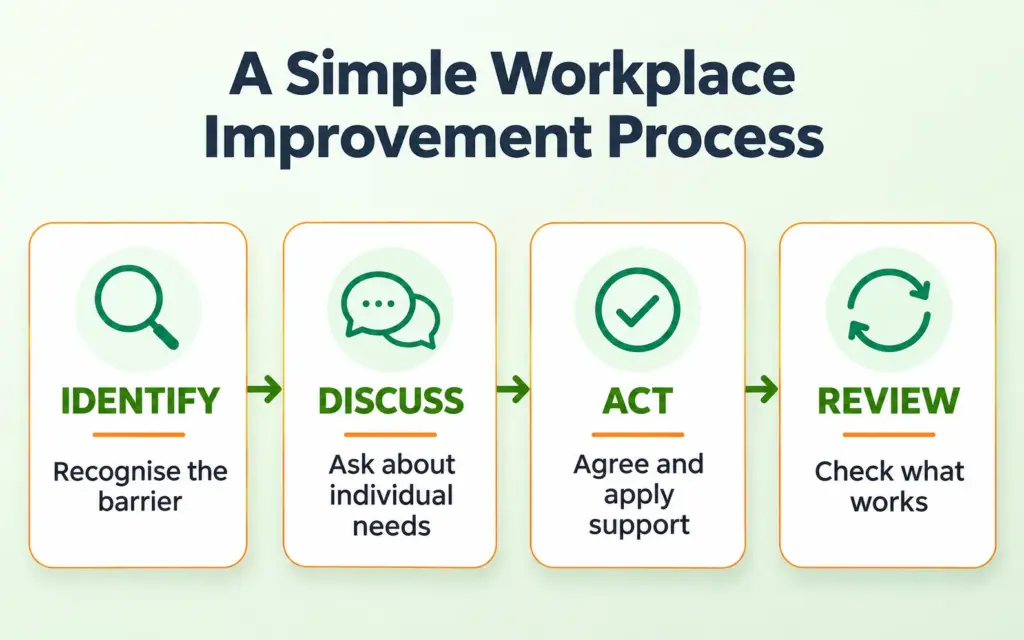
The best approach is to identify the barrier, discuss appropriate support, implement agreed changes and review whether they work.
Can Access to Work Help?
Access to Work is a government programme that may provide practical or financial support for eligible disabled people in England, Scotland and Wales.
Depending on individual circumstances, this may include communication support, specialist equipment or BSL interpreting.
However, Access to Work does not replace an employer’s legal duty to make reasonable adjustments.
The GOV.UK Access to Work guidance for employers explains the programme and its limitations. Northern Ireland operates a separate support system.
Deaf Awareness at Work: Three Everyday Scenarios
Understanding deaf awareness becomes easier when you consider familiar workplace situations.
Scenario 1: A Team Meeting Is Difficult to Follow
A Deaf employee struggles to follow a discussion because colleagues frequently speak over one another.
A practical response: The manager introduces clear turn-taking, arranges appropriate communication support and shares written action points afterwards.
This allows the employee to contribute without constantly requesting clarification.
Scenario 2: A New Employee Needs Accessible Induction
A new employee misses important information during a spoken induction session.
A practical response: The employer discusses their preferred communication method and provides suitable materials or support.
Accessible induction helps employees receive important information from the beginning.
Scenario 3: Communication in a Busy Care Workplace
A care worker finds it difficult to follow a colleague’s instructions in a noisy environment.
A practical response: They move to a suitable quieter area where possible and use an agreed communication method.

For healthcare and social care professionals, BSL for healthcare and care workers is a useful related topic, particularly when considering communication with patients who use sign language.
These are illustrative workplace scenarios rather than accounts of specific employees.
How Deaf Awareness Training Can Help Your Team
Deaf awareness training in the workplace can help employees understand communication differences, recognise barriers and develop more inclusive everyday habits.
Useful training may cover communication preferences, Deaf culture, accessible meetings and respectful workplace behaviour.
However, awareness training and learning British Sign Language are not the same thing. BSL is a language, and learning it requires practice. Not every Deaf or hard-of-hearing person uses BSL.
For those interested in developing basic sign language skills, Alpha Academy offers a British Sign Language (BSL) Certificate: Level 1 & 2. The online course introduces fingerspelling, everyday vocabulary and basic BSL communication.
Learners interested in progressing their skills may also find it helpful to consider what they’ll learn at BSL Level 2 and how those skills build on introductory BSL knowledge.
BSL learning can complement workplace awareness, but it does not replace individual adjustments or professional interpreting support where needed.
Making Your Workplace More Accessible
Deaf awareness in the workplace starts with listening to people’s needs and communicating respectfully.
For employers, this means identifying barriers, considering appropriate adjustments and making accessibility part of everyday working practices. For colleagues, it means being thoughtful, adaptable and willing to communicate differently.
No single approach works for everyone. The most useful first step is to ask what support would make communication easier—and act on the answer.
Frequently Asked Questions About Learning Spanish
There is no general UK legal requirement for every employer to provide a course specifically called Deaf awareness training. However, applicable disability discrimination law and reasonable-adjustment duties must still be followed. Training alone does not establish legal compliance.
Not necessarily. BSL is valuable when communicating with people who use it, but communication preferences vary. Employers should ask individuals what works best rather than assuming everyone needs sign language.
Small businesses can begin by discussing communication preferences, making meetings accessible and considering suitable workplace adjustments. Regular feedback helps identify whether existing arrangements meet employees’ needs.
Ask which communication support would help, agree on an appropriate immediate response and provide accessible meeting information. Consider whether future meetings need different arrangements to prevent the same barrier recurring.
Recent Posts
Spanish Tenses Explained: Present, Past and Future Made Simple
November 12, 2026

Is Spanish Hard to Learn for English Speakers?
November 11, 2026

How Long Does It Take to Learn Spanish? Realistic Timelines by Level
November 10, 2026

Barriers in Health and Social Care for Autistic People
November 9, 2026

Ser vs Estar: When to Use Each (With Simple Rules and Examples)
November 5, 2026
November 16, 2026


