

Is German hard to learn? German is moderately difficult for English speakers because of its three grammatical genders, four cases and different sentence structures. However, English and German share many related words, and German spelling is often more predictable than English spelling.
You do not need previous language-learning experience to get started. Once you recognise a few important patterns and practise regularly, German becomes much more manageable.
Let’s look at what makes German challenging, what works in your favour and how to approach the language with confidence.
Table of Contents
Is German Really Difficult for English Speakers?
German is generally manageable for English-speaking beginners, although some grammatical features require extra practice.
English and German belong to the West Germanic language family. This shared background explains why words such as Haus (house), Winter (winter) and Hand (hand) look familiar.
Basic sentences can also resemble English. For example, Ich trinke Wasser means “I drink water”, following the same subject–verb–object pattern.
The difficulty increases when you begin using grammatical cases, changing word order or forming longer sentences.
However, your learning goal makes a difference. Holding a simple conversation during a holiday requires different skills from writing professional documents or studying at a German university.
For most beginners, the best approach is to build useful communication skills first and gradually become comfortable with German grammar.
What Makes German Hard to Learn?
The hardest parts of German for many English speakers are grammatical gender, four cases, word order and unfamiliar sounds. Each becomes easier to manage when you recognise its patterns and practise using it in short sentences.
1. German Grammar, Genders and Cases
German nouns have three grammatical genders, each associated with a definite article:
- Der – masculine, as in der Tisch (the table).
- Die – feminine, as in die Lampe (the lamp).
- Das – neuter, as in das Buch (the book).
Since noun gender is not always obvious from meaning, it helps to learn the article and noun together.
German also has four grammatical cases: nominative, accusative, dative and genitive. These help show the role of a noun or pronoun within a sentence.
Consider this example:
Der Hund sieht den Mann. – The dog sees the man.
Here, der Hund is the subject, while den Mann is the direct object. The masculine article changes from der to den to reflect its grammatical role.
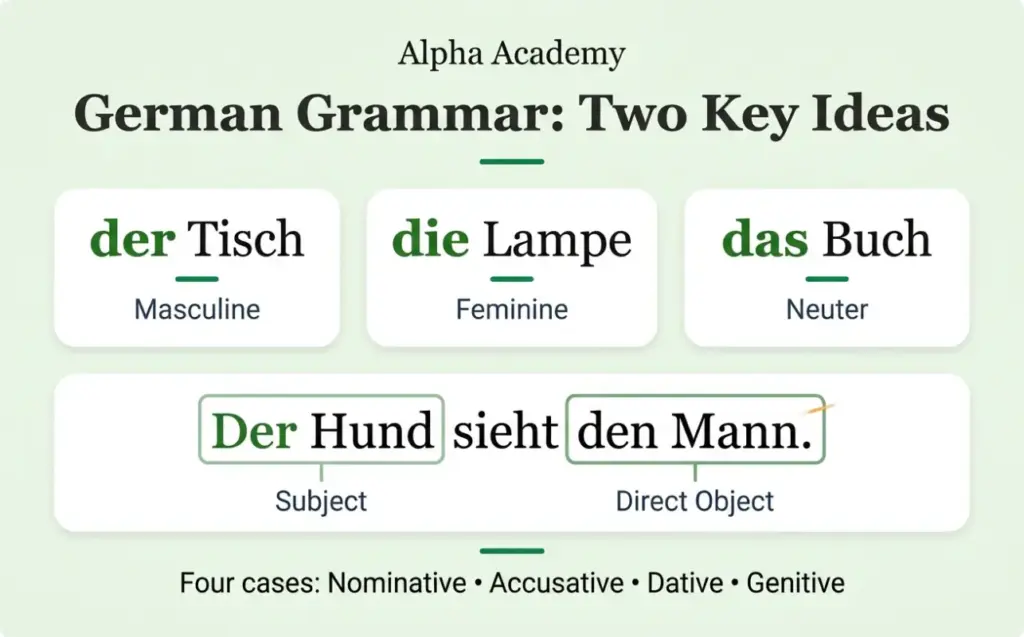
Once you recognise these patterns, it becomes easier to see how German cases work in everyday sentences.
Der, Die or Das?
About 3 minutes
Free German gender quiz
Der, Die or Das? German Noun Gender Quiz
Guess the gender of 15 everyday nouns and spot the clues that give it away.
dermasculine
diefeminine
dasneuter
- 1Pick der, die or das
- 2See the clue
- 3Get your score
Loading the quiz… If it doesn’t start, refresh the page.
dasMädchen
English: girl
derdiedas ✓
See all der, die, das rules
der · masculine
- Days, months and seasons Reliableder Montag, der Mai, der Sommer
- Endings -ling, -ismus, -ig Reliableder Schmetterling, der Tourismus, der Honig
- Male people Reliableder Lehrer, der Vater
- Most weather words Patternder Regen, der Schnee, der Wind
die · feminine
- Endings -ung, -heit, -keit, -schaft, -tät Reliabledie Zeitung, die Freiheit, die Universität
- Ending -ion, almost always Reliabledie Information, die Station
- Women ending in -in Reliabledie Lehrerin, die Ärztin
- Most nouns ending in -e Patterndie Lampe, die Blume (but der Junge)
das · neuter
- Ending -chen Reliabledas Mädchen, das Brötchen
- Verbs used as nouns Reliabledas Essen, das Schwimmen
- Most endings -um, -ment, -o Patterndas Museum, das Dokument, das Auto
- Many words starting with Ge- Patterndas Geschenk, das Getränk
- Children and baby animals, often Patterndas Kind, das Baby
Plural tip: in the basic form, every plural noun takes die: die Tische, die Bücher. No rule? Learn the noun with its article as one unit: der Tisch, die Milch, das Buch.
Reliable very few or no exceptions Pattern usually true, with some exceptions
2. German Sentence Structure and Word Order
German word order follows some familiar English patterns, but it also has important differences.
Compare these sentences:
Ich lerne Deutsch. – I am learning German.
Heute lerne ich Deutsch. – Today I am learning German.
In the second sentence, lerne stays in the second position even though the sentence begins with heute.
This is an example of the German verb-second rule, which applies to ordinary declarative main clauses.
In many subordinate clauses, the finite verb moves towards the end.
Instead of translating English sentences word for word, practise common German sentence patterns. Over time, these structures will become more familiar.
3. German Pronunciation and Long Words
German pronunciation can feel unfamiliar at first, but many sounds become easier once you recognise how certain letters are pronounced.
For example, the German letter w usually sounds like the English v. The letter combination ch can sound different depending on the word, while vowels with umlauts, such as ä, ö and ü, need some extra listening practice.
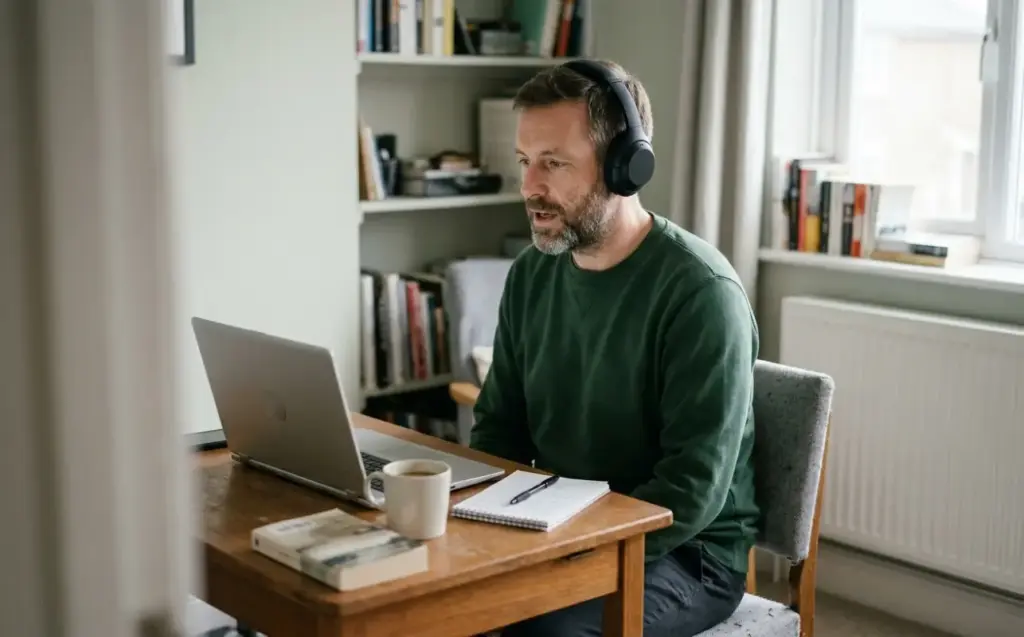
One helpful approach is to listen to short German words and repeat them aloud. Regular practice is especially useful when working on German sounds that need extra practice.
Long German words may also look complicated, but they are often made by joining smaller words together.
For example, Handschuh means “glove” and combines Hand (hand) with Schuh (shoe). Once you recognise these smaller parts, longer words become easier to remember.
4. Adjective Endings
German adjectives change their endings depending on the noun’s gender, its case and the article before it:
- der gute Kaffee – the good coffee
- ein guter Kaffee – a good coffee
- mit gutem Kaffee – with good coffee
Many learners find this one of the hardest parts of German. Learn adjectives in short, useful phrases, and focus first on the most common patterns. People will still understand you if an ending is wrong, so don’t let it stop you speaking.
5. Separable Verbs
Some German verbs split in two. The prefix moves to the end of the sentence:
- anrufen (to call): Ich rufe dich morgen an. – I’ll call you tomorrow.
- aufstehen (to get up): Ich stehe um sieben Uhr auf. – I get up at seven o’clock.
Learning common prefixes such as an-, auf- and mit- helps you spot these verbs quickly.
6. Formal and Informal “You”
German has more than one word for “you”. Use du with friends, family and children, and Sie (always capitalised) with strangers, older people and in professional settings:
- Wie geht’s dir? – How are you? (informal)
- Wie geht es Ihnen? – How are you? (formal)
If you’re unsure, use Sie. Germans will usually invite you to switch to du when it’s appropriate.
💡 Study tip: Don’t try to master every grammar rule at once. Pick one challenge each week, such as articles or word order, and practise it in 5–10 short sentences about your own life.
Which Parts of German Are Hardest, and What Helps?
German has several features that require practice, but each becomes more manageable with the right approach.
Swipe left to see the full table →
| German Feature | Why It’s Hard | What Helps |
|---|---|---|
| Noun genders | German uses three articles (der, die, das), and noun gender is not always obvious. | Learn each noun with its article, such as der Tisch (the table), rather than memorising the noun alone. |
| Four grammatical cases | Articles and other word forms change depending on their grammatical role in a sentence. | Start with simple sentences that clearly show who is doing something and who receives the action. |
| German word order | Verbs sometimes appear in different positions compared with English. | Practise short sentences such as Ich lerne Deutsch (I am learning German) to recognise common patterns. |
| Pronunciation | Some German sounds, including ch and the umlauted vowels, are unfamiliar to English speakers. | Listen to short German recordings and repeat words and expressions aloud regularly. |
| Compound words | Long words can look complicated because several smaller words are combined. | Break words into meaningful parts, such as Zahnbürste (toothbrush): Zahn (tooth) + Bürste (brush). |
The key is to focus on one challenge at a time. As you become familiar with German vocabulary, sounds and sentence patterns, using the language in everyday situations will gradually feel more natural.
Alpha Academy / Free learning resource
German Grammar Survival Kit
Make tricky German grammar feel more manageable with a beautifully illustrated beginner's workbook. Practise the essentials, check your answers and build confidence at your own pace.
- Der, die, das made simple
- Four German cases
- Word-order practice
- Fillable exercises & answers
Download free workbook
12-page PDF · Printable & fillable · No sign-up
ALPHA ACADEMY
GERMAN
GRAMMAR
SURVIVAL KIT Beginner's illustrated workbook
GRAMMAR
SURVIVAL KIT Beginner's illustrated workbook
FREE PDFA1
What Makes German Easier for English Speakers?
Despite its grammatical challenges, German offers several advantages to English speakers.
Shared Words and Familiar Vocabulary
Because English and German share linguistic roots, many everyday words have recognisable similarities.
| English | German |
|---|---|
| House | Haus |
| Water | Wasser |
| Hand | Hand |
| Winter | Winter |
| Mother | Mutter |
These similarities can make learning your first German words feel more approachable.
However, some German words look like English words but mean something different. These are known as false friends:
| German Word | Looks Like | Actually Means |
|---|---|---|
| bekommen | become | to receive or get |
| Gift | gift | poison |
| Rat | rat | advice |
| bald | bald | soon |
| also | also | so, therefore |
| Handy | handy | mobile phone |
| aktuell | actual | current, up to date |
| Chef | chef | boss |
Learning vocabulary through useful everyday German phrases helps you recognise how words function in real conversations.
More Predictable Spelling and Recognisable Patterns
German spelling-to-sound relationships are generally more consistent than those in English.
Once you recognise common letter combinations, you can often make a reasonable attempt at pronouncing an unfamiliar German word.
German also has many recognisable sentence patterns.
Although grammar remains important, you can begin communicating through short expressions while gradually building more accurate sentences.
Familiar Alphabet, Simpler Tenses and Shared Loanwords
German uses the same Latin alphabet as English, plus four extra letters: ä, ö, ü and ß. All nouns start with a capital letter, which makes them easy to spot when you read.
German also has no separate continuous tense. Ich lerne means both “I learn” and “I am learning”. In everyday conversation, people mainly use one past tense, the perfect tense, as in Ich habe Deutsch gelernt (I learned German).
You may already know some German. English uses words such as kindergarten, rucksack and angst, and German uses English words such as das Team, das Internet and der Computer.
Limited Time Offer
Learn German Online Course
Complete Beginners Level · A1 to A2+Start from scratch with essential vocabulary, pronunciation and basic grammar. Learn to introduce yourself, ask everyday questions and hold simple conversations in German.
- 16+ Hours of Video
- No Prior German Needed
- 59 Lessons
- 1 Year Access
$19.99$430.65You save $410.66
Enrol Now
- 14-Day Money-Back Guarantee
- Self-Paced Learning
- CPD-Accredited Certificate Available
Save95%OFF
Common Myths About Learning German
German’s reputation is often bigger than the reality. Here are some common myths, and what’s actually true:
| Myth | Reality |
|---|---|
| “You need perfect grammar before you can speak.” | Beginners can communicate with short phrases. Accuracy improves with practice, and small mistakes rarely stop people understanding you. |
| “German is harsh and hard to pronounce.” | German pronunciation follows consistent rules, and most of its sounds exist in English. Only a few, such as ch and ü, need extra practice. |
| “Every German word is extremely long.” | Long words are usually short words joined together, such as Handschuh (glove) = Hand + Schuh. |
| “Adults are too old to learn German.” | Adults can learn German successfully with regular practice, clear goals and a structured approach. |
| “Everyone in Germany speaks English, so there’s no point.” | Many Germans speak English, but German helps with everyday life, travel, work and deeper conversations. |
Is German Harder to Learn Than Spanish or French?
German may feel harder than Spanish or French when studying grammatical cases and article changes.
Spanish and French do not use the same four-case noun system found in German. However, they present different challenges, including verb conjugations, grammatical gender and pronunciation.
German has its own advantages, particularly its shared Germanic roots with English and relatively consistent spelling patterns.
There is no single language that is easiest for every English speaker. Your interests, previous experience and opportunities to practise all influence how manageable a language feels.
How Long Does It Take to Learn Basic German?
The time needed to learn German depends on how regularly you study, your previous language experience and what you want to achieve.
Learning basic greetings and introducing yourself will usually require less practice than maintaining detailed conversations.
For a clearer perspective, it helps to consider realistic German learning timelines at different proficiency levels.
A useful starting goal is A1, the first level of the Common European Framework of Reference for Languages (CEFR).
According to the Goethe-Institut’s official A1 language-level descriptions, A1 learners can use familiar everyday expressions, introduce themselves and communicate in simple situations when others speak slowly and clearly.
Knowing what you can do at A1 level gives you a practical first milestone without expecting advanced fluency immediately.
How Can You Make Learning German Easier?
Learning German becomes easier when you follow a manageable routine and practise the language in situations you recognise.
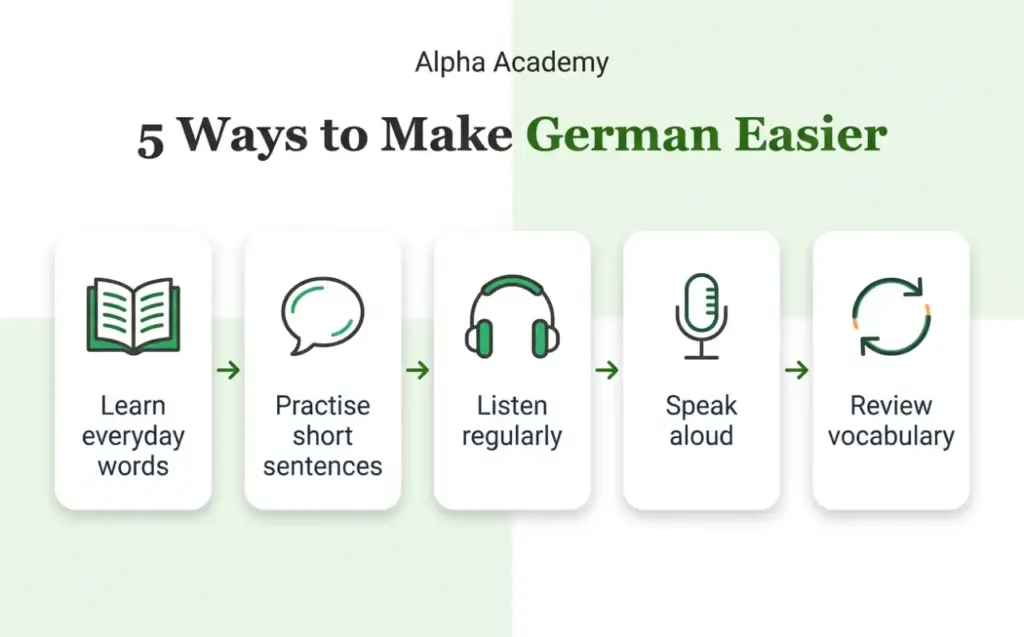
Start With Everyday Words and Short Sentences
Begin with greetings, introductions, food, travel vocabulary and common questions.
Rather than memorising isolated words, practise them in simple sentences.
For example:
Das ist ein Buch. – That is a book.
Ich lese ein Buch. – I am reading a book.
These examples help you learn vocabulary and sentence construction together.
Practise Listening and Speaking Regularly
Listening helps you recognise natural pronunciation, rhythm and commonly used expressions.
Try playing short beginner recordings, repeating sentences aloud and practising simple questions and answers.
Even a focused 10–15-minute session can become a useful daily learning habit.
Speaking practice is equally important. You can start with greetings and everyday expressions while developing greater grammatical accuracy over time.
Follow a Structured Beginner Learning Plan
A clear learning sequence helps you build knowledge gradually.
Alpha Academy’s German language course is another option for learners who want to begin with everyday vocabulary and basic grammar.
Start with basic vocabulary and pronunciation, then introduce simple grammar, questions and everyday conversation.
A beginner-friendly German learning plan can help you organise these skills and maintain steady progress.

If you prefer guided online lessons, Alpha Academy’s Learn German Language: Complete Beginners Level Course covers introductory vocabulary, pronunciation, grammar, sentence formation and everyday communication.
It offers a structured starting point for complete beginners who want to develop practical German language skills.
Is German Worth Learning in the UK?
German can be a valuable language for UK learners interested in travel, culture, education or international communication.
Knowing basic German can make trips to Germany, Austria and German-speaking regions of Switzerland more enjoyable.
It may also be useful in professional environments involving international business, tourism, customer service, or communication with German-speaking clients.
For adults learning independently, German offers a rewarding opportunity to develop a new skill.
Whether your goal is travel, personal interest or professional development, building German language skills can make communicating across cultures more enjoyable and meaningful.
Conclusion: So, Is German Hard to Learn?
German has some challenging features, particularly grammatical gender, cases and sentence structure. However, its similarities with English provide a useful advantage.
With consistent practice, familiar vocabulary and a structured learning approach, you can gradually build your German skills.
The best way to make German easier is to start with simple communication, practise regularly and build on what you already know.
Frequently Asked Questions
For many English speakers, the hardest parts are grammatical gender, the four cases and sentence structure. These features become more manageable through regular practice with familiar vocabulary and short sentences.
Yes. You can develop beginner German skills through online lessons, listening exercises, reading and regular speaking practice. A structured routine helps you build vocabulary and grammar knowledge progressively.
Adults can successfully begin learning German without previous experience. Starting with everyday vocabulary, setting manageable goals and practising consistently can help you develop confidence and useful communication skills.
No. You can start speaking German using basic greetings, introductions and short expressions. As you practise, you can gradually improve your grammar and develop more natural sentence structures.
German can feel harder for English speakers because of its grammatical genders, four cases and sentence structure. However, English has its own difficulties, particularly irregular spelling and pronunciation. The difficulty depends largely on your native language and previous learning experience.
No, 70 is not too old to start learning German. Older adults can develop language skills through regular practice, familiar vocabulary and manageable lessons. Learning at your own pace makes it easier to build confidence and enjoy the process.
Recent Posts

50 Basic German Phrases for Beginners and Travellers
November 17, 2026

Deaf Awareness in the Workplace: Practical UK Guide
November 16, 2026

Intermediate Spanish Course Online: What to Look For Before You Enrol
November 13, 2026
Spanish Tenses Explained: Present, Past and Future Made Simple
November 12, 2026

Is Spanish Hard to Learn for English Speakers?
November 11, 2026
November 19, 2026


