
Have you ever tried to describe something in Spanish but struggled to choose the right verb? You might know how to say ‘speak’, ‘eat’ or ‘go’, but the words change depending on whether you’re talking about yesterday, today or tomorrow.
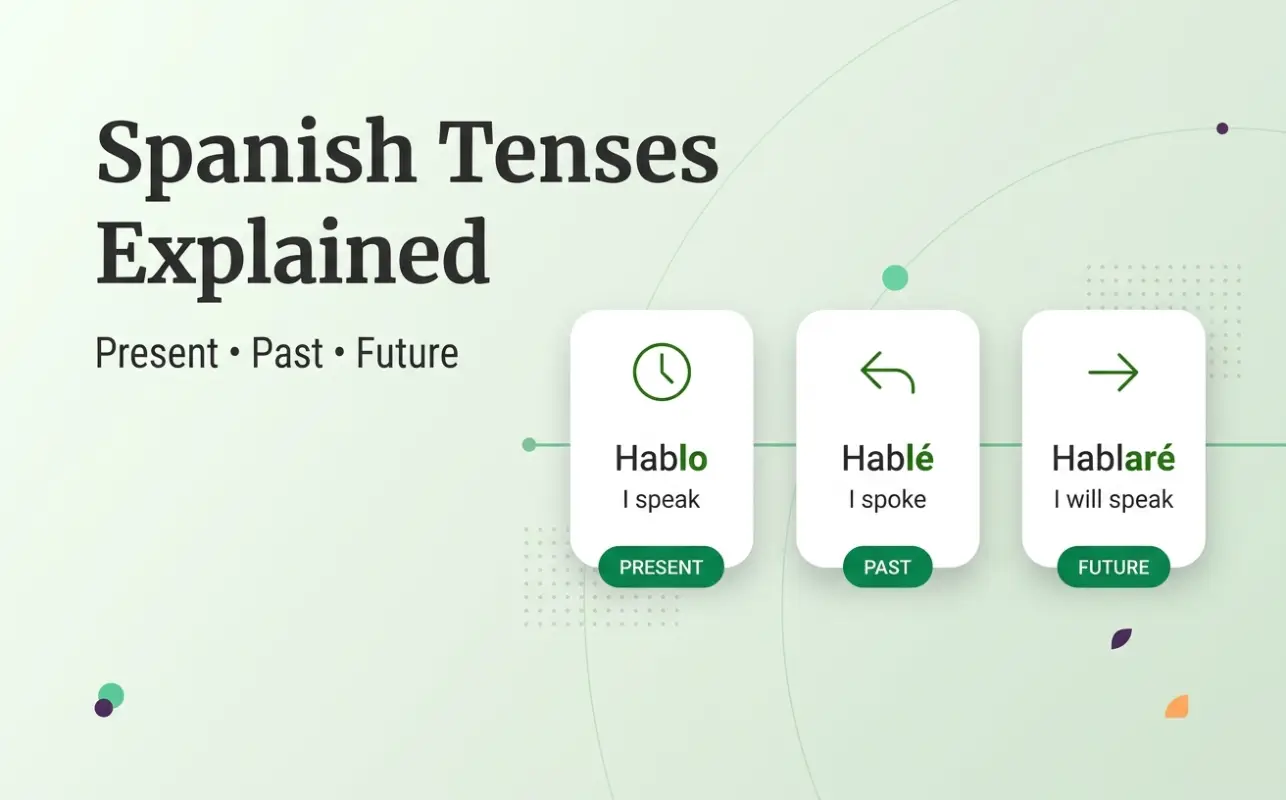
Spanish tenses explain when an action happens: in the present, past or future. For example, hablo means ‘I speak’, hablé means ‘I spoke’, and hablaré means ‘I will speak’.
Spanish has several verb tenses, but learning the most common forms gives you a practical foundation for everyday conversations.
This guide explains Spanish present, past and future tenses with simple conjugation rules, examples, comparison tables and practice activities.
Table of Contents
What Are Spanish Verb Tenses?
Spanish verb tenses are grammatical forms that indicate when something happens. They also help express whether an action is completed, repeated or ongoing.
Spanish verbs change their endings more extensively than English verbs, depending on who performs the action and when it happens.
For example:
- Hablo español. — I speak Spanish.
- Hablas español. — You speak Spanish.
- Hablamos español. — We speak Spanish.
Changing a verb to match its subject and tense is called verb conjugation.
If you’re building your grammar knowledge from the beginning, following a step-by-step Spanish learning plan can help you study these concepts in a practical order.
Most Spanish verbs belong to three groups:
| Verb group | Example | English meaning |
|---|---|---|
| -ar | Hablar | To speak |
| -er | Comer | To eat |
| -ir | Vivir | To live |
These basic forms are called infinitives. To conjugate regular verbs, you usually remove the infinitive ending and add the appropriate ending.
Spanish also has grammatical moods, such as the indicative and subjunctive. This article focuses on common indicative forms used to describe everyday actions and events.
Spanish Tenses Chart: Present, Past and Future at a Glance
The following Spanish tenses chart shows how the verb hablar (to speak) changes across different time frames.
| Tense | Spanish example | English meaning |
|---|---|---|
| Present | Yo hablo | I speak |
| Preterite | Yo hablé | I spoke |
| Imperfect | Yo hablaba | I used to speak |
| Near future | Voy a hablar | I am going to speak |
| Simple future | Yo hablaré | I will speak |
Each form communicates something different about the action.
The present describes current situations or habits. The preterite describes completed past events, while the imperfect often describes past habits or ongoing circumstances. Future constructions express what will happen or what someone intends to do.
Understanding these differences makes choosing the correct verb easier.
Spanish Present Tense: How to Talk About Now
The Spanish present tense, called presente de indicativo, is commonly used to describe routines, facts, habits and current situations.
For example:
- Trabajo en una oficina. — I work in an office.
- Estudio español todos los días. — I study Spanish every day.
- Vivo en Londres. — I live in London.
How to Form the Spanish Present Tense
Regular Spanish verbs follow predictable conjugation patterns.
Remove the infinitive ending (-ar, -er or -ir) and add the ending that matches the subject.
| Subject | Hablar | Comer | Vivir |
|---|---|---|---|
| Yo (I) | Hablo | Como | Vivo |
| Tú (you) | Hablas | Comes | Vives |
| Él/Ella (he/she) | Habla | Come | Vive |
| Nosotros (we) | Hablamos | Comemos | Vivimos |
| Vosotros (you plural) | Habláis | Coméis | Vivís |
| Ellos/Ellas (they) | Hablan | Comen | Viven |
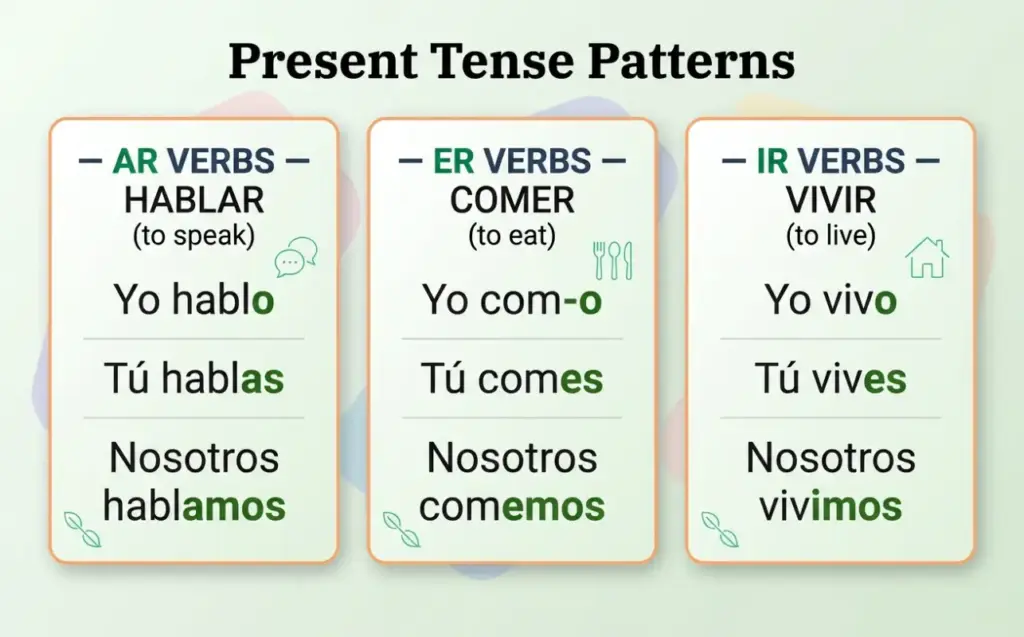
These patterns also apply to many other regular verbs.
Spanish frequently omits subject pronouns because the verb ending already identifies the subject. For example, hablo español means ‘I speak Spanish’ without needing yo.
Common Irregular Verbs in the Present Tense
Some frequently used verbs have irregular forms.
| Infinitive | First-person present | Meaning |
|---|---|---|
| Ser | Soy | I am |
| Estar | Estoy | I am |
| Tener | Tengo | I have |
| Ir | Voy | I go |
Both ser and estar mean ‘to be’, but they express different meanings depending on the situation.
For example:
- Soy estudiante. — I am a student.
- Estoy cansado. — I am tired.
Learning when to use ser and estar helps you describe people, feelings, locations and everyday situations more accurately.
Spanish Past Tenses: Preterite vs Imperfect
Spanish uses different past-tense forms depending on how an action is presented. Two essential ones are the preterite and imperfect.
Preterite: Actions That Happened and Finished
The preterite (pretérito indefinido) is commonly used for completed past events.
Examples:
- Ayer estudié español. — Yesterday I studied Spanish.
- Compré un libro. — I bought a book.
- Visitamos Madrid el año pasado. — We visited Madrid last year.
Regular first-person preterite forms include:
| Infinitive | Preterite | Meaning |
|---|---|---|
| Hablar | Hablé | I spoke |
| Comer | Comí | I ate |
| Vivir | Viví | I lived |
Other subject forms have different endings, and some common verbs follow irregular patterns.
Imperfect: Past Habits, Descriptions and Background
The imperfect (pretérito imperfecto) describes past habits, repeated activities, descriptions and situations that were ongoing.
Examples:
- Cuando era niño, jugaba al fútbol. — When I was a child, I used to play football.
- Antes vivía en Londres. — I used to live in London.
- Hacía frío. — It was cold.
For regular first-person imperfect forms, -ar verbs take -aba, while -er and -ir verbs take -ía.
Preterite vs Imperfect: What’s the Difference?
Compare these examples:
| Preterite | Imperfect |
|---|---|
| Ayer estudié español. | Antes estudiaba español todos los días. |
| Yesterday I studied Spanish. | I used to study Spanish every day. |
| Anoche llovió. | Llovía cuando salí. |
| It rained last night. | It was raining when I went out. |
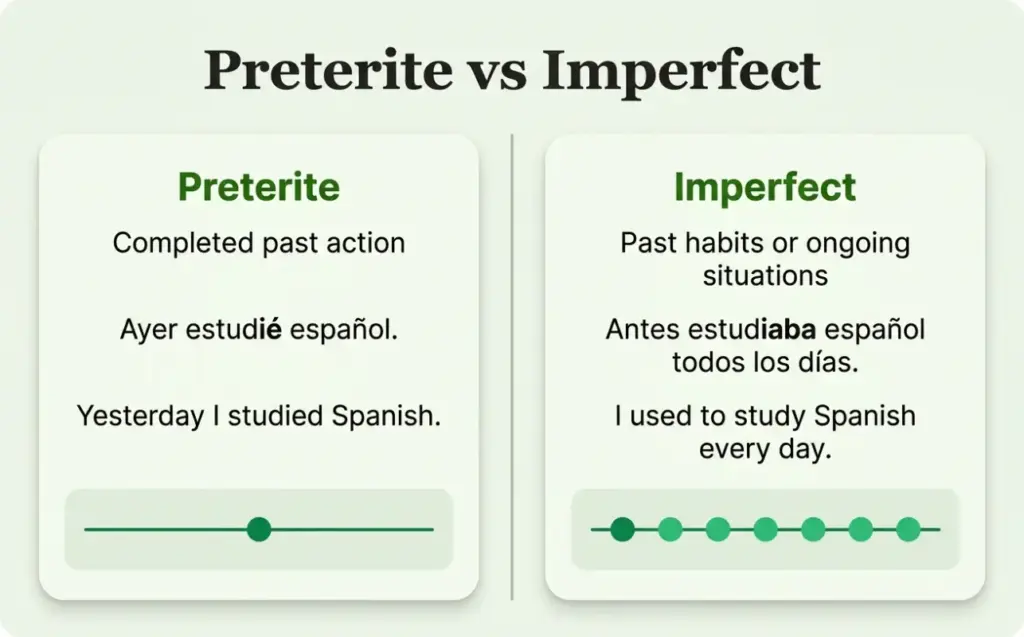
The main distinction is how the past event is presented. The preterite shows a completed event, while the imperfect describes a habit, background situation or ongoing past action.
Spanish also has a present perfect tense, formed using haber and a past participle.
For example:
He estudiado español. — I have studied Spanish.
Its usage varies between Spanish-speaking regions, so learning the main past-tense distinctions first provides a useful foundation.
Limited Time Offer
Complete Spanish Online Course
Beginner to IntermediateGo from the alphabet and greetings to past, present and future tenses. Build the vocabulary and confidence to speak Spanish in everyday situations.
- 18+ Hours of Video
- No Prior Spanish Needed
- 4 Core Modules
- 1 Year Access
$19.99$319You save $299.01
Enrol Now
- 14-Day Money-Back Guarantee
- Self-Paced Learning
- Accredited Certificate Available
Save93%OFF
Spanish Future Tenses: How to Talk About Tomorrow
Spanish commonly expresses future actions using the near future and simple future.
Near Future: Ir a + Infinitive
The near-future construction is useful for talking about plans and intentions.
Formula: Conjugated form of ir + a + infinitive
Examples:
- Voy a estudiar mañana. — I am going to study tomorrow.
- Vamos a viajar a España. — We are going to travel to Spain.
- Ella va a cocinar esta noche. — She is going to cook tonight.
This construction is particularly helpful in everyday conversations because it uses the present tense of ir with another verb.
Simple Future: Verb + Future Ending
For regular verbs, the simple future adds endings directly to the complete infinitive.
Using hablar:
| Subject | Simple future |
|---|---|
| Yo | Hablaré |
| Tú | Hablarás |
| Él/Ella | Hablará |
| Nosotros | Hablaremos |
| Ellos/Ellas | Hablarán |
Example:
Mañana hablaré con mi profesor. — Tomorrow I will speak with my teacher.
Both voy a hablar and hablaré can express future actions. The choice depends on context, intention and the emphasis the speaker wants to convey.
Common Spanish Tense Mistakes and How to Avoid Them
Small changes to verb endings can affect the meaning of a Spanish sentence.
Here are some common mistakes and their corrections:
| Common mistake | Correct form | Explanation |
|---|---|---|
| Yo habla español. | Yo hablo español. | The first-person present ending is -o. |
| Ayer hablo con Ana. | Ayer hablé con Ana. | The preterite expresses this completed past event. |
| Voy estudiar mañana. | Voy a estudiar mañana. | The near future requires a before the infinitive. |
| Cuando era niño, jugué todos los días. | Cuando era niño, jugaba todos los días. | The imperfect is more natural for a repeated childhood habit. |
Another useful distinction concerns English continuous forms.
For example, ‘I am studying’ can be translated as estudio in many contexts. You can also use estoy estudiando to emphasise an action in progress.
Practising complete sentences helps you understand when each form sounds natural.
Verb endings and tense choices are among the common challenges for English-speaking learners, but regular practice can make these patterns more familiar.
Which Spanish Tenses Should Beginners Learn First?
A practical way to learn Spanish tenses is to study the most useful forms in stages.
- Present tense: Describe routines, facts and everyday activities.
- Near future: Talk about plans using ir a + infinitive.
- Preterite: Explain completed past events.
- Imperfect: Describe past habits and ongoing situations.
- Simple future: Discuss future actions and possibilities.
This progression helps you develop different types of sentences without studying every grammatical form at once.
These tenses are also relevant to learners studying Spanish at GCSE. The AQA GCSE Spanish grammar requirements include present, past and future constructions, with different expectations for Foundation and Higher tiers.
Your learning pace will depend on previous experience, practice and study consistency. Having an idea of realistic Spanish learning timelines can also help you plan your study routine around your current level and goals.
Regularly using new forms in meaningful sentences is particularly valuable.
How to Practise Spanish Tenses

One effective practice method is to take a simple sentence and change its time frame.
For example:
- Present: Hoy hablo español. — Today I speak Spanish.
- Past: Ayer hablé español. — Yesterday I spoke Spanish.
- Future: Mañana hablaré español. — Tomorrow I will speak Spanish.
You can repeat this exercise using verbs such as comer, vivir and estudiar.
Alongside conjugation exercises, practising vocabulary, pronunciation and everyday phrases can help you build a foundation in Spanish.
Quick Spanish Tenses Exercise
- Complete the present-tense sentence:
Yo _____ (comer) arroz.
- Change the sentence into the preterite, using ayer:
Hoy estudio español.
- Complete the near-future sentence:
Nosotros _____ a viajar mañana.
Answers:
- Como
- Ayer estudié español.
- Vamos
Try creating your own sentences about what you do today, what you did yesterday and what you plan to do tomorrow.
If you prefer organised lessons, Alpha Academy’s Complete Spanish Online Course – Beginner to Intermediate covers present, past and future tenses alongside vocabulary and everyday communication. It provides a structured way to develop these language skills.
Conclusion
Spanish tenses become easier to understand when you connect verb endings with their meaning. The present helps describe everyday life, the preterite and imperfect explain past events, and future constructions help you discuss plans and upcoming activities.
Start with common verbs, practise short sentences and gradually explore more complex forms. As your grammar and conversation skills develop, knowing what to look for in intermediate Spanish lessons can help you choose a suitable next stage of study. With consistent practice, choosing the appropriate Spanish tense will become increasingly natural.
Frequently Asked Questions About Learning Spanish
Different grammar resources count Spanish verb forms differently. Some list 16 or 18 forms, depending on whether they include particular moods, compound forms and commands. Beginners can start with the common forms used in everyday communication.
You can begin with essential present, past and future forms. As your confidence develops, learning additional forms will help you express more detailed meanings.
Tense indicates when an action happens. Mood expresses how the speaker presents the action, such as a fact, wish, possibility or command.
The three main time categories are present, past and future. The present describes current actions or habits, the past refers to previous events, and the future expresses upcoming actions. Spanish has different verb forms within these categories.
The present tense is a practical starting point for beginners. Regular verbs such as hablar, comer and vivir follow predictable conjugation patterns, making it easier to practise everyday sentences.
Think about when the action happens and what you want to express. Use the present for routines, the preterite for completed past events, the imperfect for past habits, and future constructions for upcoming actions.
You can communicate many basic ideas using the present tense, including routines, facts and current situations. Learning past and future forms will help you describe previous experiences, make plans and express yourself more clearly.
All three forms come from hablar (to speak), but they express different times. Hablo means ‘I speak’, hablé means ‘I spoke’, and hablaré means ‘I will speak’. The verb ending changes to indicate the tense.
Recent Posts

How Long Does It Take to Learn Spanish? Realistic Timelines by Level
November 10, 2026

Barriers in Health and Social Care for Autistic People
November 9, 2026
Ser vs Estar: When to Use Each (With Simple Rules and Examples)
November 5, 2026

Online Speech Therapist Training A Beginners Career Guide
August 24, 2026
November 12, 2026


