
You know some Spanish, but choosing what to study next isn’t always straightforward. One course promises intermediate grammar, another focuses on conversation, and a third starts with lessons you may already know.
Choosing an intermediate Spanish course online means checking your current level, course curriculum, speaking and listening activities, learning format, feedback and certificate details. Look for clear learning outcomes and realistic entry requirements. The right course should match your existing knowledge and help you practise the Spanish you want to use.
Before enrolling, it’s worth knowing which features matter and what questions to ask.
Table of Contents
What Level Should You Be Before Starting Intermediate Spanish?
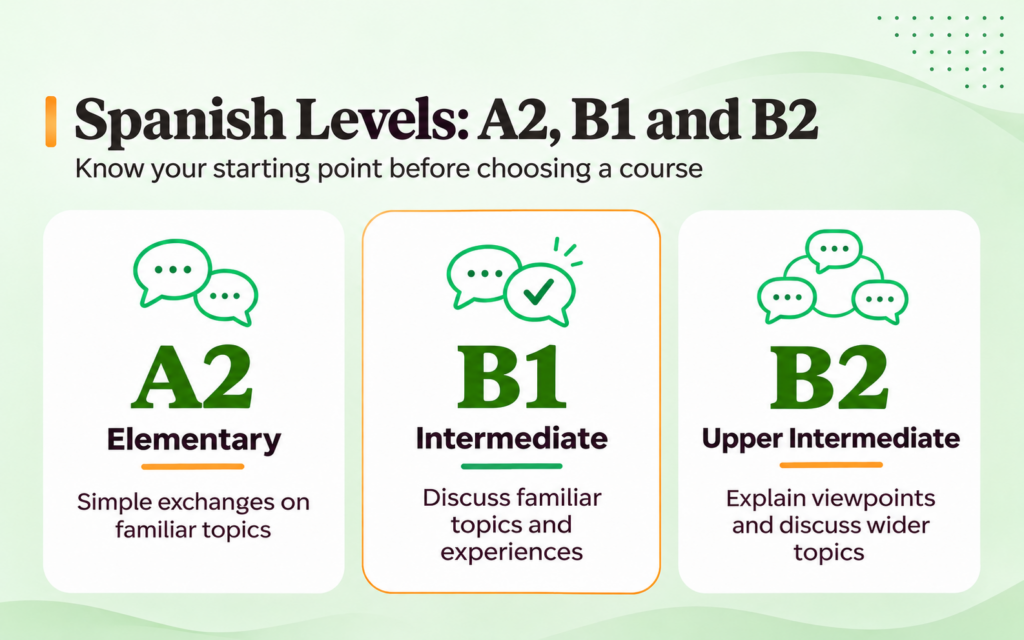
Most learners moving towards intermediate Spanish encounter three proficiency levels: A2, B1 and B2.
These come from the Common European Framework of Reference for Languages (CEFR), which describes language ability through practical communication skills.
According to the Council of Europe’s CEFR self-assessment grid, the levels broadly represent the following abilities:
Swipe left to see the full table →
| CEFR Level | General Language Ability | Course Suitability |
|---|---|---|
| A2 – Elementary | Handle simple exchanges about familiar, everyday matters | May suit courses preparing learners for B1 |
| B1 – Intermediate | Discuss familiar subjects, describe experiences and manage many common travel situations | Often suitable for learners ready for intermediate study |
| B2 – Upper intermediate | Discuss more complex topics, explain viewpoints and interact with greater fluency | Suits learners with stronger existing Spanish skills |
These levels describe what learners can do, not simply which grammar topics they’ve studied.
If you sit somewhere between A2 and B1, you don’t have to choose between repeating beginner lessons and jumping straight into advanced grammar. A beginner-to-intermediate course lets you strengthen the foundations quickly, then move on to intermediate structures in the same programme.
Are You Ready for B1? A Quick Self-Check
Try answering these questions in Spanish without translating word by word from English. If you can do most of them comfortably, you’re likely ready for intermediate study.
- Can you introduce yourself and talk about your family, work or studies?
- Can you describe what you did last weekend using the past tense?
- Can you explain your plans for next week?
- Can you follow a short, slow conversation about everyday topics?
- Can you ask and answer simple questions in a shop, café or hotel?
If two or more feel difficult, start by strengthening the basics. Our guide on how to learn Spanish can help you identify which skills to work on first, and is Spanish hard to learn explains the common sticking points learners face and how to get past them. A placement test or sample lesson can also show whether a course starts at the right level for you.
What Should an Intermediate Spanish Course Online Include?
A suitable intermediate course should move beyond isolated vocabulary and introduce opportunities to use Spanish in meaningful situations.
However, a long curriculum isn’t necessarily a good curriculum. What matters is whether the lessons develop skills appropriate to your current knowledge and intended outcomes.
A Clear Curriculum That Builds on Your Existing Spanish
Start with the syllabus. An online intermediate Spanish course should explain its entry requirements, learning outcomes and topics. For someone progressing from A2 towards B1, useful lessons might cover:
- Describing past experiences and future plans.
- Expressing preferences, opinions and reasons.
- Asking more detailed questions.
- Understanding everyday conversations.
- Connecting sentences to communicate longer ideas.
Check that lessons become progressively more demanding. A course that keeps repeating beginner vocabulary offers too little progression, while one that starts with advanced grammar before reviewing essential concepts can make learning unnecessarily hard.
Grammar and Vocabulary You Can Use in Context
Intermediate Spanish involves applying familiar language more flexibly while introducing additional grammar and vocabulary.
Depending on the course level, relevant topics may include past tenses, future expressions, object pronouns, conditional sentences and the subjunctive.
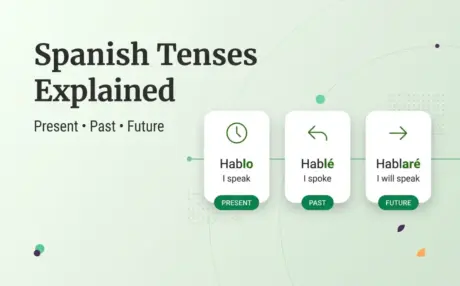
If verb forms are an area you want to strengthen, our guide to Spanish tenses explains present, past and future structures with simple examples.
However, recognising grammatical rules isn’t the same as using them correctly.
Consider the difference between ser vs estar. Both verbs can mean “to be”, but choosing the correct one depends on what you’re communicating.
A helpful course should offer opportunities to apply distinctions like these through complete sentences and realistic situations.
Activities and Progress Checks
A syllabus tells you what you’ll study. Learning activities show how you’ll practise it.
Look for opportunities to complete exercises, test comprehension, review mistakes and assess your understanding.
| Course Feature | What to Check |
|---|---|
| Lesson exercises | Can you apply new language rather than simply watch explanations? |
| Listening activities | Are there opportunities to hear and interpret spoken Spanish? |
| Written practice | Can you construct your own sentences and responses? |
| Progress checks | Can you identify mistakes and revisit difficult topics? |
| Feedback | Is correction automated, tutor-led or self-assessed? |
Always check the course description for these features rather than assuming they’re included.
💬Spanish Level Check
4 minutes
Does the Course Help You Practise Speaking and Listening?
Speaking and listening deserve particular attention when choosing intermediate Spanish lessons online.
Knowing grammar and vocabulary doesn’t automatically mean you can follow a conversation or respond comfortably.
The Council of Europe’s CEFR language proficiency descriptors distinguish listening, spoken interaction, spoken production, reading and writing as different language activities.
When evaluating a course, consider whether its activities support the skills you want to improve.
For listening, useful activities may include short conversations, spoken instructions and audio accompanied by comprehension questions.
For speaking, look at whether you can record responses, practise pronunciation or communicate with another person.
Recorded speaking exercises and live conversations are not equivalent. Recording yourself can help with pronunciation and sentence formation. Live interaction also requires you to understand unexpected responses and communicate in real time.

Match Practice Activities to Your Learning Goals
Your reason for learning should shape your choice:
- Travel: prioritise listening and responding in everyday situations, such as ordering food, asking for directions and checking into accommodation.
- Work: look for practice explaining information, asking questions and discussing familiar professional topics.
- Family and friends: focus on conversational Spanish, informal expressions and talking about everyday life.
- Exams: check that the course builds the skills tested in the specific exam you plan to take.
The best course is the one whose activities match how you intend to use Spanish.
Self-Paced or Live Online Spanish Lessons: Which Fits You?
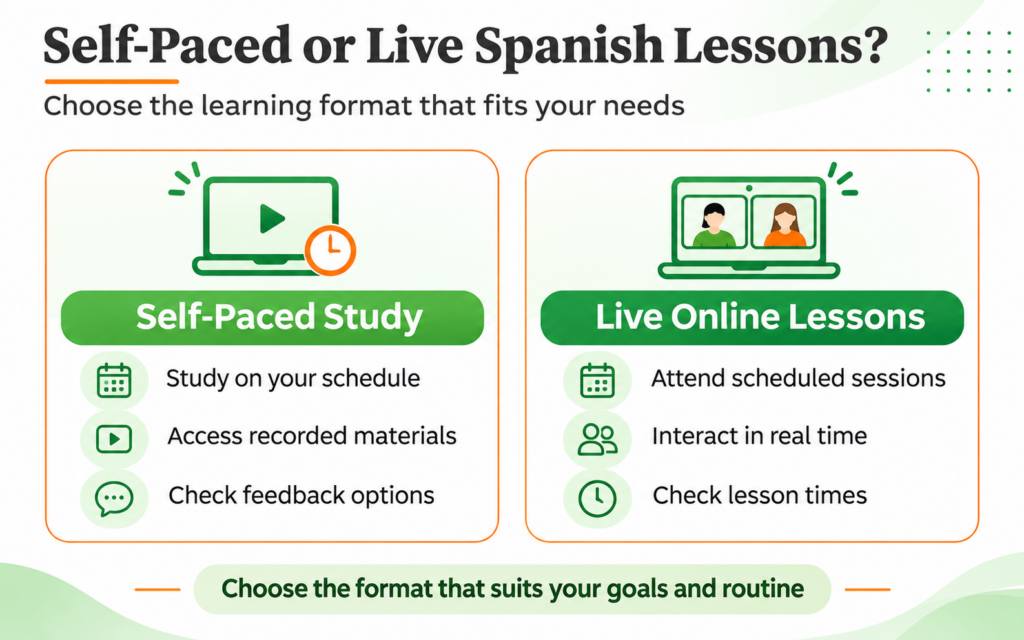
Self-paced courses let you study whenever suits you, which works well if you’re balancing learning with work or family commitments. Live online classes follow a timetable with a teacher and offer immediate answers and real-time conversation practice.
Swipe left to see the full table →
| Format | Best For | Things to Consider |
|---|---|---|
| Self-paced course | Flexible schedules, studying at your own speed and revisiting lessons whenever you need | Needs self-motivation, and live speaking practice may be limited |
| Live online classes | Real-time conversation, accountability and instant feedback | Fixed lesson times, usually a higher cost, and time-zone differences with overseas providers |
Many learners combine the two: a self-paced course for structure and grammar, plus regular conversation practice with a tutor, language exchange partner or Spanish-speaking friend. For a wider comparison of courses, apps and tutors, see our guide to the best way to learn Spanish online.
What Support and Feedback Are Available?
Before enrolling, find out what happens when you struggle with a lesson.
Some courses offer technical assistance, while others include academic feedback or direct contact with a tutor.
These are different services.
Ask whether you can receive individual corrections, revisit explanations or access supplementary materials.
Also check whether support is included in the advertised fee.
Limited Time Offer
Complete Spanish Online Course
Beginner to IntermediateGo from the alphabet and greetings to past, present and future tenses. Build the vocabulary and confidence to speak Spanish in everyday situations.
- 18+ Hours of Video
- No Prior Spanish Needed
- 4 Core Modules
- 1 Year Access
$19.99$319You save $299.01
Enrol Now
- 14-Day Money-Back Guarantee
- Self-Paced Learning
- Accredited Certificate Available
Save93%OFF
What Should You Check Before Paying or Enrolling?
A course can cover the right topics and still be the wrong fit because of its timetable, access period or assessment arrangements, so review the practical details as carefully as the curriculum. UK learners should also check the total price in pounds and, with overseas providers, any currency conversion charges.
Course Certificates vs Official Spanish Qualifications
It helps to understand the two main types of certificate before you enrol.
A course-completion certificate shows that you have finished a course under the provider’s conditions. It’s a useful record of your learning for your CV or personal development.
An official proficiency qualification independently assesses your level. The two best-known options are:
- DELE (Diplomas de Español como Lengua Extranjera): official diplomas issued by the Instituto Cervantes on behalf of Spain’s Ministry of Education. Each exam tests one specific CEFR level, from A1 to C2.
- SIELE: a computer-based test developed by the Instituto Cervantes with partner universities. It gives you a score linked to CEFR levels A1 to C1 in a single exam.
If an employer or university asks for evidence of B1 or B2 Spanish, check which qualification they accept. A structured online course is a practical way to build the skills you’ll need for these exams.
A Practical Pre-Enrolment Checklist
Use these five questions to compare your options.
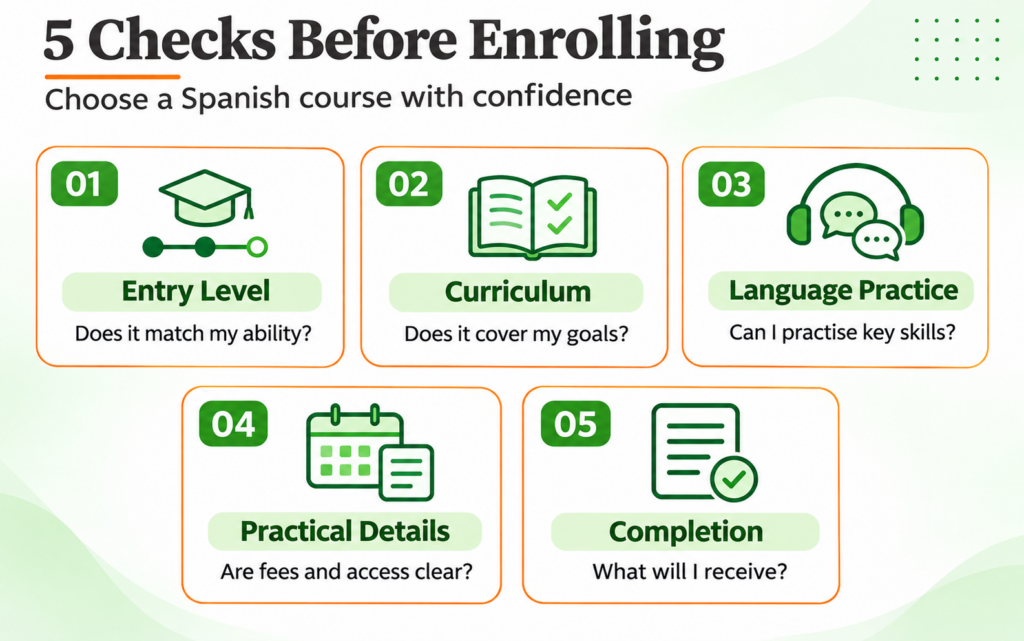
| Check | Question to Ask |
|---|---|
| 1. Entry level | Does the course match my existing Spanish knowledge? |
| 2. Curriculum | Will the lessons help me achieve my language-learning goals? |
| 3. Practice | Can I develop the listening, speaking, reading or writing skills I need? |
| 4. Practical arrangements | Are the total fees, access period, learning format and support clearly explained? |
| 5. Completion | What assessments must I complete, and what certificate or evidence will I receive? |
The course lists approximately 18 hours and 27 minutes of content, self-paced study with one year’s access, an assignment and an option to order a certificate.
It may suit learners who prefer structured independent study. However, it should not be treated as an independently assessed CEFR B1 or B2 qualification.
Review the syllabus against your goals before enrolling.
When Might a Beginner-to-Intermediate Spanish Course Be a Better Fit?
Many people searching for an intermediate Spanish course aren’t quite ready for B1 or B2 lessons. You might remember plenty of vocabulary but still find verb forms, pronunciation or longer sentences difficult. A beginner-to-intermediate course refreshes the foundations quickly before moving into more demanding topics, so you don’t waste time on lessons that are too easy or struggle with ones that are too hard.
Alpha Academy’s Complete Spanish Online Course – Beginner to Intermediate is designed for exactly this kind of learner. It takes you step by step from pronunciation and core grammar to the tenses and structures you need at intermediate level.
| If You Want To… | The Course Covers |
|---|---|
| Strengthen the basics | Alphabet and pronunciation, ser, estar and tener, numbers, questions and the present tense |
| Talk about the past | Present perfect, past simple, imperfect and how to contrast them |
| Talk about plans and possibilities | Near future, future tense and conditionals |
| Share opinions and preferences | Gustar-type verbs, comparatives and superlatives |
| Sound more natural | Object pronouns, reflexive verbs, imperatives and the present subjunctive |
The course lists approximately 18 hours and 27 minutes of content, self-paced study with one year’s access, an assignment and an option to order a certificate.
It may suit learners who prefer structured independent study. However, it should not be treated as an independently assessed CEFR B1 or B2 qualification.
Review the syllabus against your goals before enrolling.
Final Thoughts: Choose the Course That Fits Your Goals
An intermediate Spanish course online should offer more than an appealing title or a long list of lessons.
Check whether its level, curriculum, practice opportunities and learning arrangements suit your needs. Pay particular attention to assessment and certificate details if recognition matters.
A course that fits your current ability and gives you meaningful opportunities to practise is a more useful choice than one selected purely for its advertised level.
Frequently Asked Questions About Learning Spanish
Yes. B1 is classified as intermediate within the CEFR framework. At this level, learners can generally communicate about familiar topics, describe experiences and manage common travel situations. B2 represents a more advanced stage, usually described as upper intermediate.
Yes, if the course is designed to help A2 learners progress towards B1. However, entry requirements vary. Some intermediate courses expect existing B1 knowledge. Check the syllabus, prerequisites and placement guidance before enrolling.
Yes. Independent online study can help you develop grammar, vocabulary, listening and reading skills. However, practising spoken interaction with another person can also be valuable, particularly when your goal involves real conversations.
Not necessarily. Fluency has no single universal definition. B1 describes an ability to communicate independently in many familiar situations, but learners may still struggle with unfamiliar topics, complex conversations or rapid speech.
There is no single timeline that applies to everyone. Your starting level, study consistency, previous language-learning experience and opportunities to practise all affect progress. For a clearer picture of realistic study expectations, our guide on how long it takes to learn Spanish explains how learning timelines vary by level. Focus on demonstrated communication skills rather than expecting a particular course duration to guarantee B1 proficiency.
Yes, some online Spanish courses offer completion certificates. However, these are not necessarily formal proficiency qualifications. If you need recognised evidence of B1 or B2 ability, check which assessment or certificate the receiving institution or employer accepts.
Recent Posts

Is Spanish Hard to Learn for English Speakers?
November 11, 2026
How Long Does It Take to Learn Spanish? Realistic Timelines by Level
November 10, 2026

Barriers in Health and Social Care for Autistic People
November 9, 2026
Ser vs Estar: When to Use Each (With Simple Rules and Examples)
November 5, 2026

November 13, 2026


