
Healthcare assistant roles are becoming increasingly important across UK healthcare. Recent NHS vacancy statistics show continued staffing pressure across NHS services, while an ageing population and more people living with long-term conditions are increasing demand for care.
For many people, this makes healthcare assistant work one of the more accessible entry-level routes into UK healthcare. The role is no longer a niche career option. It is often included in discussions about in-demand UK jobs, especially for people who want to start a healthcare career without first completing a university degree.
Over the years, many HCAs have described similar experiences, some came directly from school, while others changed careers in their 40s, after working in retail or hospitality. Each time, their experiences were often remarkably similar: some trepidation at first, but then calm confidence once they understood that the work was not about clinical perfection. It was about showing up, paying attention and caring.
This guide explains what healthcare assistants do, how to get started, and how to build a realistic path into the role.
Table of Contents
Why This Career Is Trending in 2026
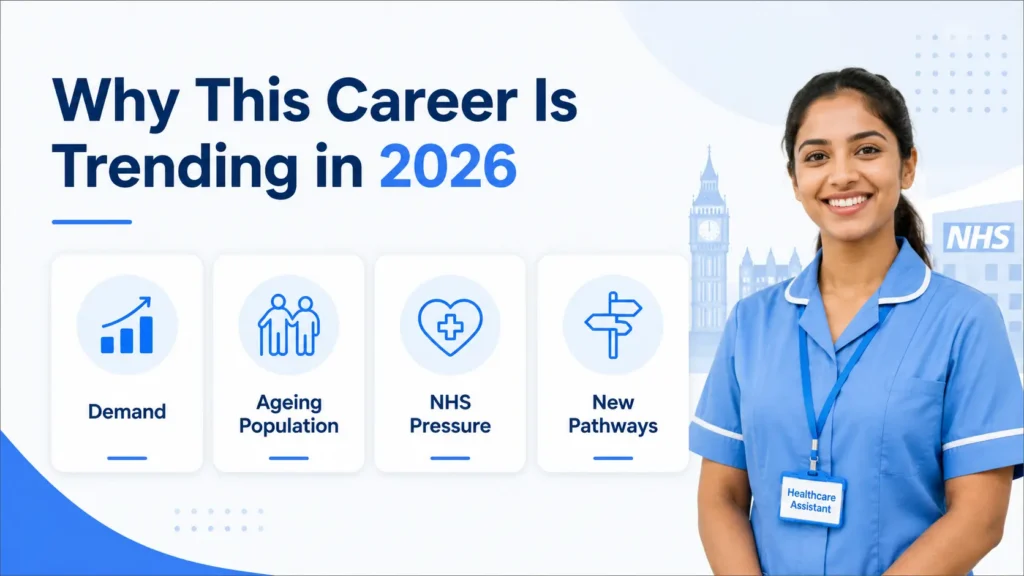
Before searching for how to apply, it is useful to understand the bigger picture first. Several factors are now making healthcare assistant roles more visible across the UK jobs market.
The first is that patient demand has grown faster than the available workforce in many areas. Industry data on NHS staffing levels shows that these figures are especially high in community and mental health roles and NHS workforce data shows that staff turnover and resignations remain important workforce issues.
Secondly, new pathways to qualifications, such as the Higher Technical Qualifications for healthcare support roles, have simplified the career pathway. The role is significantly more appealing to those who wish to have a career path to follow beyond entry-level HCA work, given the more visible pathway through Assistant Practitioner roles and ultimately into nursing degree apprenticeships.
Third, the UK continues to face pressure across nursing and wider healthcare roles. This increases the need for trained and reliable healthcare assistants who can be recruited and trained at short notice. This does not mean the role is easy, but it does show that the role is needed.
What Does a Healthcare Assistant Actually Do?
Healthcare assistant, often abbreviated to HCA, is a healthcare support worker who assists doctors and nurses with patients’ daily needs. HCAs work at the heart of hospital wards, GP practices, care homes and community health teams that work across the country.
A healthcare assistant will usually work in a clinical setting, whereas a care assistant will work in a social care setting, such as a residential home. The difference is important, because it can affect the tasks you carry out and the training you receive.
On a typical shift, an NHS healthcare assistant might:
- Assist patients with bathing, dressing, feeding and mobility.
- Measure and document blood pressure, temperature and pulse.
- Support registered nurses with wound care preparation, sample collection, or equipment set-up.
- Record clear notes and share observations with more experienced staff.
- Provide reassurance and comfort, particularly for patients who are anxious, confused and isolated.
This emotional support is often overlooked. I once shadowed a nurse who referred to HCAs as the people that patients remember. Doctors may diagnose, but healthcare assistants often provide the day-to-day support patients remember.
Do You Need Qualifications to Get Started?
What comes as a shock to many new entrants is that there are no fixed mandatory qualifications for becoming an HCA in the UK.Many employers may accept candidates without formal healthcare certificates as long as you have the right attitude, are reliable and are willing to learn.
But no fixed requirements does not mean no preparation. In reality, most NHS trusts and private employers will value candidates who can show reliability, compassion, good communication skills, and a willingness to learn.
- Good English and maths skills, often at GCSE or equivalent level
- Some exposure to caring environments, whether formal or informal, such as caring for a relative
It is possible to apply with no formal healthcare experience, especially for trainee or entry-level roles. With trusts facing a shortage of staff, many find their first positions in healthcare assistant roles, and during this initial period, they are trained by the employer while completing the required induction standards.
The Care Certificate: Your First Real Milestone
After you have been hired, most healthcare employers in the UK will require you to complete the Care Certificate. It is a nationally recognised induction programme that covers the following core areas: communication, safeguarding, infection control and person-centred care.
Think of it as a structured induction process, not a university-style exam. It is a process of showing your knowledge of the basics before you’re given greater responsibility. Most employers incorporate it into your first 12 weeks, and help you along the way, instead of expecting you to learn it on your own.

The New Career Ladder: Why Progression Looks Different Now
There have been some important changes over the last few years in this industry, such as the clarity of the career pathway for healthcare assistants. In the past, the role was often seen as having limited progression.
Higher Technical Qualifications (Level 4 and 5) are new qualifications which provide a structured pathway from HCA into Assistant Practitioner, a role which has greater clinical autonomy and sits at a higher pay band within the NHS. For some learners, this route may also support progression towards a nursing degree apprenticeship. Reducing the amount of time it takes to qualify as a registered nurse.
| Career Stage | Typical Entry Point | What Changes |
|---|---|---|
| Healthcare Assistant (Band 2) | Entry-level, Care Certificate | Core personal and clinical support tasks |
| Senior HCA (Band 3) | Experience + Level 2/3 Diploma | Delegated clinical tasks, more independence |
| Assistant Practitioner (Band 4) | Level 4–5 qualification | Semi-autonomous clinical practice |
| Registered Nurse Pathway | Degree apprenticeship | Full clinical registration |
This matters for anyone weighing up whether to start as an HCA: it’s no longer just an entry-level job with a ceiling. It’s increasingly treated as the first rung of a structured ladder.
Building Real Experience Before You Apply
Practical experience, even unpaid experience, can help a candidate stand out.
Some realistic ways to build this include:
Volunteering: Some hospital trusts and hospices give volunteers the chance to work in non-clinical positions in community healthcare charities. It may not be paid, but it shows initiative and helps you understand care environments.
Caring for family members: This is informal but not to be overlooked. If you have taken care of a family member or an older parent, you know what it is to be patient, follow a schedule, and feel a burden of emotion in caring for a loved one with a long-term illness. Include it in your application.
One common route is to start as a care assistant in a residential home, gain experience, and then apply for HCA roles in NHS settings.
Should You Take a Course Before Applying?
With the increased competition for the more popular trusts and settings, structured training can truly give you a competitive edge — especially if you’re changing your career or are looking for a confidence boost before heading to a clinical environment.
This is when a course like a Healthcare Assistant Training course comes in handy. A quality course will teach you these things:
- Understanding of anatomy, infection control and safe moving and handling techniques.
- Communication skills in relation to vulnerable patients.
- Introduction to safeguarding and confidentiality duties.
- Getting ready for the first few weeks at work.
Completing a recognised Healthcare Assistant Training programme before applying can strengthen a CV with little or no healthcare experience. It shows employers that you are actively building healthcare knowledge.
This kind of course is best suited for those who like to learn in a more structured setting where there is a definite syllabus to follow instead of finding things out on their own as they proceed.
Healthcare Assistant Training
Start your career in care with Healthcare Assistant Training. Learn essential care skills, patient support, communication, safeguarding and workplace responsibilities.
Where the Demand Is Highest Right Now
A key factor that is not always considered is that demand varies by setting.A key factor that is not always considered is that demand varies by setting. Vacancy rates in the NHS are highest in mental health and community posts, and these can be more widely accessible, with a greater expectation of emotional resilience.
In general, you might work in one of the following settings:
- Acute hospital wards are hectic and have a high turnover of patients.
- GP practices are usually more routine, often involving health checks and support with minor procedures.
- Mental health environments, which require emotional resilience and strong communication skills.
- Care homes and community teams, usually in the form of longer term relationships with the same patients.
If you’re not sure which environment is the right fit for you, it’s actually worth asking a prospective employer to let you shadow them for a day prior to committing. It shows seriousness, and although it is a small step, it can tell you a lot more than any job description.

What About Pay?
Salaries can differ if you’re employed by the NHS or privately and based at different locations in the UK. In the NHS, a healthcare assistant is normally at Band 2 on the Agenda for Change pay band, a more senior or clinically expanded role at Band 3 and an Assistant Practitioner at Band 4.
Pay in the private sector can vary more widely by location, shift pattern, and unsociable hours such as nights or weekends. It is better to look at current NHS Agenda for Change pay scales directly, and make comparisons to pay listings in your area in the private sector, as both are updated from time to time and do not necessarily specify exact amounts.
The one thing that remains relatively stable across the board is that higher income is generally associated with increased experience, further training and shifting from Band 2 to Band 3 or 4 roles.
A Realistic Step-by-Step Path
To sum up, a realistic route into this growing field is presented below:
- Do all that you can, even informal caregiving, volunteering or shadowing
- If you need an extra boost of confidence or you don’t have any experience in healthcare at all, think about a Healthcare Assistant Training course.
- Search for entry level or trainee healthcare assistant posts on NHS Jobs, private hospitals, or care providers and note down places where there are high vacancies such as mental health, community care.
- Complete the Care Certificate after starting work, with employer support
- Based on some hands-on experience, determine if a Level 2, Level 3, or the newer Level 4–5 path is the best choice for the next step in your career.
- Build on your experience to progress to Band 3/4 roles, specialist roles or continue training through a nursing degree apprenticeship.

Final Thoughts
Many people search for healthcare assistant jobs every year, and many are at a real crossroads – not sure if they have what it takes, or if the job will work for them for the long haul. With the current workforce of the NHS, the honest answer is that this role is about consistency, empathy and a willingness to learn much more than it is about having the absolute best qualifications when first starting out – it’s also one of the more reliable entry routes into UK healthcare right now.
The most helpful thing you can do if you are serious about beginning is to gain some small, informal experience as early as possible and decide whether a structured Healthcare Assistant Training course would improve your confidence and preparation.
FAQs: How to Become a Healthcare Assistant in the UK
No. There’s no single legally mandated qualification for the role. Most employers care more about your attitude, reliability, and willingness to learn than your certificates. That said, GCSE-level English and maths (or equivalent) are commonly preferred, and a relevant Level 2 or Level 3 Diploma in Health and Social Care can strengthen your application, especially for senior roles.
The Care Certificate is a nationally recognised induction framework covering areas like safeguarding, communication, and infection control. It isn’t a regulated qualification like a diploma, but almost every UK healthcare employer expects you to complete it within your first few months of starting work. It’s typically supported by your employer rather than something you study for independently beforehand.
Yes. Many NHS trusts and private employers hire entry-level candidates and provide on-the-job training, including the Care Certificate, once you start. Informal caregiving experience, such as looking after a family member, also counts in your favour, even if it wasn’t a paid role.
Typically, healthcare assistants will be employed in a clinical setting, for example, in a general practice surgery, in a hospital setting or within a community health team, where they work alongside nurses and doctors and provide assistance with patient care. Care assistants are more likely to work in social care environments such as residential care homes, or in people’s own homes. Healthcare assistants have a more clinical relationship to the tasks and procedures, but the two roles share some of the same tasks.
There’s no fixed timeline since formal qualifications aren’t mandatory. Many people apply directly for entry-level roles and start working within a few weeks of applying, then complete the Care Certificate during their first months on the job. If you choose to complete a Level 2 or Level 3 Diploma beforehand, that typically adds several months to a year, depending on the course and study pace.
It is not required, but it can make a real difference, particularly if you are changing careers or have no healthcare background. A structured Healthcare Assistant Training course typically covers basic anatomy, infection control, safeguarding, and communication skills, giving you practical talking points for interviews and a head start once you are hired.
Tasks vary by setting, but commonly include helping patients with washing, dressing, eating, and mobility, recording vital signs like blood pressure and temperature, assisting nurses with basic clinical tasks, and offering reassurance and companionship to patients. The exact mix depends on whether you’re working on a hospital ward, in a GP surgery, or in community care.
Pay depends on whether you work for the NHS or a private employer, your location, and your role level. In the NHS, healthcare assistant jobs are generally classified as Band 2 (Agenda for Change) and senior healthcare assistant positions would be considered Band 3. Pay in the private sector, particularly in care homes, is more affected by shift pattern and location. It is best to check the current NHS pay scales directly, as they are updated regularly.
Yes, this is a common progression route. With experience, many healthcare assistants move into senior HCA roles, then pursue further training such as the Nursing Associate pathway or a nursing degree apprenticeship. Some newer Level 4–5 qualifications also support a more structured route toward Assistant Practitioner roles, which can shorten the journey toward registered nursing later on.
NHS-based jobs are advertised on NHS Jobs, and private hospitals, care homes and healthcare recruitment agencies advertise jobs in the private sector. It may be worthwhile applying to both NHS and private sectors, as entry requirements and training support may differ, and some services such as the mental health and community care services, may have more vacancies than other services.
Recent Posts



June 26, 2026


