















































































On this page
- TEFL vs TESOL: What’s the Difference?
- Are TEFL and TESOL Certificates Interchangeable?
- TEFL vs TESOL: Which Is Better for Your Teaching Plans?
- Does TEFL or TESOL Matter for Teaching Jobs in the UK?
- How to Choose a TEFL or TESOL Course
- What About CELTA, TESL, ESOL and TOEFL?
- TEFL or TESOL: What Should You Choose?
- TEFL vs TESOL FAQs
Thinking about teaching English abroad or online, but unsure which certificate you need? The TEFL vs TESOL debate can make a simple decision feel complicated.
TEFL means Teaching English as a Foreign Language, while TESOL means Teaching English to Speakers of Other Languages. Traditionally, TEFL focuses on teaching English in countries where it isn’t the main language. TESOL has a broader meaning, including teaching people who use English as an additional language.
But here’s what matters: many employers accept either term, and the course itself often matters more than its name.
So, when considering TEFL vs TESOL, which is better for your plans? The answer depends on where you want to teach, what your training includes and what employers require.
Not sure which route fits you? Take our 1-minute TEFL or TESOL quiz.
Online course
Considering a Career in English Teaching?
Our online TEFL (TESOL) Masterclass introduces English teaching methods, lesson planning, pronunciation, grammar and classroom management for aspiring teachers.
- Teaching methods and lesson planning
- Pronunciation, grammar and classroom management
- Self-paced online study you fit around your week
TEFL vs TESOL: What’s the Difference?
The main TEFL and TESOL difference is their traditional teaching focus. However, the distinction is less clear when it comes to modern courses and job advertisements.
What does TEFL mean?
TEFL stands for Teaching English as a Foreign Language. It traditionally refers to teaching English in places where another language is used in everyday life.
For example, a British teacher helping students in Spain improve their English may be described as a TEFL teacher.
The term also appears in online tutoring and international language-school vacancies. If you’re unfamiliar with the subject, what TEFL means is a useful starting point.
What does TESOL mean?
TESOL stands for Teaching English to Speakers of Other Languages. It is a broader term that can include teaching English abroad and supporting people who speak another language at home.
For instance, someone teaching English to adult migrants in a UK education centre may work in an ESOL setting.
When discussing TESOL vs TEFL, remember that the names describe teaching fields. They do not automatically establish a certificate’s level or professional recognition.
TEFL versus TESOL: key differences
| Feature | TEFL | TESOL |
|---|---|---|
| Full meaning | Teaching English as a Foreign Language | Teaching English to Speakers of Other Languages |
| Traditional focus | English taught as a foreign language | English taught to speakers of other languages |
| Typical settings | Overseas language schools and online lessons | Overseas teaching, language schools and ESOL settings |
| Course content | Depends on the provider | Depends on the provider |
| Employer acceptance | Depends on the vacancy | Depends on the vacancy |
| Automatically a regulated qualification? | No | No |
The takeaway: The TEFL and TESOL difference is mainly about terminology. The actual training, assessment and employer requirements determine how useful a particular certificate will be.
Are TEFL and TESOL Certificates Interchangeable?
Sometimes, yes. But not always.
Some employers advertise vacancies for applicants with either a TESOL or TEFL certificate. Others specify a particular qualification, practical teaching experience or minimum training standard.
Imagine two applicants.
One completes an online TEFL course assessed through multiple-choice questions. Another completes a TESOL qualification that includes observed teaching sessions with real students.
Both have English-teaching training, but their certificates demonstrate different things.
Staffing standards under Accreditation UK, the quality assurance scheme for UK English language providers managed by the British Council in partnership with English UK, illustrate why these distinctions matter.
While the British Council does not accredit TEFL courses themselves, accredited centres must verify that entry-level teachers hold a qualifying TEFLI certificate meeting specific external validation, training-hour and supervised teaching-practice criteria. These are scheme-specific staffing standards for accredited UK centres, not universal legal rules for every English-teaching job.
Similarly, whether a 120-hour TEFL certificate is enough to get a job depends on the employer’s expectations and the applicant’s other qualifications. For TEFL vs TESOL certification, the safest approach is to examine the exact award rather than assume the two labels are automatically equivalent.
TEFL vs TESOL: Which Is Better for Your Teaching Plans?
Neither certificate name is universally better. The right choice depends on the type of teaching you want to pursue.
If you want to teach English abroad
TEFL is a familiar term in international English-language teaching. However, many employers also accept suitable TESOL qualifications.
Your eligibility may depend on your degree, nationality, visa conditions, teaching experience and the employer’s requirements.
Some destinations have opportunities for teaching English abroad without a degree, but the rules vary considerably. Before enrolling, examine actual job advertisements in your preferred destination.
If you want to teach English online
Both TEFL and TESOL training can introduce useful teaching methods for remote lessons. However, platforms, private clients and online language schools may have different expectations.
For example, teaching conversational English privately is not necessarily subject to the same recruitment standards as working for an established language school. If teaching English online appeals to you, investigate the requirements of the organisations you hope to work with.
If you want to teach English in the UK
The TEFL vs TESOL UK question needs particular care because English teaching takes place in several different settings.
Private language schools, adult education centres and mainstream schools do not necessarily require the same qualifications. That makes the intended workplace more important than choosing a certificate solely because it says TEFL or TESOL.
Quiz: Which TEFL or TESOL Training Fits Your Goal?
Answer five quick questions to see which kind of training suits your plans, and what to check before you pay for a course.
Question 1 of 5

Does TEFL or TESOL Matter for Teaching Jobs in the UK?
Yes, but the specific qualification matters more than the acronym.
Private language schools: Employers may prefer recognised initial teaching qualifications, particularly when their centres operate under established accreditation schemes.
Adult ESOL education: Teaching English to adults who use another language at home may require specialist ESOL training and appropriate teaching qualifications, depending on the role.
Mainstream schools: A TEFL or TESOL certificate alone does not normally replace Qualified Teacher Status (QTS).
According to the Department for Education's qualified teacher status guidance, QTS is generally a legal requirement for teaching in maintained schools in England, subject to exceptions. Academies and independent schools operate under different arrangements.
The requirements also differ across England, Scotland, Wales and Northern Ireland.
So, when weighing TEFL vs TESOL UK opportunities, identify the workplace first. Then establish which qualification that employer accepts.
How to Choose a TEFL or TESOL Course
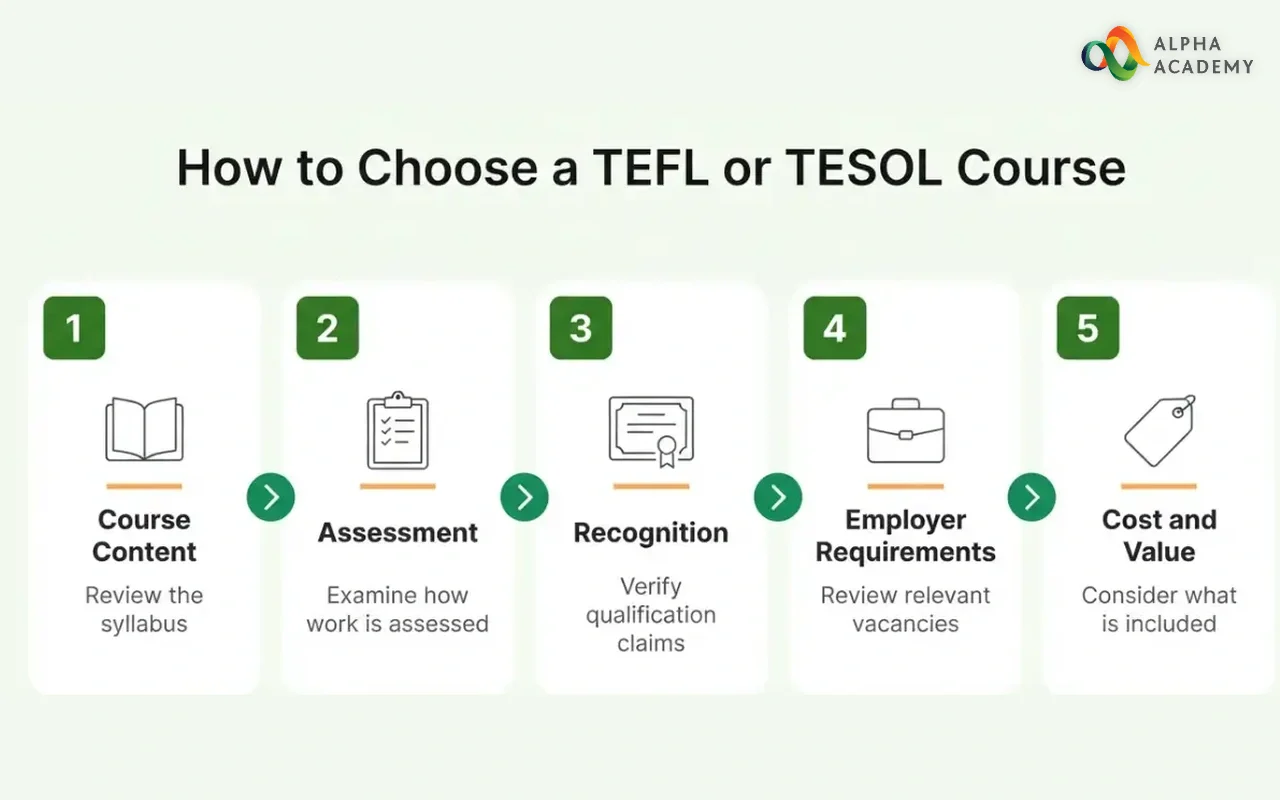
Unsure whether to choose a TESOL or TEFL certificate? Start with five practical questions.
1. What subjects does the course include?
Look for relevant topics such as grammar, pronunciation, lesson planning, teaching methods, classroom management and student assessment. A useful starting point is what a 120-hour TEFL course includes.
2. How is your work assessed?
Some courses use online tests. Others require written assignments, observed lessons or teaching practice with real students. These differences can affect employer acceptance.
3. Is the qualification formally recognised?
Accreditation, endorsement and regulation do not mean exactly the same thing.
For qualifications in England and Northern Ireland, the official Register of Regulated Qualifications can help establish whether a particular award is regulated. Separate arrangements apply in Wales and Scotland.
Do not assume that CPD accreditation makes a course equivalent to a regulated teaching qualification.
4. What do employers actually request?
Read several vacancies in your chosen location. Pay attention to named qualifications, supervised teaching practice, degree requirements and previous experience.
5. What are you paying for?
A higher price does not automatically mean better training. Consider the syllabus, assessment, tutor support and certificate arrangements. Understanding how much a TEFL course costs can help you assess whether the training suits your budget and goals.
CPD-accredited · 120 hours
A Practical Starting Point for TEFL and TESOL Training
This CPD-accredited 120-hour online TEFL course covers teaching methods, pronunciation, lesson planning, classroom management and assessment, ending with a multiple-choice exam without teaching practice.
- Teaching methods, pronunciation and grammar
- Lesson planning, classroom management and assessment
- Online study with a multiple-choice final exam
What About CELTA, TESL, ESOL and TOEFL?
TEFL and TESOL are not the only terms you'll encounter.
| Term | What it means |
|---|---|
| TESL | Teaching English as a Second Language |
| ESOL | English for Speakers of Other Languages |
| CELTA | Certificate in Teaching English to Speakers of Other Languages |
| Trinity CertTESOL | A specific teacher-training qualification awarded by Trinity College London |
| IELTS | International English Language Testing System |
| TOEFL | Test of English as a Foreign Language |
CELTA and Trinity CertTESOL are specific qualifications, unlike the broader TEFL and TESOL labels.
For example, Cambridge English's CELTA qualification includes assessed teaching practice and written assignments. IELTS and TOEFL, by contrast, assess English-language proficiency. They are not qualifications in teaching English.
TEFL or TESOL: What Should You Choose?
The answer to TEFL vs TESOL is simpler than the course names suggest. Both terms relate to teaching English to people who speak other languages. Neither automatically offers better employment prospects.
Choose training that suits your intended workplace, includes appropriate assessment and meets the requirements of employers you hope to approach.
If future earnings influence your decision, TEFL teacher salaries vary according to location, experience and teaching arrangements.
Ultimately, the best TEFL or TESOL course is the one whose actual training and recognition fit your plans, not simply the one with the more impressive title.
TEFL vs TESOL FAQs
Can I teach abroad with just a TEFL certificate?
Possibly. Some employers accept TEFL certificates, but others require a degree, teaching experience or specific qualifications. Visa requirements also vary between countries.
Can I teach with a TESOL certificate?
Yes, for roles that accept your particular certificate. However, some employers require additional qualifications, supervised teaching experience or a university degree.
How long are TEFL and TESOL certificates valid?
Most TEFL and TESOL course certificates do not carry a built-in expiration date. However, individual employers, accreditation schemes or visa authorities may require recent teaching experience or updated training, so verify specific requirements before applying.
Is TESOL equivalent to a university degree?
Not automatically. TESOL describes a teaching field. Qualifications carrying that name can range from short certificates to university degrees and postgraduate programmes.
Do I need a degree to take a TEFL or TESOL course?
Not always. Many introductory courses accept applicants without degrees. However, particular teaching jobs and overseas visa arrangements may require university qualifications.
Is a TESOL certificate worth it?
It can be useful when the course matches your teaching goals and employers accept it. Training quality and assessment matter more than the name.
Is TESOL harder to pass than TEFL?
Not necessarily. Difficulty depends on the programme, assignments, examinations and teaching practice. Neither acronym guarantees an easier or harder assessment.
What is the most respected TEFL or TESOL certification?
There is no universal winner. Employers may value specific qualifications such as CELTA or Trinity CertTESOL, particularly where assessed teaching practice is required.