




















































































Ever wondered why der Hund suddenly becomes den Hund or dem Hund in a German sentence? The noun stays the same, but the article changes. This happens because German uses four grammatical cases: nominative, accusative, dative and genitive.
Each case helps explain the role of a noun in a sentence. Nominative usually identifies the subject, accusative often marks the direct object, dative commonly identifies the indirect object, and genitive frequently shows possession.
Once you recognise these patterns, German sentences become easier to follow. If you’re still building your German foundations, this guide explains the four cases with simple examples, useful tables and practice questions.
Beginners course
Start learning German step by step
Gender, articles, sentence structure and an intro to cases.
Explore the course →
der
die
das
What Are the Four German Cases?
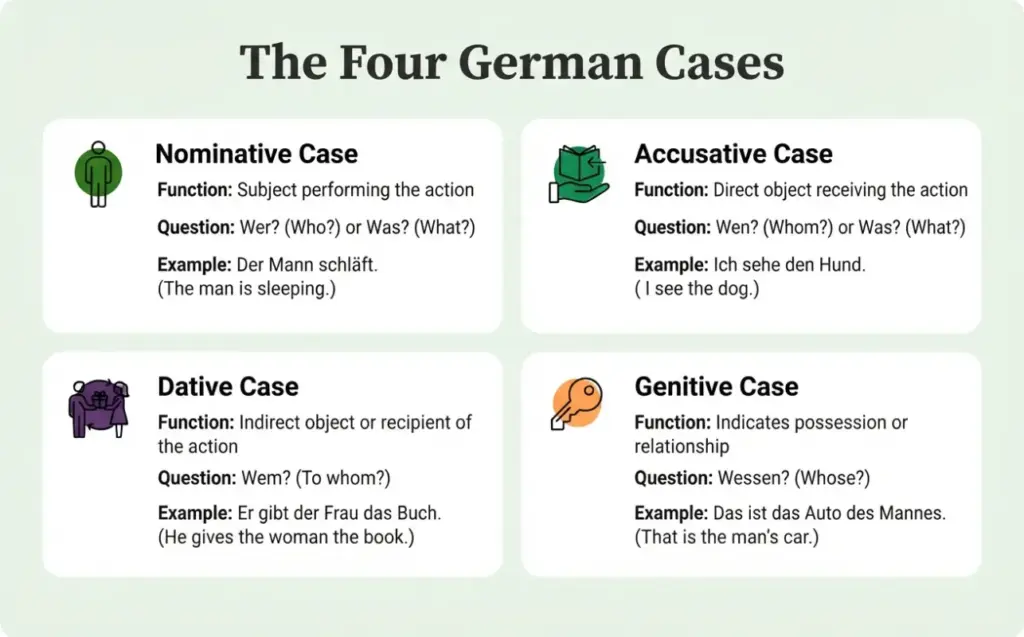
German has four grammatical cases: nominative, accusative, dative and genitive. These cases help show the role of a noun or pronoun in a sentence. They tell us who is performing an action, what is being affected, who receives something or who owns something.
Each case has a different purpose:
- Nominative (Nominativ): Identifies the subject of a sentence, usually the person or thing acting. For example, Der Hund schläft (The dog is sleeping). The dog is the subject, so der Hund is nominative.
- Accusative (Akkusativ): Usually identifies the direct object, which is the person or thing directly affected by an action. For example, Ich sehe den Hund (I see the dog). Here, the dog is the direct object, so der Hund changes to den Hund.
- Dative (Dativ): Often identifies the indirect object, particularly someone receiving something. For example, Ich gebe dem Kind ein Buch (I give the child a book). The child receives the book, so dem Kind is dative.
- Genitive (Genitiv): Commonly shows possession or a relationship between nouns. For example, Das Auto des Mannes (The man’s car). The phrase des Mannes tells us who owns the car.
These examples give you a useful starting point. However, German cases are not determined by sentence roles alone. Certain verbs and prepositions also require specific cases.
It is also important to know the difference between grammatical gender and case. Every German noun has a gender: masculine, feminine or neuter. Gender is a characteristic of the noun, while case describes its grammatical function in a particular sentence.
For example, Hund (dog) is a masculine noun. Its gender stays the same, but its article can change from der Hund to den Hund or dem Hund, depending on how it is used.
Once you recognise this difference, German article changes become much easier to follow.
The Four German Cases Explained With Examples
The easiest way to recognise German cases is to look at what each noun does within a sentence.
1. Nominative Case (Nominativ): Who Is Doing the Action?
The nominative case usually identifies the subject, which is the person or thing acting.
Consider:
Der Hund schläft. — The dog is sleeping.
Here, der Hund is nominative because the dog is the subject.
The nominative definite articles are:
- Masculine: der
- Feminine: die
- Neuter: das
- Plural: die
Another example is:
Die Frau liest. — The woman is reading.
The woman acts, so die Frau is nominative.
Nominative also appears after certain verbs, particularly sein (to be).
Er ist ein Lehrer. — He is a teacher.
Both er and ein Lehrer are nominative.
Remember: Nominative usually identifies who or what the sentence is about.
2. Accusative Case (Akkusativ): The Direct Object
The accusative case commonly identifies the direct object: the person or thing directly affected by an action.
For example:
Ich sehe den Hund. — I see the dog.
Here, ich (I) is the subject, while den Hund (the dog) is the direct object.
Notice how der Hund becomes den Hund.
This is a useful beginner rule: masculine singular definite articles change from der to den in the accusative.
Compare:
Der Mann kauft einen Apfel. — The man buys an apple.
The man acts, while the apple is what he buys. The indefinite masculine article ein becomes einen.
Accusative is also required after certain prepositions, including für (for), ohne (without) and durch (through).
As you practise everyday German phrases, recognising direct objects will help you form more accurate sentences.
3. Dative Case (Dativ): The Indirect Object
The dative case often identifies the indirect object, particularly someone who receives something or benefits from an action.
For example:
Ich gebe dem Kind ein Buch. — I give the child a book.
In this sentence:
- Ich is nominative because I act.
- dem Kind is dative because the child receives the book.
- ein Buch is accusative because the book is what I give.
Notice that das Kind changes to dem Kind.
Dative also appears with certain verbs, even when the English equivalent uses a direct object.
For example:
Ich helfe dem Mann. — I help the man.
The verb helfen (to help) requires the dative.
You will also encounter the dative case after prepositions such as mit (with), zu (to) and nach (after or to, depending on context).
4. Genitive Case (Genitiv): Showing Possession
The genitive case commonly expresses possession or a relationship between nouns.
For example:
Das Auto des Mannes ist rot. — The man’s car is red.
Here, des Mannes identifies whose car it is.
Notice two changes: the masculine article der becomes des, and Mann gains the ending -es.
Another example:
Die Tasche der Frau ist schwarz. — The woman’s bag is black.
The feminine article die changes to der in the genitive.
The genitive remains important in standard written German. In informal speech, you may also encounter alternative possession structures using von with dative.
For beginners, recognising these common possession patterns provides a useful foundation for further grammar study.
German Cases Table: How Articles Change
One of the most useful ways to recognise German cases is to compare article endings.
The following German cases table shows how definite articles change according to grammatical case, gender and number..
| Case | Masculine | Feminine | Neuter | Plural |
|---|---|---|---|---|
| Nominative | der | die | das | die |
| Accusative | den | die | das | die |
| Dative | dem | der | dem | den |
| Genitive | des | der | des | der |
Three patterns are particularly worth remembering.
First, masculine der becomes den in the accusative.
Second, masculine and neuter definite articles both become dem in the dative.
Third, feminine and plural definite articles share der in the genitive.
Indefinite articles also change:
| Case | Masculine | Feminine | Neuter |
|---|---|---|---|
| Nominative | ein | eine | ein |
| Accusative | einen | eine | ein |
| Dative | einem | einer | einem |
| Genitive | eines | einer | eines |
There is no ordinary plural form of ein.
These tables focus on articles. Some German nouns and adjectives also change their endings depending on the case.
How Do You Know Which German Case to Use?
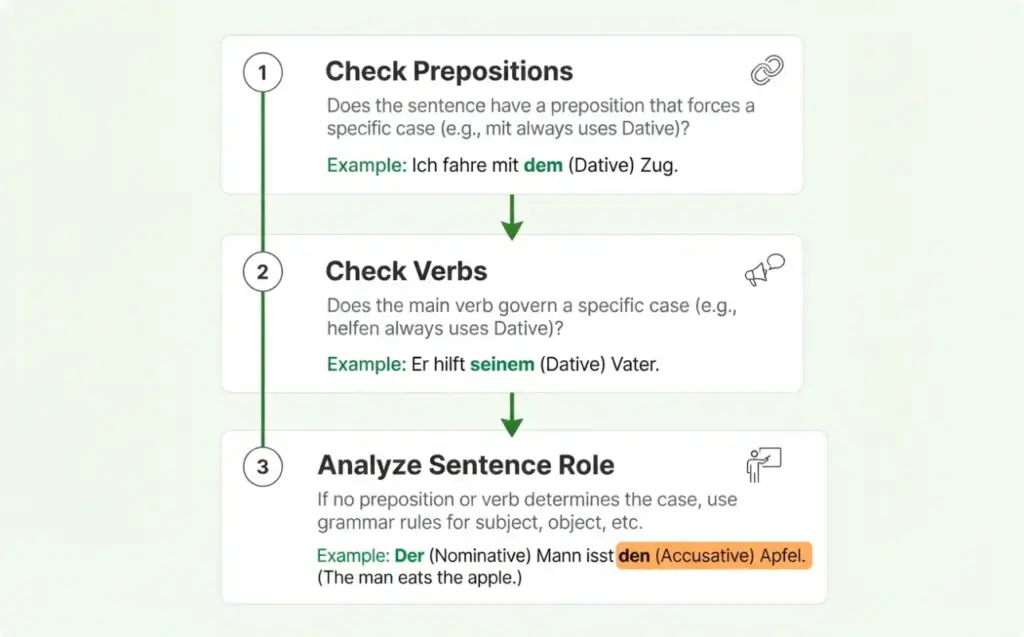
Knowing the four definitions is helpful. Choosing the correct case becomes easier when you follow a consistent process.
Start by checking the preposition, then the verb, and finally the noun’s grammatical role.
Step 1: Check for a Preposition
Certain German prepositions require a specific case.
For example:
Ich fahre mit dem Bus. — I travel by bus.
The preposition mit requires the dative, so der Bus becomes dem Bus.
Compare:
Das Geschenk ist für den Mann. — The present is for the man.
The preposition für requires the accusative.
Some prepositions, including in and auf, can take either accusative or dative.
Consider:
Ich bin in der Schule. — I am at school.
Ich gehe in die Schule. — I am going into the school.
The first describes a location, while the second describes a destination involving a change of location.
Step 2: Check the Verb
Some German verbs determine the case of their objects.
For example, helfen requires the dative:
Sie hilft dem Kind. — She helps the child.
Meanwhile, sehen normally takes an accusative object:
Sie sieht das Kind. — She sees the child.
Learning common verbs together with their required cases makes sentence-building more straightforward.
Step 3: Identify the Sentence Role
When the verb or preposition does not already determine the relevant case, identify the subject and objects.
Use this quick checklist:
- Who acts? This is usually nominative.
- What or whom does the action directly affect? This is often accusative.
- Who receives something? This is often dative.
- Whose possession or relationship is being expressed? This may require the genitive.
Once you identify the case, choose the article that matches the noun’s gender and number.
For UK learners studying GCSE German, AQA’s GCSE German grammar requirements include nominative, accusative and dative article functions at the Foundation tier, with specified uses of the genitive for recognition at the Higher tier.
Accusative vs Dative: What’s the Difference?
Accusative and dative can look similar because both frequently describe objects within a sentence.
The main beginner distinction is:
- Accusative: Often identifies what or whom an action directly affects.
- Dative: Often identifies who receives something or serves as an indirect object.
Consider:
Der Lehrer gibt dem Schüler den Stift.
The teacher gives the pupil the pen.
Here, der Lehrer is nominative because the teacher acts. Dem Schüler is dative because the pupil receives the pen. Den Stift is accusative because the pen is what the teacher gives.
The verb geben (to give) makes these roles especially clear.
Other verbs and prepositions may require accusative or dative in different situations, so always consider the complete sentence.
Recognising this distinction also helps explain why German grammar feels challenging for English speakers. With regular practice, the patterns become more familiar.
Common Mistakes With German Cases
A few small article changes can make a noticeable difference to a German sentence.
- Forgetting masculine accusative changes
Incorrect: Ich sehe der Hund.
Correct: Ich sehe den Hund.
The dog is the direct object, so the masculine article changes to den.
- Using accusative after a dative verb
Incorrect: Ich helfe den Mann.
Correct: Ich helfe dem Mann.
The verb helfen requires the dative case.
- Confusing location and destination
Ich bin im Park. — I am in the park.
Ich gehe in den Park. — I am going into the park.
The two-way preposition takes different cases in these examples.
- Forgetting dative plural endings
Ich spiele mit den Kindern. — I play with the children.
Many plural nouns gain -n in the dative, unless they already have an appropriate ending.
- Forgetting genitive noun endings
Das Fahrrad des Mannes — The man’s bicycle.
Many masculine and neuter singular nouns take -s or -es in the genitive.
Practise German Cases: Quick Exercises and Answers
Try choosing the correct article before checking the answers.
ALPHA ACADEMY
Fill in the correct article
Tap an option, then check your answers.
Check your answers
- Der Mann schläft. Subject, so nominative.
- Ich sehe den Hund. Masculine direct object, so accusative.
- Sie hilft dem Kind. Helfen takes the dative.
- Das Buch des Lehrers. Genitive shows possession.
- Ich fahre mit dem Bus. Mit always takes the dative.
Tip: find the word or relationship that decides the case before you choose.
How to Remember the Four German Cases
The most useful way to remember German cases is to connect each rule with a sentence you already recognise.
Start with nominative and accusative examples, then practise common dative patterns and gradually introduce genitive possession.
If you prefer guided lessons, Alpha Academy’s German Language for Beginners offers another option for developing your language skills.
Try writing one simple sentence each day and identifying its subject and objects. Keep the article table nearby until the changes become familiar.

A consistent practice routine can also help you judge how long learning German takes, as progress develops through repeated use.
Beginners course
Start learning German step by step
Gender, articles, sentence structure and an intro to cases.
Explore the course →
der
die
das
Conclusion
German cases become easier when you recognise sentence roles, article changes and common verb and preposition patterns. Start with simple sentences, use the reference table when needed and practise identifying each case in context.
For a structured approach to beginner study, Alpha Academy’s Learn German Language: Complete Beginners Level Course includes lessons on grammatical gender, articles, sentence structure and an introduction to German cases.
Frequently Asked Questions
German has four grammatical cases: nominative, accusative, dative and genitive. Nominative identifies the subject, accusative usually marks the direct object, dative often identifies the indirect object, and genitive commonly shows possession. Each case affects how articles and certain other words change within a sentence.
You use den as the masculine singular definite article in the accusative case. For example, Ich sehe den Hund means “I see the dog”. Here, den Hund is the direct object. Den is also the definite article used with dative plural nouns, as in mit den Kindern (with the children).
All three words refer to the first-person singular, but their grammatical cases differ. Ich is nominative and means “I”, mich is accusative and usually means “me”, while mir is dative and can mean “me” or “to me”. For example, Er hilft mir means “He helps me”.
Start by checking the verb and any preposition in the sentence, as these can determine the required case. Then identify the noun’s grammatical role. Subjects usually take the nominative, direct objects commonly take the accusative, recipients often take the dative, and possession is frequently expressed using the genitive.
German nouns have grammatical genders, shown by their dictionary articles: der (masculine), die (feminine), and das (neuter). Some noun endings provide clues, but learning each noun together with its article is a reliable approach. Remember that grammatical gender stays the same even when the article changes according to case.
For many beginners, the main challenge is choosing the correct case and remembering how articles change. The accusative and dative can be particularly confusing because some verbs and prepositions require specific cases. Practising short sentences and checking article changes regularly can make these patterns easier to recognise.
Recent Posts

Is German Hard to Learn for English Speakers?
November 19, 2026

How Long Does It Take to Learn German? Hours by CEFR Level
November 18, 2026

50 Basic German Phrases for Beginners and Travellers
November 17, 2026

Deaf Awareness in the Workplace: Practical UK Guide
November 16, 2026

Intermediate Spanish Course Online: What to Look For Before You Enrol
November 13, 2026
November 21, 2026


