Join for £49/yearJoin £49

German Pronunciation Guide: Sounds English Speakers Find Tricky

Ever tried saying ‘ich’ or ‘schön’ and wondered why the sound coming out of your mouth doesn’t quite match the German speaker? This German pronunciation guide explains the sounds English speakers often struggle with, including umlauts, ch, r and unfamiliar letter combinations.

The good news? German spelling follows many consistent patterns. Once you understand where to place your tongue, how to shape your lips and which letters sound different from English, unfamiliar words become easier to pronounce.

Below, you’ll get clear examples, practical corrections and short exercises you can try straight away.

Beginner course

Start Speaking German with More Confidence

Our beginner German course introduces essential language skills through structured online lessons, helping you practise vocabulary, pronunciation and everyday communication.

Start the Learn German Language: Complete Beginners Level Course

Table of Contents

Why Is German Pronunciation Tricky for English Speakers?

German pronunciation for English speakers can be confusing because familiar letters sometimes make completely different sounds.

Take Wasser (water). The German w sounds like the English v. Meanwhile, Zeit (time) begins with a ts sound, not the English z in zoo.

Three differences matter most:

  • Vowels: German distinguishes sounds that English speakers may treat as similar.
  • Consonants: Letters such as w, v, z and r follow unfamiliar patterns.
  • Letter combinations: ei, ie and ch have pronunciation rules worth practising.

These unfamiliar sounds are one reason beginners often wonder whether German is hard to learn for English speakers, although many pronunciation patterns become easier with practice. 

The examples below use Standard German. Regional accents may sound different, especially when pronouncing r.

German Sound Trainer

a

Long a /aː/

Staat state

Open your mouth and hold the vowel longer.

Practise
a

Short a /a/

Stadt town or city

Keep the vowel short and crisp.

Practise
ie

Long ie /iː/

bieten to offer

Spread your lips slightly and hold a long ee.

Practise
i

Short i /ɪ/

bitten to request

A short, relaxed i, as in English bit.

Practise
ä

Umlaut ä /ɛː/

spät late

An open e, as in bed. In spät, hold it longer.

Practise
ö

Long ö /øː/

schön beautiful

Put your tongue where it goes for e, then round your lips. Hold the sound.

Practise
ö

Short ö /œ/

zwölf twelve

Start with the e in bed, round your lips and keep your tongue forward.

Practise
ü

Long ü /yː/

Tür door

Put your tongue where it goes for ee, then round your lips. Hold the sound.

Practise
ü

Short ü /ʏ/

fünf five

The same rounded ü, but short and relaxed.

Practise
ch

Soft ch (ich-Laut) /ç/

ich I

Raise the middle of your tongue towards the hard palate and breathe out without using your voice. It is not English sh.

Practise
ch

Back ch (ach-Laut) /x/

Buch book

Raise the back of your tongue towards the soft palate and let the air rasp through, as in Scottish loch.

Practise
w

German w /v/

Wasser water

Say an English v, with your top teeth on your lower lip.

Practise
v

German v /f/

Vater father

Usually an f sound. Some words, such as Vase (vase), use v.

Practise
z

German z /ts/

Zeit time

Always ts, like the end of cats.

Practise
s

s before a vowel /z/

Sonne sun

At the start of a word, before a vowel, often a buzzing z. Southern speakers may use s.

Practise
ß

Eszett ß /s/

Straße street

A sharp, voiceless s, as in miss.

Practise
r

German r /ʁ/

rot red

Made at the back of the mouth, like a soft gargle. Regional accents vary.

Practise
-er

Final -er /ɐ/

besser better

At the end of a word, -er sounds like a short uh, not an English r.

Practise
sch

sch /ʃ/

Schule school

Like English sh in shoe.

Practise
sp st

sp and st at the start /ʃp/ /ʃt/

Sport sport

At the start of a word or syllable, say shp and sht.

Practise
-d

Final b, d and g [t]

Rad wheel

At the end of a word, b, d and g sound like p, t and k. Rad sounds like Rat (advice).

Practise
ei

ei /aɪ̯/

Wein wine

Like the English word eye.

Practise
ie

ie /iː/

Wien Vienna

A long, steady ee, as in see.

Practise
eu

eu /ɔʏ̯/

neu new

Like oy in boy.

Practise
äu

äu /ɔʏ̯/

Häuser houses

The same oy sound as eu.

Practise
au

au /aʊ̯/

Haus house

Like ow in cow.

Practise
Minimal pairs quiz

Which word did you hear?

Hear one word from a pair of similar German words, then pick the word you heard. 10 questions, about 3 minutes.

Loading… If this message doesn’t change, please refresh the page.

Practise these sounds in real conversations. View the German Beginners Course

Audio uses your device’s German voice, so it can sound slightly different on each device. Accents vary.

German Pronunciation Guide: Vowels and Umlauts

German vowel pronunciation matters because changing a vowel can change a word’s meaning.

Long and Short German Vowels

German distinguishes long and short vowels. The difference often involves both duration and the shape of the sound. Consider these words:

German word Meaning Pronunciation difference
Staat State Long a
Stadt Town or city Short a
bieten To offer Long ie sound
bitten To request Short i sound

Try saying Staat and Stadt slowly. Hold the vowel longer in Staat, then shorten it in Stadt. German spelling provides useful clues, but these are patterns rather than rules without exceptions.

Correctly pronouncing common words such as Tür and schön is useful when practising the simple conversations introduced at German A1 speaking skills. 

How to Pronounce Ä, Ö and Ü

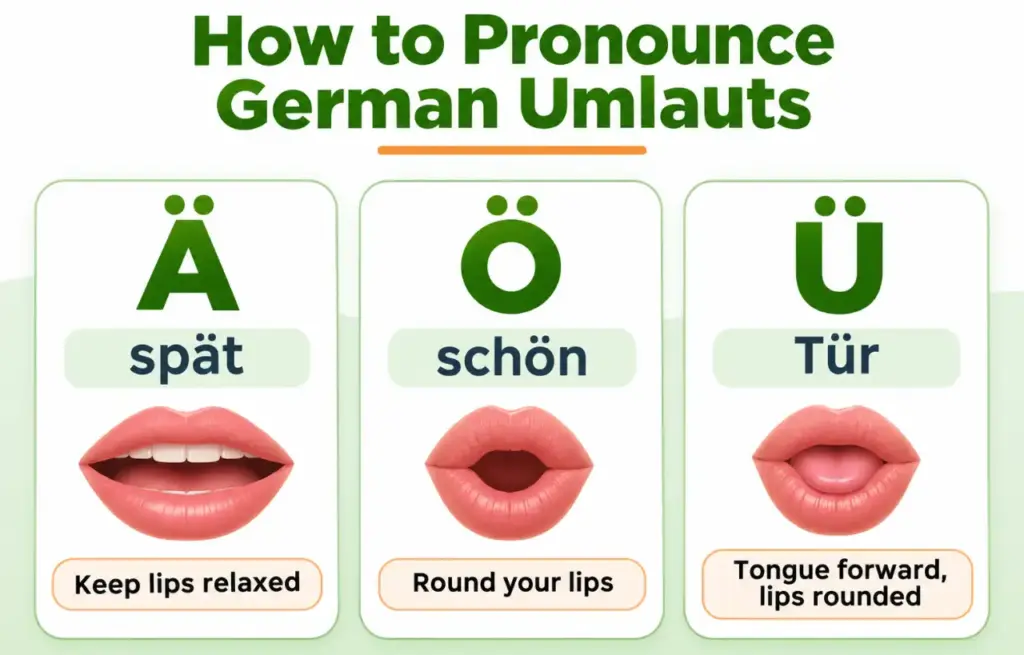
German umlauts pronunciation is especially important because ä, ö and ü represent distinct vowel sounds.

Umlaut Example Mouth position
ä spät (late) Similar to an open e sound; length matters
ö schön (beautiful) Position your tongue for e, then round your lips
ü Tür (door) Position your tongue for ee, then round your lips

For a short ö (as in zwölf), begin with the vowel in bed, then round your lips without moving your tongue backwards. For a long ö (as in schön), hold the sound longer with tenser lips and a slightly higher tongue position. 

German umlauts pronunciation infographic showing ä, ö and ü with example words and lip-position guidance

These are starting exercises, not exact English equivalents. The Goethe-Institut’s pronunciation tutorials include dedicated activities for German vowels and umlauts.

How Do You Pronounce the Two German CH Sounds?

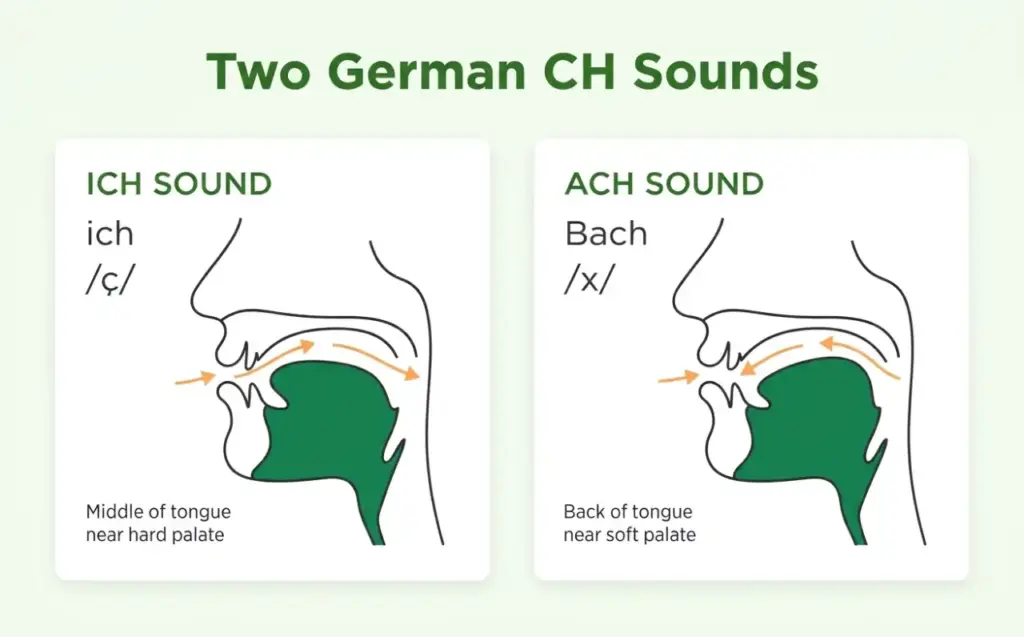
German ch pronunciation can be difficult because the letters ch do not always represent the same sound. Two common pronunciations are called the ich-Laut and ach-Laut.

The Soft CH Sound in Ich

The ch in ich (I) is written /ç/ in the International Phonetic Alphabet (IPA).

To produce it:

  1. Keep your lips slightly apart.
  2. Raise the middle of your tongue towards the hard roof of your mouth.
  3. Let air pass through the narrow gap without using your voice.

Try ich, Milch (milk) and Licht (light). This is not the same as the English sh in shoe.

The Back CH Sound in Bach

The ch in Bach uses /x/, produced further back in the mouth.

Raise the back of your tongue towards the soft palate and allow air to pass through. If you speak Scottish English and pronounce loch with a rough final sound, you may already be familiar with something similar.

Try Bach, Buch (book) and machen (to make). The Goethe-Institut’s ich and ach sound exercises explain the mouth positions and common spelling patterns.

Remember that some words, such as sechs, contain a different pronunciation pattern. The two sounds above are the main starting point, not every possible use of ch.

German Consonant Sounds English Speakers Often Mispronounce

Some difficult German sounds come from letters that look completely ordinary.

German W, V, Z and S

Letter Usual sound Example
w English v Wasser (water)
v Often f, sometimes v Vater (father), Vase (vase)
z ts Zeit (time)
s Often z at the start before a vowel Sonne (sun)
ß Voiceless s Straße (street)

German letter pronunciation becomes more predictable once you stop applying English spelling habits.

For example, Vater starts with an f sound, while Vase usually starts with a v sound. German v does not have one universal pronunciation. The Deutsche Welle German alphabet pronunciation guide provides additional examples of these consonant differences.

How to Pronounce German R

German r pronunciation varies by region and word position. In much of Standard German speech, the consonant r is produced towards the back of the mouth rather than with the English tongue position.

Try rot (red) and Reise (journey). Listen to the German sound before repeating it. In words such as besser (better), the final -er often sounds more like a vowel than a clearly spoken English r.

The Deutsche Welle guidance on German l and r explains several accepted r pronunciations. Don’t worry about copying one regional accent perfectly. Aim for a clear, recognisable sound.

German Pronunciation Guide: Tricky Letter Combinations

One useful answer to how to pronounce German words is to pay attention to pairs of letters rather than reading each letter separately.

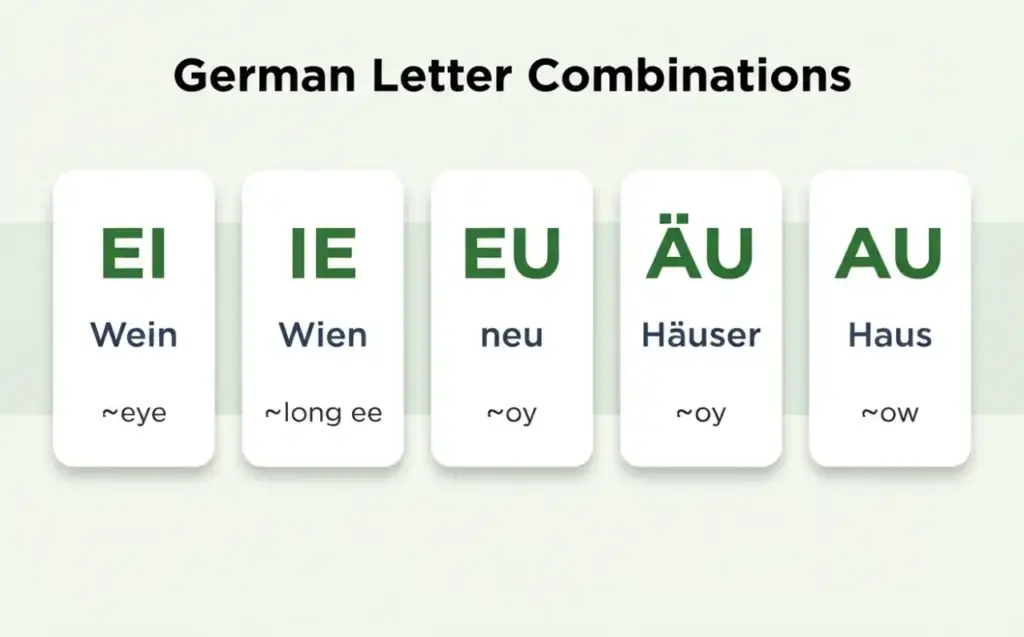
Ei, IE, EU and ÄU

Combination Example Approximate sound
ei Wein (wine) eye
ie Wien (Vienna) Long ee
eu neu (new) oy
äu Häuser (houses) oy
au Haus (house) ow in British English cow

The difference between Wein and Wien is particularly useful. The first contains a changing vowel sound; the second has a long, steady vowel.

These combinations become easier to remember when you practise basic German phrases for beginners rather than repeating individual sounds without context. 

SCH, SP and ST

The letters sch usually sound like English sh, as in Schule (school). At the beginning of a syllable, sp and st commonly start with the same sh sound:

  • Sport — starts with shp.
  • Stadt — starts with sht.
  • spielen — starts with shp.

However, this pattern does not apply to every sp or st combination in every position.

Alpha Academy FREE TEACHING RESOURCE

Your first English lesson, ready to teach.

Plan a confident first online lesson with our free First Online English Lesson Starter Pack — lesson templates, A1 speaking activities and tutor feedback sheets in one practical PDF.

  • 30 & 60-minute lesson plans
  • Ready-to-use A1 activities
  • Speaking worksheets & scripts
  • Feedback & preparation checklists
Download the Free Starter Pack

16-page printable PDF  ·  No sign-up required  ·  alphaacademy.org

Why Do German Word Stress and Final Consonants Matter?

German pronunciation rules also affect which syllables stand out and how words end.

German Word Stress

Word stress means giving one syllable more emphasis. In verstehen (to understand), the second syllable (the word stem) receives the main stress: ver-STEH-en. 

German words do not always stress the first syllable. Listening to the full word is more reliable than guessing from spelling alone.

Final Consonant Devoicing

At the end of German words, consonants such as b, d and g are commonly pronounced without voicing. For example, Rad (wheel) and Rat (advice) are pronounced alike in Standard German.

This feature is called final devoicing. It explains why a German word may sound different from what an English speaker expects when reading its final letter.

Common German Pronunciation Mistakes and How to Fix Them

Most German pronunciation mistakes happen when English speakers use familiar English sounds in German words.

Common mistake Example Better approach
Pronouncing German w like English w Wasser Use the English v sound
Saying ich like ish ich Raise your tongue towards the hard palate
Treating ö like ordinary o schön Keep your tongue forward and round your lips
Confusing ei and ie Wein / Wien Practise the two vowel patterns separately
Pronouncing final d with English voicing Rad Use a final t sound

These German pronunciation tips for beginners work best when you concentrate on one mistake at a time.

For a quick exercise, record yourself saying Wasser, ich, schön, Wein and Rad. Then listen to reliable German audio and identify which sound needs attention.

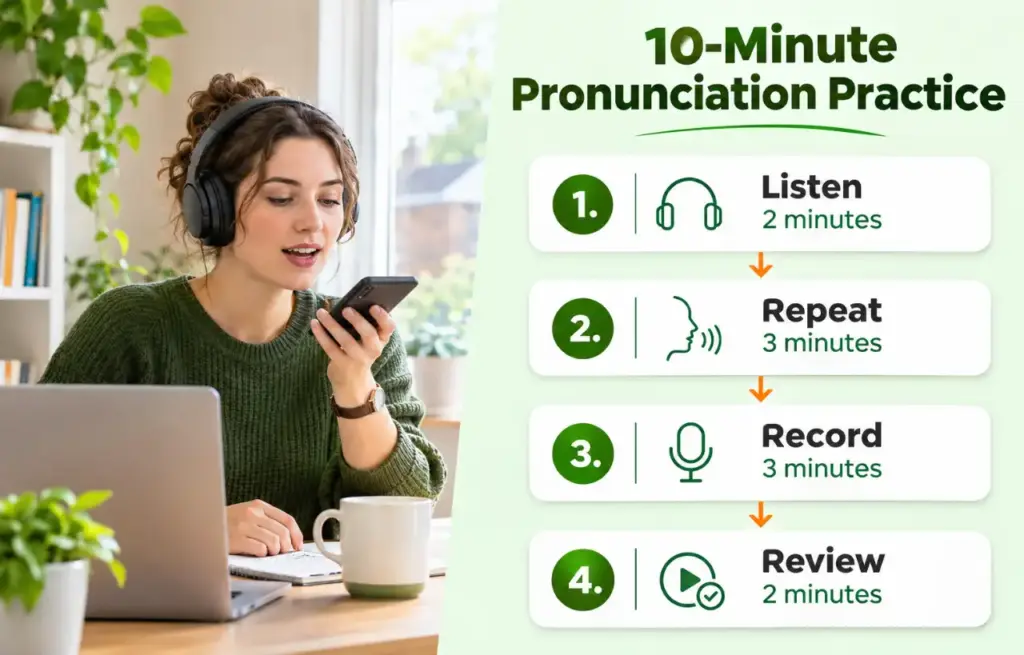
How to Practise German Pronunciation for 10 Minutes a Day

German pronunciation practice does not need to involve lengthy sessions. A short, focused routine gives you time to listen, repeat and correct individual sounds.

Try this four-step routine:

  1. Listen for 2 minutes. Choose two or three German words containing the same difficult sound.
  2. Repeat for 3 minutes. Say each word slowly, paying attention to your lips and tongue.
  3. Record for 3 minutes. Speak the words and a short sentence containing them.
  4. Review for 2 minutes. Play the original recording and your version, then focus on one difference.

For structured audio exercises, the Goethe-Institut’s online pronunciation training offers listening tasks, speaking activities and feedback.

As your pronunciation improves, combine speaking exercises with vocabulary and simple conversations from German for beginners, so you can practise sounds in everyday situations.

Next step

Put Your German Pronunciation into Everyday Use

Ready to move beyond individual sounds? Alpha Academy’s online beginner German course offers structured lessons for studying essential language topics.

View the German Beginners Course Curriculum

Final Thoughts

German pronunciation becomes more manageable when you focus on individual sounds instead of trying to perfect every word immediately.

Start with umlauts, ch, r and common letter combinations. Practise them in real words, listen carefully and give yourself time to adjust your pronunciation.

Frequently Asked Questions About German Pronunciation

Some sounds are unfamiliar, particularly umlauts and ch. However, German spelling has consistent patterns that can make pronunciation easier to predict with practice.

German spelling is often more predictable than English spelling. However, unfamiliar vowels and consonants can still make spoken German challenging for beginners.

For ö and ü, keep your tongue towards the front of your mouth while rounding your lips. The sound of ä depends on vowel length.

No. The ch in ich and Bach uses sounds different from English sh. Their tongue positions and airflow also differ.

No. German r varies by region and word position. Some speakers use a back-of-mouth sound, while others use a tongue-tip pronunciation.

German ei sounds approximately like eye, as in Wein. German ie usually represents a long ee sound, as in Wien.

No. IPA helps explain unfamiliar sounds, but beginners can also practise successfully using accurate audio, mouth-position guidance and regular speaking exercises.

Yes. Listening to native-speaker recordings, repeating short phrases and recording your own speech can help you identify pronunciation differences and practise corrections.

Regular short sessions can make practice manageable. Concentrate on a few sounds at a time and prioritise accuracy rather than speaking quickly.

November 23, 2026

Learn Today. Lead Tomorrow. Alpha Academy equips you with real-world skills that employers demand and industries respect. From beginner to expert, explore 2800+ courses designed to get you hired, promoted, or started. Your next breakthrough is one click away.

Contact

For Business

Certificate validator

Payment methods possible

© ALPHA ACADEMY IS A PART OF ADAMS ACADEMY INC. LTD.

top
0
    0
    Your Cart
    Your cart is emptyReturn to Shop

    Summer Sale – Get 2500+ COURSES FOR Original price was: $606.15.Current price is: $66.15. / year

    ADD OFFER TO CART-

      Apply Coupon